

Resources
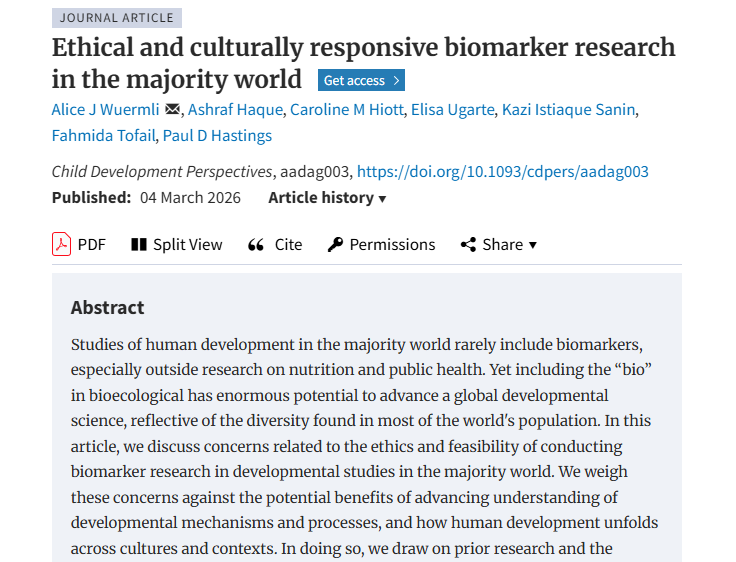
The iRRRd team has published a paper in the Child Development Perspectives Journal on ethical and culturally responsive biomarker research in the majority world
Do biomarkers have a place in human developmental research in the Majority World?
While commonly used in medicine, public health, and nutrition their application in developmental and educational science has remained contested.
In our new paper in Child Development Perspectives, we draw on both our own work and the field’s collective experience to examine the ethical considerations and practical challenges of conducting biomarker research responsibly in low-resource and conflict-affected settings in the Majority World.
We argue that, when implemented thoughtfully, biomarkers can meaningfully complement traditional developmental measures and deepen our understanding of how adversity becomes biologically embedded. The paper offers a roadmap for integrating biomarker data into developmental science while remaining grounded in ethics and cultural context.

The iRRRd team has published a paper on Predictors of antenatal care utilization among the Rohingya population in the refugee camps of Cox’s Bazar, Bangladesh
We're excited that the latest article from our iRRRd prenatal birth cohort in Cox’s Bazar, Bangladesh is now out! See the post below for details. This paper adds important evidence on maternal health care access in humanitarian settings, drawing on data from our ongoing study in Cox's Bazar.
The paper reflects a close collaboration between early-career scholars, senior researchers, and field teams, and highlights how context-specific constraints—particularly mobility and timing—shape antenatal care use even where services are widely available.
Congratulations to Daniel Simon, Duja Michael, @Md. Sajjadur Rahman, Caroline Hiott, AK Rahim, Kazi Istiaque Sanin, Fahmida Tofail, Alice Wuermli and everyone who contributed to this work.
We’re glad to see this paper out in the world and contributing to ongoing conversations about how to strengthen maternal health systems for displaced and crisis-affected populations.

The iRRRd team has published their first paper on their ongoing pre-natal birth cohort study in Bangladesh
We’re proud to share the work of our NYU-TIES colleague, Alice Wuermli, and her coauthors, who have just published the first major paper of their ongoing pre-natal birth cohort study in Bangladesh.
This cohort profile paper outlines the study's foundations, sets the stage for future publications, and offers a powerful reminder of why early childhood research matters—not just for developmental science, but for creating real-world impact in diverse contexts. At Global TIES we are committed to bridging rigorous evidence with meaningful action.
Read Alice’s post to learn more about the study’s insights and the implications they hold for early childhood initiatives. Kudos to Alice and the entire research team for their hard work and dedication.

World Refugee Day 2025
Millions of refugees around the world suffer in silence, not because they lack a voice, but because their pain is misunderstood or mismeasured.
On World Refugee Day, we uplift the voices and lived realities of displaced communities and call for deeper, more culturally responsive care.
At TIES, we work hard to partner with local communities and integrate methods that capture participant voices directly. For example, the paper we reshare today highlights some of the qualitative work we have done as part of the iRRRd study, led by Rohingya researchers and collaborators, to explore cultural concepts of distress (CCDs) among Rohingya refugees in Cox’s Bazar. It identifies five locally meaningful expressions of emotional suffering, like tenshon and bishi sinta, that often go unrecognized by standard mental health tools.
As we act in solidarity with refugees, we must design support systems that reflect how communities themselves understand and communicate distress.

A qualitative study of cultural concepts of distress among Rohingya refugees in Cox's Bazar, Bangladesh
Excerpt: Rohingya refugees residing in Bangladesh have been exposed to profound trauma in addition to ongoing daily stressors of living in the refugee camps. Accurate assessments of mental health burden and their impact among this population require culturally sensitive tools that remain lacking in this context. The purpose of this study was to characterize salient cultural concepts of distress (CCDs), their causes, consequences, and approaches to treatment, among Rohingya refugees living in Cox's Bazar, Bangladesh, to help inform future measurement and intervention design.
Authors:Kathy Trang, Caroline Hiott, AK Rahim, Shafiqur Rahman, Alice J Wuermli
KEYWORDS: Mental Health, Rohingya

Delivering Quality Research in Culturally Dynamic, Conflict-Affected Contexts: Lessons from Large-Scale Pilot Research in Cox's Bazar
In this third brief in our series, we outline the process and strategies used as we piloted multiple data collection tools that were being considered for use in several large-scale research studies with the Rohingya in Cox's Bazar. This brief aims to provide context and a path forward for future researchers to deliver quality research in this, and other, complex research environments with the ultimate goal of informing the types, design, and delivery of services to support families and foster resilience in these contexts for generations to come.