

Resources
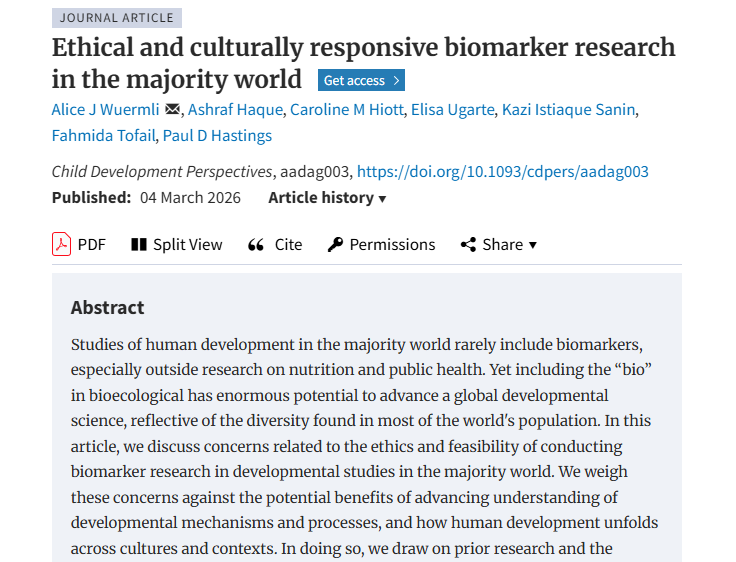
The iRRRd team has published a paper in the Child Development Perspectives Journal on ethical and culturally responsive biomarker research in the majority world
Do biomarkers have a place in human developmental research in the Majority World?
While commonly used in medicine, public health, and nutrition their application in developmental and educational science has remained contested.
In our new paper in Child Development Perspectives, we draw on both our own work and the field’s collective experience to examine the ethical considerations and practical challenges of conducting biomarker research responsibly in low-resource and conflict-affected settings in the Majority World.
We argue that, when implemented thoughtfully, biomarkers can meaningfully complement traditional developmental measures and deepen our understanding of how adversity becomes biologically embedded. The paper offers a roadmap for integrating biomarker data into developmental science while remaining grounded in ethics and cultural context.

The iRRRd team has published a paper on Predictors of antenatal care utilization among the Rohingya population in the refugee camps of Cox’s Bazar, Bangladesh
We're excited that the latest article from our iRRRd prenatal birth cohort in Cox’s Bazar, Bangladesh is now out! See the post below for details. This paper adds important evidence on maternal health care access in humanitarian settings, drawing on data from our ongoing study in Cox's Bazar.
The paper reflects a close collaboration between early-career scholars, senior researchers, and field teams, and highlights how context-specific constraints—particularly mobility and timing—shape antenatal care use even where services are widely available.
Congratulations to Daniel Simon, Duja Michael, @Md. Sajjadur Rahman, Caroline Hiott, AK Rahim, Kazi Istiaque Sanin, Fahmida Tofail, Alice Wuermli and everyone who contributed to this work.
We’re glad to see this paper out in the world and contributing to ongoing conversations about how to strengthen maternal health systems for displaced and crisis-affected populations.