

Christian Evadzi, Lecturer and Counselor - University for Development Studies
Building School Cultures That Support Youth Development in a Digital World
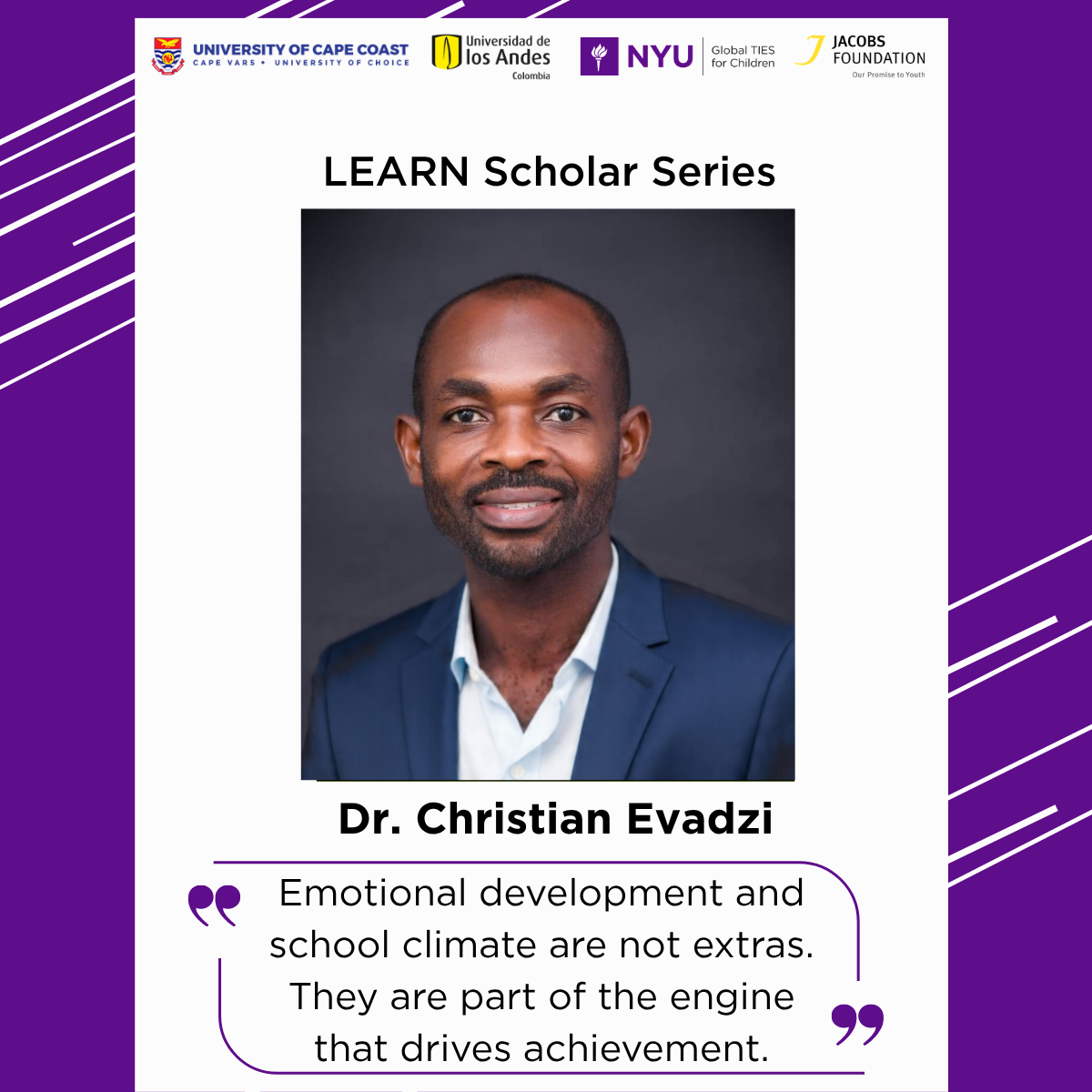
In our “Get to Know a LEARN Scholar” series, today we are introducing Dr. Christian Evadzi, a lecturer and counselor at the University for Development Studies in Tamale, Ghana. His work merges the fields of education, guidance, and counseling, but is also focused on youth wellbeing. Speaking in his own words, he reflects on how an unexpected entry into education led him to develop his passion for research, and building school cultures that support young people to grow.
Q: Let’s start at the beginning. Who are you, and what does your work focus on today?
A: I work as a lecturer in the Faculty of Education and also as a counsellor at the Counselling Centre at the University for Development Studies. I teach across all levels: from bachelor’s, master’s to doctoral programmes, and I absolutely love it! I am covering courses such as Introduction to Guidance and Counselling, Assessment in Counselling, and Applied Behaviour Analysis. I also supervise master’s theses and serve as an internal thesis assessor for other departments within the faculty. Alongside this, I also manage my own research agenda on understanding how to develop emotionally resilient and socially aware youth in a digital world. My research agenda is at the intersection of child development, technology, and guidance and counseling — areas that I am passionate about.
Q: That sounds lovely! It would be great if you could first tell us how did you get into education? Was there a moment, experience, or curiosity that first sparked your interest?
Initially, my plan was not to go into education. In Ghana, teaching is one of the most accessible professions, and hence, it was more like a practical choice for me to take up teaching. But, when I was training to become a teacher a mandatory course in guidance and counselling got me very curious. I became fascinated by how effective guidance can influence learning habits and support young people as well as adolescent’s development. I’ve always enjoyed learning and helping others learn, so this interest grew naturally. Over time, my focus on young people’s wellbeing has increased and continues to inform my academic and research interests. The fulfilment I find in supporting learners’ growth is what keeps education meaningful to me, on a day to day basis.
Q: Great! That brings me to your research which we want to know more about. What is the central problem or challenge your research aims to address, and for whom?
The central problem my research seeks to address is the rise of maladaptive behaviours among adolescents and young people. This issue is especially urgent today, as many young people are growing up in a rapidly evolving digital world shaped by technology, social media, and constant online influence but without consistent guidance, coaching, or mentoring that can help mitigate the harmful effects and magnify what’s meaningful.
The pressure of the digital world is further compounded by ill-informed or absentee parents who rely on schools and school cultures that are not always well equipped to support students’ socio-emotional development.
For me, success in addressing this challenge means supporting young people to develop strong emotional knowledge, social awareness, and decision-making skills. When adolescents are guided to understand themselves, relate well to others, and make informed choices about their future careers and life paths, they are better positioned to navigate both personal and societal challenges. My research is ultimately about creating the conditions at home, in schools, and in communities to allow young people to grow into confident, emotionally grounded, and purposeful adults.
Q: That is important work for which there is a need to bring teachers on board. How have you thought about that aspect? teachers’ instructional supervision and how that impacts learning?
A: Yes! I do work on head teachers’ instruction supervision and how that impacts learning. This is something that I am highly interested in. First, we need to take into consideration that the new knowledge economy and globalization are requiring countries worldwide to respond to change. Owing to this, education providers are obliged to rethink their approaches to meet the diverse knowledge and skills needs of learning outcomes, and in all of this, the head teacher’s role cannot be overemphasized.
My research is ultimately about informing both practice and policy. I work on developing country-specific key performance indicators for head teachers that can help strengthen learning outcomes and foster more positive, supportive school environments. Alongside this, I’m deeply interested in understanding how school culture shapes learners’ social awareness because what students experience daily in their schools plays a powerful role in how they relate to others and navigate the world around them.
Q: Can you describe your research as if you were designing a solution?
A: Yes — absolutely! In fact, we are in the process of designing a solution — a school culture improvement program — that focuses on strengthening children’s social awareness. The idea is to start by understanding each school’s existing culture from what is working well and where the gaps are. We then work closely with schools to build practical and targeted interventions. These can include activities to build empathy, ability to resolve conflicts, and modelling of positive social behaviours, primarily led by the teachers. This is one way teachers can actively help develop positive behaviors and responses by shaping how students understand themselves, others, and the choices they make.
Now, where does the research come in? The research helps us identify which aspects of school culture have the biggest impact, so schools can focus on approaches that genuinely support students in becoming more emotionally aware and socially engaged learners.
Q: That sounds like a feasible and engaging approach for both teachers and students! Can you tell me what specific type of partner or expertise would help you most in this regard? Who or what are you most eager to connect with?
A: I would really love to work with a school district to pilot this. Ideally, it would be with schools that see the value of the research and are open to supporting it by involving both students and teachers. If it works well, it could become a strong example that can be replicated and scaled in other settings.
I would also love to connect with other scholars and researchers working on improving social and emotional learning within school systems. I would like to understand the challenges faced across different contexts, within Ghana, and also across Africa. Broadening my understanding and collaborating with others would push my thinking to be truly design-first which makes interventions and research effective, scalable, and subsequently, impactful.
Q: Finally, if everything goes to plan, what is the long-term contribution you hope your research will make?
I hope this study contributes to the development of a long-term model that clarifies which aspects of school culture truly matter—elements such as teacher–student relationships, approaches to discipline, peer norms, school routines, and inclusive practices, among others. Such a model could help schools intentionally design learning environments that nurture empathy, respect, and cooperation over time, rather than addressing these outcomes in fragmented ways. It could also inform more context-specific emotional and social counselling that responds to students’ lived realities. The possibilities, I believe, are wide-ranging and deeply promising.
Q: For those interested in your work or potential collaboration, what is the best way for them to learn more or get in touch?
Researchgate: https://www.researchgate.net/profile/Christian-Evadzi?ev=hdr_xprf
Linkedin: https://www.linkedin.com/in/christian-evadzi-phd-94a2041aa/
UDS website: https://www.uds.edu.gh/staff/echristian-48612
