

Turning Personal Struggles into Policy Insights: Improving Mathematics Achievement in Ghana
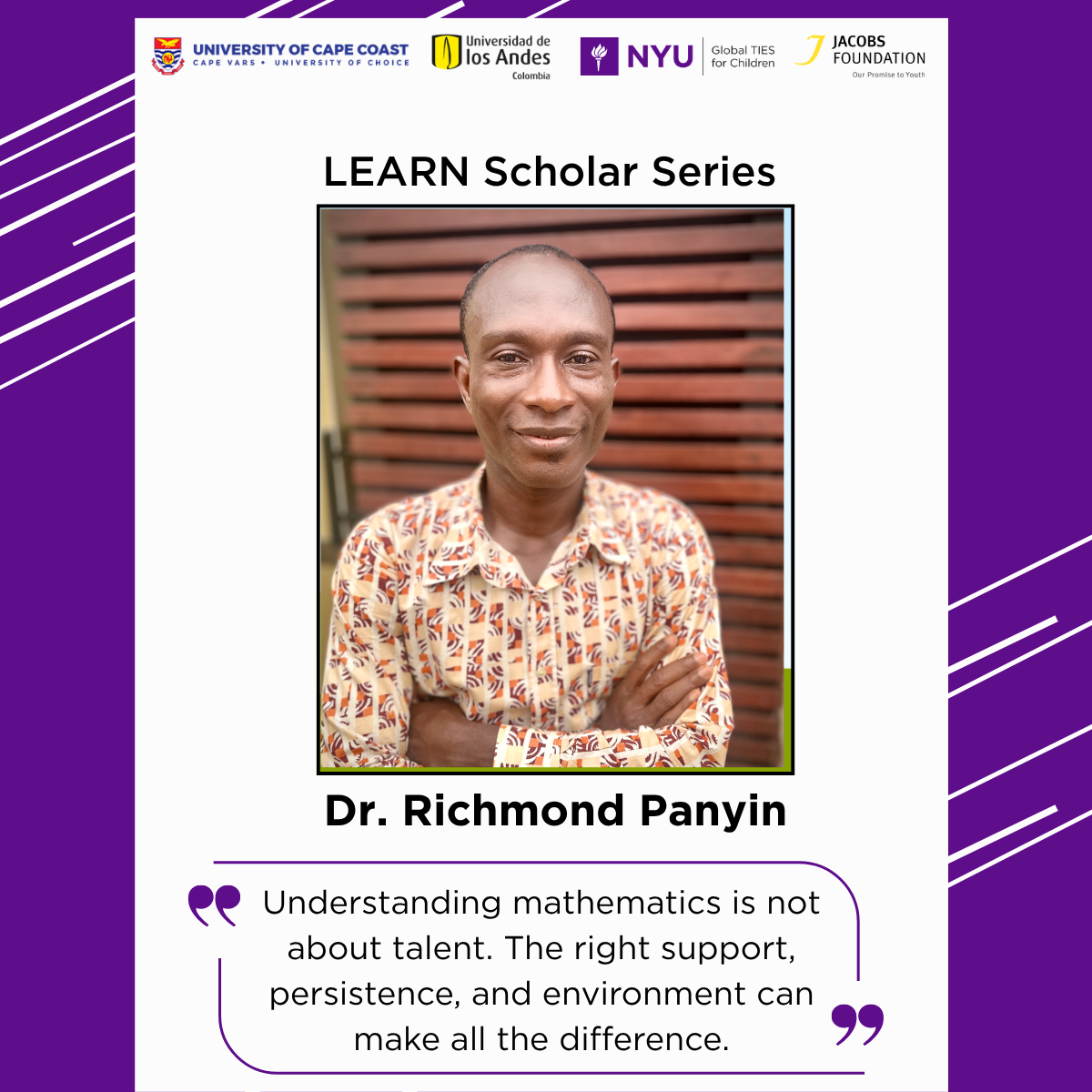
In this installment of our “Get to Know a LEARN Scholar” series, we introduce Richmond Panyin, a Lecturer and Researcher in the Department of Education and Psychology at the University of Cape Coast, Ghana. Richmond’s work focuses on understanding why some students thrive in mathematics while others struggle, drawing on large-scale assessment data to examine how individual attitudes and school environments shape learning outcomes across the educational journey. In the conversation that follows, he reflects on how his own experiences with mathematics have influenced his research interests, and how evidence from large scale assessments like TIMSS is helping to inform teacher development, school climate, and early interventions aimed at improving mathematics achievement in Ghana.
Q. Hi Richmond! Thank you for taking the time to speak with us. Tell us about yourself and what you’re working on.
A: Thank you for having me here! I work at the University of Cape Coast. I teach as a Lecturer and I also do research, which I love because it combines my university professional life and my passion for mathematics. My research focuses on how mathematical learning develops. I study that development from a child’s first experience with numbers to advanced concepts in senior high school.
I also do some work in measurement and evaluation, where I use large-scale assessment data to understand what drives success in mathematics. My goal is not just to analyze performance, but to identify the conditions that help students thrive. That work also informs the courses I teach, including Research Methods and Educational Statistics, where I train future educators to use evidence to improve learning.
Q. It is great to hear about your love for mathematics, which is also relatively rare. Was there a personal moment that drew you to this work?
A. Yes. I’d had a bit of an experience with Mathematics myself! I struggled deeply with it as a student with many moments when I felt completely lost. A turning point came when I was forced, by my own self, to sit with the material. I was so fed up with not understanding things and feeling fearful that I locked myself in my practice notebook until the sums and concepts finally started making sense. That experience not only liberated me from my fear of math but also fundamentally changed how I saw and approached learning. It hit me that understanding Mathematics is not about talent alone. I am sure there are those who simply just “get it” but for those who don’t, the right support, persistence, and environment can help grasp difficult concepts.
Later in life, I leveraged that personal frustration and turned it into a research question: why do some students struggle so much more than others? And what can we actually do about it? I try to answer that question using large-scale assessment data to examine the broader pedagogical, psychological, and school-level factors that shape mathematics achievement across different stages of schooling. I was able to solve my own learning challenge – whether it was through hardwork, frustration, or a little bit of luck, but now, I want to systematically understand the conditions under which students succeed or struggle in mathematics, so that we can design more supportive learning environments across the education system. I don’t want children to feel isolated in their frustration, which is something I went through.
Q: Thank you for sharing that story! It is so relatable, and I think that is what makes it so powerful, and the research coming from it, so relevant. Can you tell us a bit more about your research? How would you describe what it entails, and why is that your focus?
A: Yeah, sure! So, simply stated, I study the “why” behind mathematics achievement. In Ghana, we see uneven performance across schools, and we usually see an abundant reporting of achievement gaps. I, on the other hand, try to identify the factors we can actually change to change the dismal reality of mathematics achievement. Now, you may ask what are those factors? Student-level factors, such as confidence and enjoyment of mathematics, are strong predictors of achievement. At the same time, school-level factors such as safety, discipline, and academic focus matter enormously. In fact, nearly half of achievement differences can be traced to differences between schools. Success is not only about curriculum or natural ability, contexts matter, and the focus of my research is to unveil these factors so that the conversation shifts from conversations like “Which students are failing?” to ask “Are we building student confidence?” and “Are we creating safe, focused learning environments?” How do I study those factors? Well, as of now, I use large scale assessment data. In my recent study, I used the TIMSS data from over 7,000 students in Ghana, and found that a student's enjoyment of mathematics was the single strongest predictor of their achievement. At the same time, nearly 41% of the variation in achievement came down to differences between schools: things like discipline, safety, and whether a school genuinely emphasizes academic success. That's a huge share of the outcome sitting at the school level, largely outside any individual student's control. What this tells us is that improving mathematics outcomes isn't just a classroom problem. It's a systems problem.
Q. That’s fascinating! So when operationalized, what does your research look like in practice?
That’s an amazing question to ask! When we develop programs or interventions based on our findings, we aim to work with both the teachers and the school leadership as our data shows these pieces are deeply connected. On the teacher's side, we help develop professional development approaches to introduce formative assessments as they catch and address learning gaps in real time. In Ghana, it is usually the end of year test when you get to know your performance, and it is more like a statement of ability which doesn't really help a student if not positive. Since it is at the end of a term, it's also too late for teachers to offer any remediation. We’re trying to move the focus from formal, infrequent, summative tests to informal, frequent, formative tests which are less stressful for students and more helpful for teachers.
On the leadership side, we work to strengthen school-wide emphasis on safety, order, and academic focus. And we're also exploring how seemingly small things, like how feedback is worded on a test, can either build or undermine a student's resilience in mathematics.
Q: We wish you good luck with these endeavors. Looking ahead, what impact do you hope this work will have?
A: Like I said before, I hope to shift how we think about mathematics education. Success should not be defined only by exam scores. It should also include whether students feel confident, safe, and motivated to learn. I hope that at the policy level, I hope our findings support more integrated reforms that combine curriculum, teacher development, school climate, and socio-emotional learning. Ultimately, I want to challenge the idea that “hard skills” and “soft skills” are separate. Confidence and school climate are not extras. They are part of the engine that drives achievement.
Q: Thank you for your time, Richmond! Lastly, if other math-loving researchers or practitioners want to reach out to you, how can they connect?
A: I would welcome all collaboration! I can be reached by email at richmond.panyin@ucc.edu.gh or through LinkedIn. I would also encourage readers to explore my recent preprint on mathematics achievement in Ghana, which outlines these findings in detail.
