

Ándres Pinzón Ricaurte, Coordinator and Professor at Master's Program in Mathematics Education - Faculty of Education, Universidad de los Andes
Improving Mathematics Learning through Teacher Education and Practice
In our next installment of the “Get to Know a LEARN Scholar” blog series, we are pleased to introduce Andrés Pinzón Ricaurte, coordinator of the Master’s in Education program at Universidad de los Andes
Behind Andres’s role as coordinator of the Master’s in Education program at Universidad de los Andes is a deep commitment to improving social well-being through mathematics education. His work focuses on preparing mathematics teachers to help students engage with real world problems, not just procedures, so they can participate fully and critically in society. In this feature, we share Andres’s path into mathematics education, the questions that drive his research, and the collaborative opportunities he sees ahead.
Q: Could you introduce yourself for readers who may be meeting you for the first time?
A: I’m Andres, and my academic background is in Mathematics and Educational Administration. I hold a Master’s in Mathematics Education and a PhD in Education. Outside of work, I'm 44 years old and the proud father of two sons. I enjoy playing soccer, tennis, and volleyball, and I also love reading or watching movies. I hope that gives a sense of who I am beyond my work.
Q: That was a great introduction! Please tell us a bit more about you as a research professional?
A: Ofcourse! I currently work at Universidad de los Andes as the coordinator of the Master’s in Education program, where I also teach. My research centers on understanding the impact of this master’s program on the classroom practices of our in-service secondary mathematics teachers. For the past 12 years, I have served as both coordinator and professor in the Master’s in Mathematics Education program. During that time, I’ve become very interested in examining my own practice as a teacher educator and understanding whether the program truly influences what teachers do in their classrooms. These insights help us refine the program and contribute to broader policy conversations about teacher education. Engaging directly with teachers -- for example, seeing how they reflect, adapt, and grow -- is one of the most rewarding parts of my work.
Q: How did you first become interested in mathematics education?
A: My interest began in high school. In math class, I noticed that many classmates struggled with math, but it came naturally to me. Later, when we did community service in group homes with children between the ages of 5 and 7, I realized I was drawn to professions focused on supporting the community. Both things—achieving good grades in a course and being able to work with communities—came together when I realized I wanted to be a math teacher. Fortunately, I had my parents' support and was able to pursue my university studies in this field.
Q: Wow, that’s great. What excites you most about mathematics education?
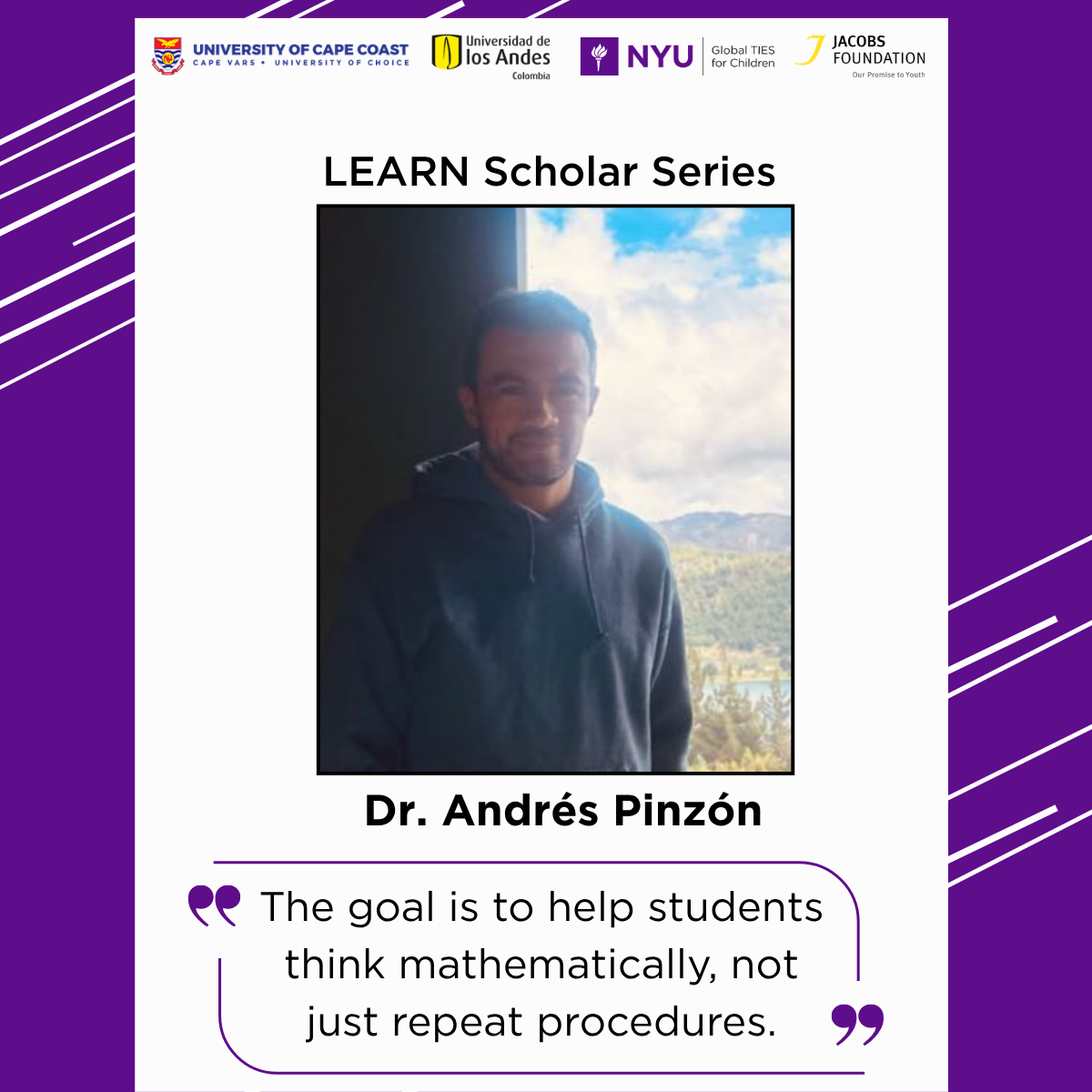
A: What excites me most is working directly with practicing teachers to strengthen their planning, instruction, and assessment. My goal is to help teachers design experiences that push students to think mathematically, not just repeat procedures.
The real goal is to help children and young people learn mathematics in meaningful, applicable ways. A lot of times mathematics is taught and learned as a series of memorization of formulas, but there is so much more to it than that; it’s about using those ideas to solve problems, analyze information, and think critically about the world. My research supports practicing teachers, teacher education programs, educational institutions, and policymakers who want to improve the quality of mathematics teaching and learning.
Q: Beyond the data, what personally motivates you to do this work?
A: I really believe that when we strengthen math education, we strengthen society. Math is embedded everywhere and in everything, from technology to comparing to personal finances. When teachers help students build real mathematical reasoning skills, those students are better prepared to make informed choices and engage confidently in the world around them.
What drives me is supporting teachers so they can help students become thoughtful, capable problem-solvers. And I’ve seen how strong teacher preparation can play a role in narrowing social, economic, and gender gaps in math education. That’s the kind of impact I want to be part of.
Q: Research is full of surprises. Has there been a human moment that reminds you why you love this work?
A: Absolutely. What truly inspires me is accompanying teachers as they grow and experience new things, and then observing how that transforms what happens in their classrooms. I've seen teachers use art or music to bring mathematics to life, and others turn to robotics or astronomy to show students how vast and interesting the world of mathematics is.
In particular, I remember a teacher who used origami to teach geometry. The children made very interesting figures while the teacher showed them how to make a parallel or perpendicular fold, and through these hands-on activities, the children grasped concepts that can be complex. These moments remind me that teaching isn't just about content; it's an act of creativity and dedication, and teachers convey that to their students every day.
Q: Yes, teachers can be truly inspirational. What are you currently working on that you’re excited about?
A: I’m excited about a few things right now. One of the big highlights is my work with the LEARN program, where I’m teaming up with colleagues from different fields to look at how math teachers can help students build metacognitive skills--basically, helping students think about their own thinking. I’m also digging into how teacher preparation programs can do a better job weaving in technology and reflective practice. Across all of these projects, the goal is the same: to strengthen everyday classroom teaching and open up richer learning opportunities for students.
Being part of the LEARN program has allowed me to deepen my research skills and broaden my perspective on educational challenges, especially those in early childhood education. The opportunity to collaborate with colleagues from diverse backgrounds has been tremendously enriching.
Q: What kinds of partners or collaborators are you most interested in connecting with?
A: I would love to collaborate with colleagues across Colombia and Latin America who are involved in mathematics teacher education—both initial preparation programs and continuing professional development. I believe that by working together, we can share insights, build stronger networks, and craft more effective strategies for preparing the next generation of mathematics teachers.
Q: It was lovely to get to know you. Where can someone find your work?
A: Thank you for your time! Please check out the research repository at Universidad de los Andes — funes.uniandes.edu.co — which includes my publications as well as those of my students.
