

Dr. Kotor Asare, Senior Lecturer - Aketen Appiah-Menka University of Skills Training and Entrepreneurial Development (AAMUSTED)
Strengthening the Foundation: A Conversation with Dr. Kotor Asare on Early Childhood and Fatherhood
In this edition of our “Get to Know a LEARN Scholar” series, we feature Dr. Kotor Asare, a senior lecturer at the Aketen Appiah-Menka University of Skills Training and Entrepreneurial Development (AAMUSTED), whose work brings attention to the foundations of learning that are often overlooked. Drawing on experience as a classroom teacher, Kotor reflects on how early gaps in literacy and learning can shape students’ confidence and trajectories long before they reach adolescence.
In the conversation that follows, Kotor shares how these early classroom experiences led to a research focus on early childhood education, social-emotional development, and the role of families, particularly fathers, in supporting young children’s growth. Through a combination of research, community-based inquiry, and a commitment to strengthening early learning environments, Kotor offers a hopeful vision for building stronger educational foundations for children in Ghana and beyond.
Q: To start us off, can you tell us a little about who you are, what you do, and how you became interested in early childhood education?
I am Kotor Asare. I am a senior lecturer at the Aketen Appiah-Menka University of Skills Training and Entrepreneurial Development (AAMUSTED) in Kumasi, Ghana. Alongside teaching undergraduate and graduate students in the Department of Interdisciplinary Studies, I work on a research agenda focused on early childhood education. My passion for early childhood education did not begin in a lecture hall; it began in a Junior High School classroom. As a teacher at that level, I was confronted with a troubling and recurring challenge: many of my students struggled with basic reading and writing skills in English. I quickly learned that it was more than an academic gap. It affected their comprehension, limited their ability to express themselves, and slowly eroded their confidence. Sitting in that classroom, it became clear to me that what I was seeing were not class-specific learning difficulties, but symptoms of a much deeper problem that started long before. Most children, on average, were years behind their actual class level.
As I was now interested to find the source of this disconnect, I began observing the kindergarten department at my school. What I saw was eye-opening: early learning environments were often unstructured and lacked the deliberate, language-rich, and play-based approaches essential for cognitive development. Critical literacy pillars like phonemic awareness, vocabulary development, and print motivation were being neglected during the most rapid period of brain development. This was my turning point, inspiring me to pursue a degree in Early Childhood Education to gain the pedagogical expertise to fix the root of the problem. My goal shifted from remediation to building a foundation to try to prevent the accumulation of learning issues that had plagued my junior high school students.
Q: Can you tell us a bit about your research and why does this work matter to you?
My research has gradually developed around a few connected interests in early childhood education. One area I am especially drawn to is how leadership, classroom assessment, and technology can work together to improve teaching and learning. I am interested in how school leaders can create environments where teachers continuously reflect on their practice, and how formative assessment, supported by tools like digital portfolios or observational apps, can help teachers respond more effectively to children’s needs. I see assessment not as something done occasionally, but as an ongoing process that helps teachers and schools better understand how children are learning.
Alongside this, I have become increasingly interested in children’s social-emotional development and the role families play in supporting it, particularly the role of fathers. Skills like emotional regulation, empathy, and relationship-building are critical for children’s long-term well-being, yet early childhood education in Ghana is still often seen as primarily the responsibility of mothers and female teachers. This makes father involvement an important and often overlooked area for research and practice.
What connects these interests is a belief that early childhood education should support the whole child. Children’s development is shaped not only by what happens in classrooms, but also by leadership, family engagement, and the broader learning environment. Through my research, I hope to contribute evidence that helps schools, families, and communities create stronger foundations for young children’s learning and development.
Q: What central problem is your research trying to address, and what does it look like when your ideas are put into action?
Let me talk about the research on social and emotional learning which is trying to address a gap that goes beyond curriculum or instruction alone. Children’s environments do not always intentionally support the development of emotional regulation, empathy, and resilience, even though these skills are foundational during early childhood. In addition, important people in children’s lives, especially fathers, are often not actively included in conversations about early learning and development.
In response, I am developing a research project that explores how fathers in Ghana can be more meaningfully involved in their children’s early lives. The idea is that structured and intentional father engagement can strengthen children’s social-emotional development and learning outcomes. What makes this work especially meaningful to me is the way it connects classrooms and communities, recognizing that children’s development is shaped across both spaces.
In patriarchal contexts like Ghana, fathers’ involvement in children’s daily lives can carry significant influence, yet social norms have often positioned fathers outside early caregiving and learning. By challenging these patterns, the project aims to promote shared responsibility for child development within families and communities, ultimately strengthening the support systems around young children.
Q: What challenges do you anticipate as you carry out this research?
Ha! The irony of it all is amusing to me as one of the main challenges I anticipate is engaging fathers! In many contexts, including Ghana, early childhood care and education are still widely seen as the responsibility of mothers and women. Fathers may not be accustomed to participating in research or programs focused on early learning, even when they care deeply about their children’s development. Encouraging participation will likely require thoughtful community engagement and a gradual shift in expectations.
Another challenge relates to measurement. There are few validated tools in the Ghanaian context for assessing social-emotional development and family engagement in culturally meaningful ways. Addressing this will require careful research design and the use of qualitative approaches that capture lived experiences alongside quantitative measures.
Q: Given these challenges, what kinds of collaboration or expertise would be most important for moving this work forward?
Yes! If you are someone who has worked on father-engagement in contexts similar to Ghana, I would love to connect, especially, to think through the measurement challenge. Collaboration will be essential to improve the rigor of this work as studying the effects of fathers’ engagement still remains one of the newer concepts in development sciences. I would also value partnerships with mixed-methods researchers, mentors, and scholars working in early childhood and longitudinal research. These collaborations would help strengthen both the design of the study and how findings are interpreted, especially when working across complex social and cultural settings.
Q: Well, we wish you luck in finding support and collaboration. If everything goes to plan, what longer-term change do you hope this work will create?
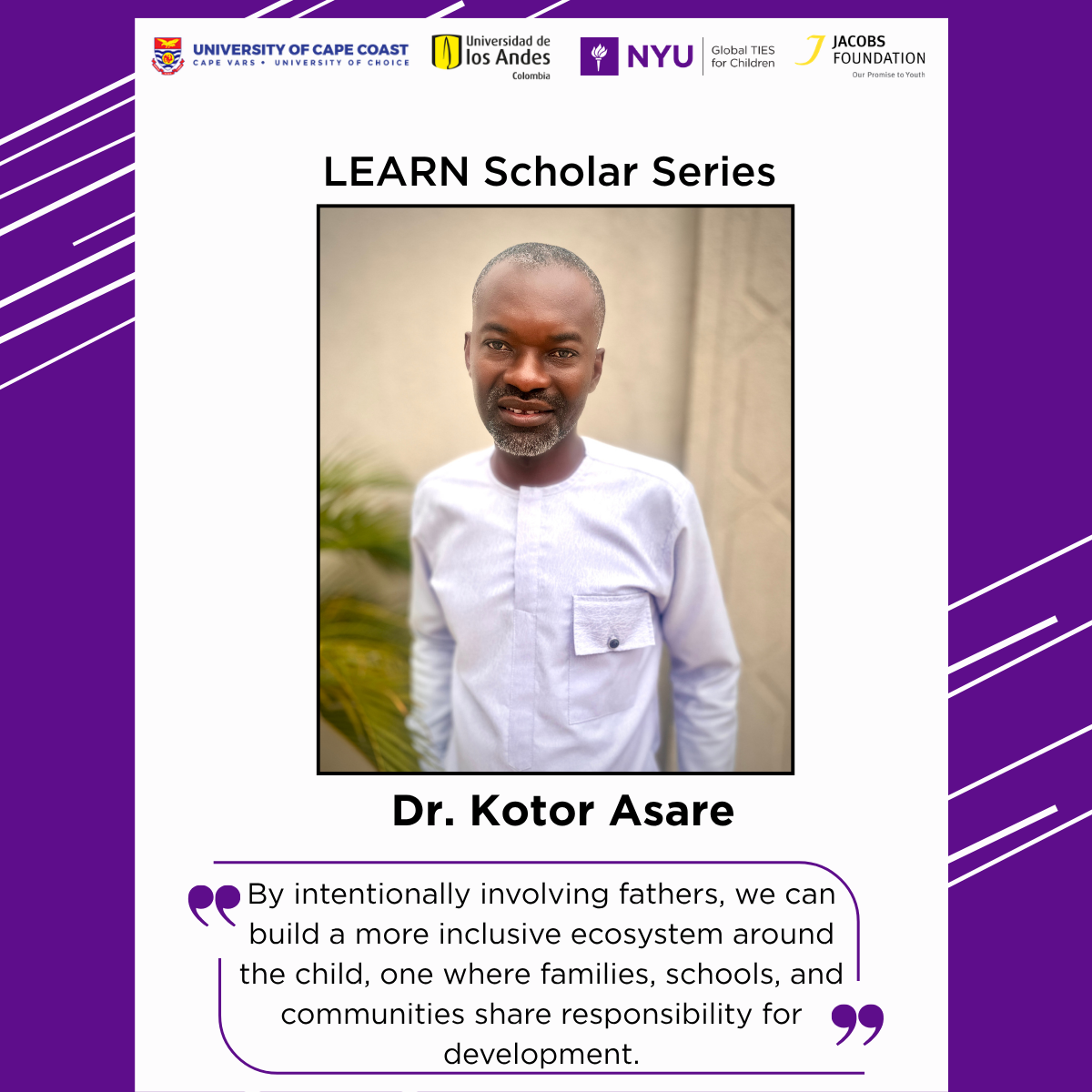
I hope this work helps shift attention toward the social-emotional foundations of early learning and the role families play in supporting them. By intentionally involving fathers, I want to contribute to a more inclusive ecosystem around the child, where families, schools, and communities share responsibility for development.
Ultimately, I hope this research contributes to a generation of Ghanaian children growing up with stronger emotional foundations and a generation of fathers who see themselves as active participants in their children’s learning and development from the very beginning.
Linkedin: https://tinyurl.com/mpndh529
