

Dr. Esinam Avornyo, Senior Research Fellow - Institute of Education, University of Cape Coast
From Classroom Observations to System-Level Change
A conversation with a researcher working to strengthen how young children learn and develop in Ghana and beyond.
In our “Get to Know a LEARN Scholar” series, we are pleased to introduce Dr. Esinam Ami Avornyo, a Research Fellow at the Institute of Education, University of Cape Coast, Ghana. In this conversation, she reflects on her journey into education and child development research, which began during an undergraduate placement in a preschool in Ghana, where she observed young children being taught through rote memorization in ways that felt misaligned with developmental theory. That early frustration evolved into a set of questions that shaped her academic path and research agenda focused on understanding how environments of home, school, and policy should be improved to offer children developmentally appropriate opportunities for children to thrive. Continue reading below to know more about Esinam and her research journey.
Let’s start at the beginning. Who are you, and what does your work focus on today?
Hi! My name is Esinam. I am a Research Fellow at the Institute of Education at the University of Cape Coast in Ghana. My research focuses on children and how their home and school environments shape learning and development. This work spans both descriptive research and the testing and evaluation of interventions that promote positive child development and educational outcomes. I hold a Bachelor of Science degree in Psychology from the University of Cape Coast, and an MPhil and PhD in Education from the University of Cambridge.
Your work is at the intersection of education, psychology, and child development. Where did this interest first take shape?
That interest began when I was an undergraduate student in 2009 and I had a student placement at a preschool in Ghana in 2009. While observing classroom practices, I noticed that learning usually meant rote memorization. I was learning about approaches grounded in developmental theory that should shape a classroom but found them to be largely absent in nursery and kindergarten classrooms. Instead, children were expected to memorize concepts, an approach not optimal for young children to learn. That experience stayed with me. In a way, it was unsettling to see such a clear gap between developmental theory and classroom practice. Over time, that discomfort evolved into a deeper curiosity about how early childhood education should be reimagined to better support the children and their development.
That is a helpful context. So, how did you decide on what path to take to address the issues in early childhood education?
Well, that early experience shaped how I approach learning: it should be aligned with children’s developmental needs and everyday experiences. Over time, my motivation expanded from simply observing classroom practices to systematically studying the broader environments that influence children’s learning. This includes not only classrooms and schools, but also homes, caregivers, and the wider systems that influence children’s development everyday. That shift led me towards realizing that research is an important aspect to bridge the gap between theory and practice.
That makes a lot of sense. Can you tell us about your research?
At a high level, my research looks at how children’s everyday environments, both at home and at school, shape how they learn and develop. I’m interested in what children experience inside classrooms, such as how teachers teach, how classrooms are organized, and how teachers are supported through professional development. But I’m just as interested in what happens outside of school: how parents and caregivers help children learn through daily routines, play, and interactions at home.
For example, I might look at how a teacher’s approach to learning influences children’s engagement in the classroom, while also examining how parents support learning through storytelling, chores, or informal numeracy activities at home. To capture this full picture, I use a mix of both quantitative and qualitative methods, so I can understand not just what is happening, but why.
I’ve been very fortunate to receive strong mentorship during my PhD and postdoctoral training. My supervisors encouraged me to think beyond academic publications and to ask how research can actually inform decisions that affect children, families, teachers, and schools. That perspective has stayed with me and continues to shape how I approach my work.
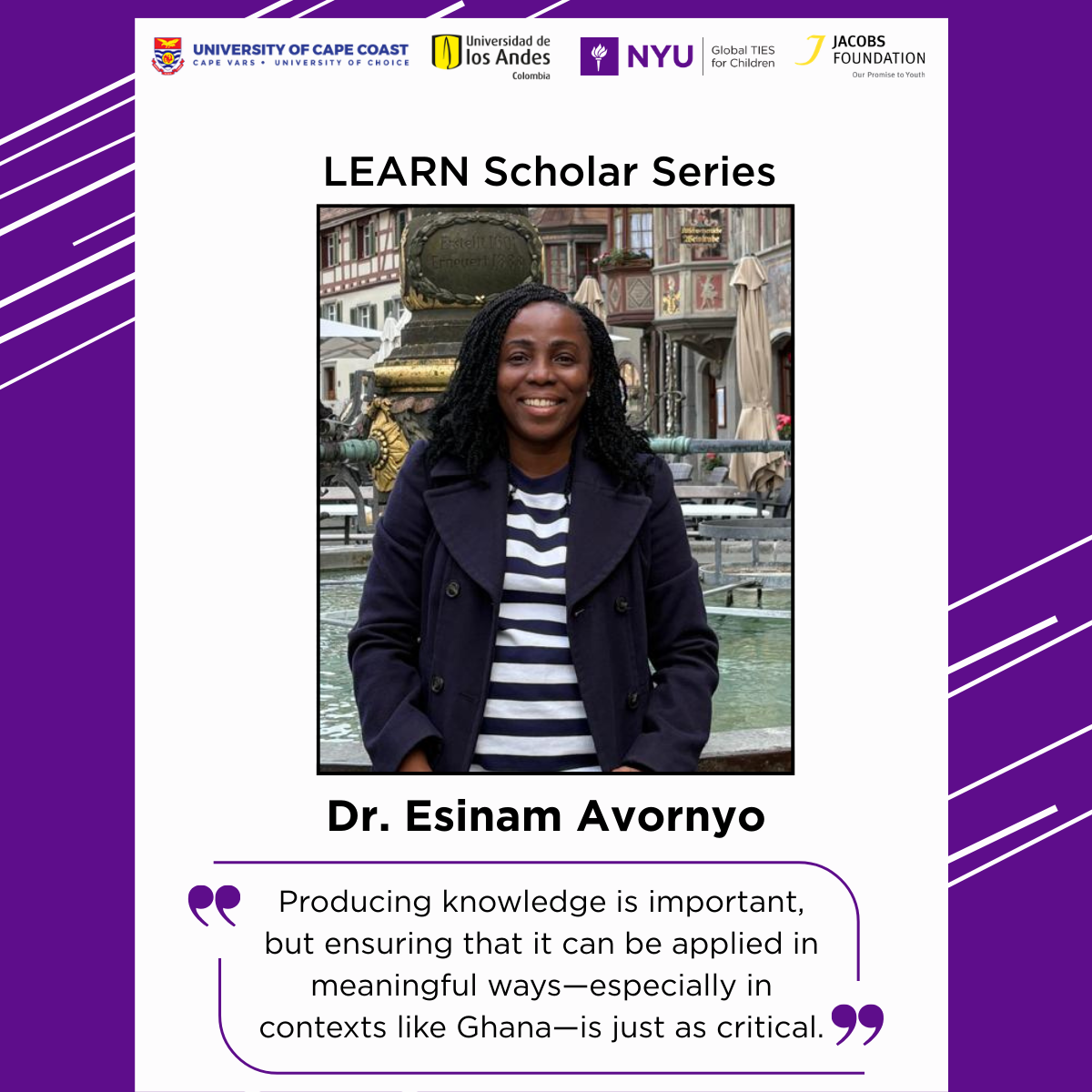
At its core, my research balances two goals. One is to generate solid evidence about what supports children’s learning and well-being. The other is to figure out how that evidence can be used in real-world settings -- especially in contexts like Ghana, where resources are limited and educational inequalities remain a major challenge. Producing knowledge is important, but ensuring that it can be applied in meaningful ways is just as critical.
This sounds quite exciting! Can you share an example of a project that brings these strands together?
Yes! One project I’m working on right now does exactly that. I’m collaborating with schools and parents to test a new way of measuring children’s executive function skills in everyday settings. On one side, we’re using direct assessments with children in pre- and early primary grades that look at skills like attention, memory, and self-control. On the other, we’re working with adults like teachers and parents to develop a simple reporting tool that captures how these skills show up in daily life, both at home and in the classroom.
What makes this project especially meaningful is its connection to policy. The study is designed to provide feedback on Ghana’s efforts to develop a national learning assessment that goes beyond academic skills alone. By including social and self-regulation skills alongside literacy and numeracy, the goal is to support a more holistic view of children’s development within the education system.
That’s fascinating! Are there any upcoming projects you’re particularly excited about?
Yes, definitely. I’m especially excited about a new project supported by the Jacobs Foundation Young Scholars Grant. This study looks at how the home literacy environment--including parents’ own reading skills--shape children’s language and reading development in Ghana.
What’s new here is that instead of relying on proxies like parents’ education levels, we’re directly assessing parents’ reading skills. To my knowledge, this hasn’t been done before in Ghana. The idea is to better understand what kinds of support families actually need and to use that evidence to design culturally appropriate, home-based literacy interventions that can realistically fit into families’ daily lives.
As your work increasingly engages with policy-relevant questions, who are you hoping to collaborate with to meet some of your research aims?
I’d really welcome collaborations with policy analysts and education planners who are interested in turning research evidence into action. Working together to translate findings for different audiences, such as ministries, school systems, or NGOs, is something I see as essential for making research matter beyond academic circles.
Well, we wish you good luck with that! Finally, do you want to share something about your aspirations in terms of long-term contributions you hope to make?
In the long run, I hope my work helps improve children’s lives both at home and at school in Ghana and across Africa. I’d like to be known as an African scholar in child development and learning whose research informed real policy decisions and led to better support for children and families. Ultimately, my goal is to contribute to education systems that truly recognize children’s developmental needs and respond to them in meaningful, practical ways.
Profile: https://directory.ucc.edu.gh/p/esinam-ami-avornyo
Linkedin: www.linkedin.com/in/esinam-avornyo-a8045364
Latest Publication: https://onlinelibrary.wiley.com/doi/10.1111/desc.70129?af=R
