Dr. Davis Mawuena Aweso, Lecturer and Researcher - University of Education
From Home Languages to Classrooms: Rethinking Early Learning in Ghana
In this week’s “Get to Know a LEARN Scholar” series, we feature Davis Mawuena Aweso, a teacher and researcher at the University of Education, Winneba, whose work is contributing to the future of education in Ghana. With a PhD in Curriculum Studies from the University of South Africa (2022) and extensive experience in technology education and teacher training, Davis brings together classroom practice, leadership experience, and policy-oriented thinking. In the conversation that follows, he reflects on his professional journey and the questions that drive his work, as well as the impact he hopes to make across classrooms, communities, and national education policy.
Q: To begin, could you introduce yourself and the path that brought you into research?
A: Thank you. I like to describe myself first and foremost as a teacher. I’m currently a Research Fellow at the University of Education, Winneba, but my career began with teacher certification at Ada College of Education in Ghana, followed by several years as a headteacher in a local school.
Over time, I pursued further studies: first a B.Ed. in Technology Education, then an M.A. in Adult Education, an M.Phil. in Curriculum and Pedagogical Studies, and ultimately a Ph.D. in Curriculum. I’ve taught at all levels of education, from the basic school to the tertiary; worked in a college of education training where we train teachers for the basic schools in Ghana; and even served as Head of Department for Early Childhood and General Education. Most recently, I’ve shifted fully into research, collaborating with colleagues on foundational learning and preparing to deepen my work on inclusivity in early childhood.
Q: With such deep roots in teaching, what drew you specifically toward curriculum and pedagogy?
A: Being a lifelong teacher showed me just how central the curriculum is to everything we do. It’s the backbone, from planning and development to implementation and evaluation. I became interested in what kinds of curriculum models truly engage communities and support teachers.
I often say: you can’t give what you don’t have.” So, I committed to building curriculum expertise to help those preparing young learners. Many people don’t fully understand how schools and teaching actually work; becoming a curriculum specialist allows me to support new teachers with the knowledge and practical tools they need.
Q: Yes, our teachers are especially important leaders. Your recent work focuses on the home-to-school transition in multilingual communities. Why has this become such an urgent issue for you?
A: In Ghana, children speak many different languages at home: Fante, Twi, Ewe, Hausa, and more. Imagine arriving at school on your very first day and the teacher greets you in a language you don’t understand! Many children experience that disconnect, and it can make the classroom feel intimidating or unfriendly.
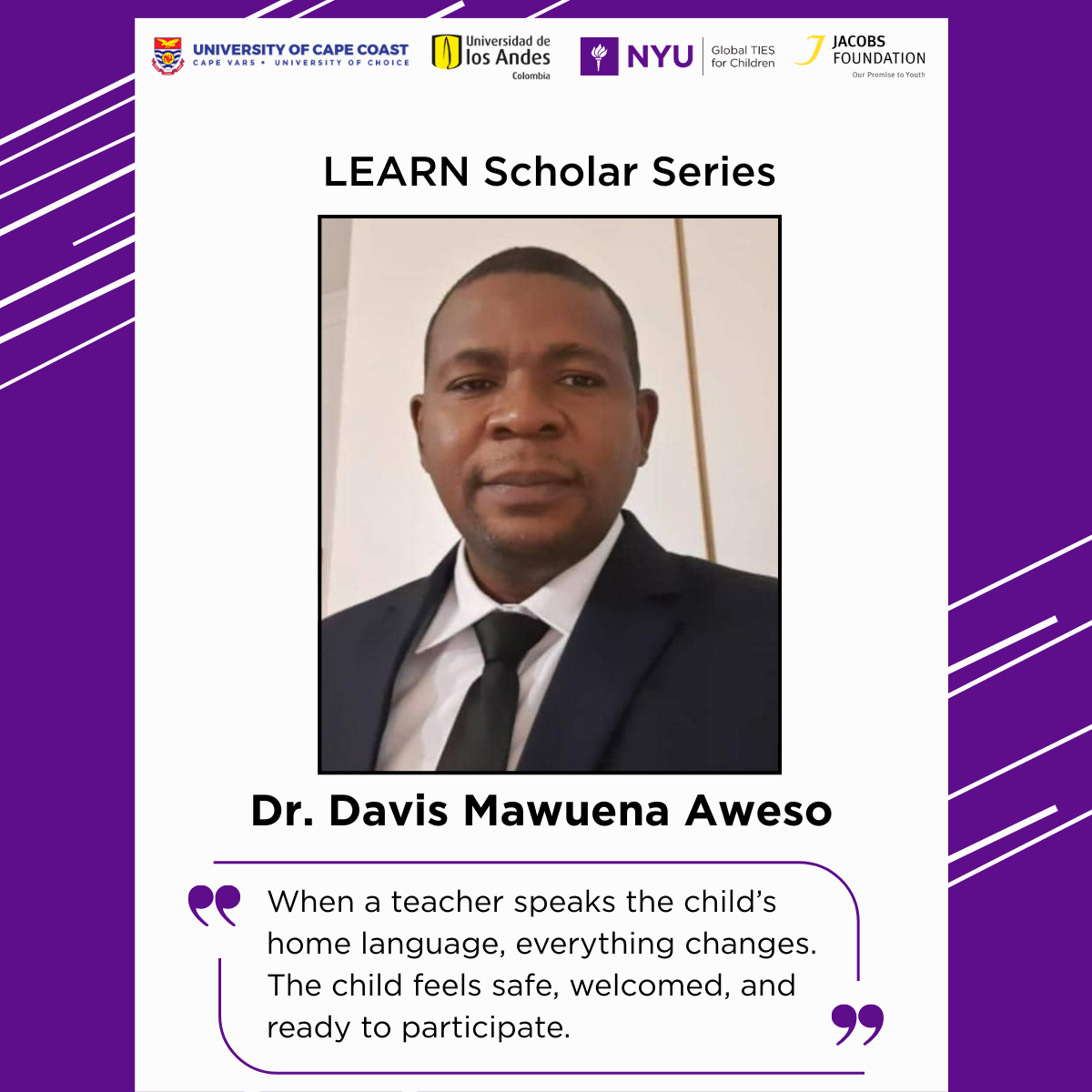
But when a teacher speaks the child’s home language, everything changes. The child feels safe, welcomed, and ready to participate. My work aims to support parents, communities, and policymakers in aligning language-in-education policy with the realities of multilingual classrooms. We’ve seen national conversations intensify around this, including statements from the Minister of Education, which shows just how important--and debated--the issue is.
Q: Yes, language policies in schools are very debated! I know you’ve also begun exploring disability inclusion. How does that connect to your broader research?
A: Ghana is moving toward a more inclusive system by integrating learners with and without disabilities in mainstream classrooms. The idea is that learning side-by-side helps all children adapt, reduces stigma, and builds a shared sense of belonging. But for that to work, schools must provide the right support, and teachers need guidance.
I see a real need for policy clarity and implementation. Some proposals are underway, but more concrete work must be done to ensure children receive the support they deserve in inclusive settings.
Q: How do you study what actually happens in multilingual early-grade classrooms?
A: I use a qualitative, multi-case study design to understand lived experiences in real communities. I’m working in three very different multilingual areas: Kasoa (peri-urban), Ashaiman (urban), and Accra (the capital). In each location, I interview learners, teachers, parents, and caregivers to understand what actually happens in early-grade classrooms.
I’m especially interested in local language practices such as code-switching and translanguaging, or how teachers move between languages to help students learn, and what support they need to implement language-in-education policy effectively. As I dig deeper into these communities and their classroom realities, the insights have already started shaping my research in meaningful ways.
Q: I’d love to hear about some of them! Is there a recent milestone you’re proud of?
A: Yes, I recently co-authored a study on early childhood education in Ghana that we presented at an international conference in Accra. One key finding was that trained early-childhood specialists are not consistently deployed to kindergarten and lower primary levels. Instead, these classes are often staffed by generalist teachers, especially in competitive urban areas.
As a result, we recommended revisiting deployment policies. This is especially urgent because if the foundation of children’s learning is weak, everything built on top of it is at risk of collapse. Early-grade teaching requires targeted expertise.
Q: Beyond multilingualism, what else is on the research horizon for you?
A: I’m expanding my work in foundational learning more broadly. I recently applied to the Education Sub-Saharan Africa (ESSA) research call, which focuses on essential early learning skills. My interests include curriculum planning, quality assurance, teacher education, adult education, and increasingly, early childhood and the early grades.
Q: And finally, what kinds of partnerships would help advance your work right now?
A: I welcome both local and international partnerships. I’m already working with two early-childhood Ph.D. fellows at the University of Cape Coast, and I’m open to collaborating with universities, NGOs, school systems, and research groups; I’m especially interested in working with people focused on language in education, inclusion, or teacher deployment.
I’m happy to share my contact details, professional profiles, and publications with anyone interested in connecting or collaborating.
Google Scholar: https://scholar.google.com/citations?view_op=new_profile&hl=en&authuser=3
Linkedin: www.linkedin.com/in/davis-mawuena-aweso-491121b8