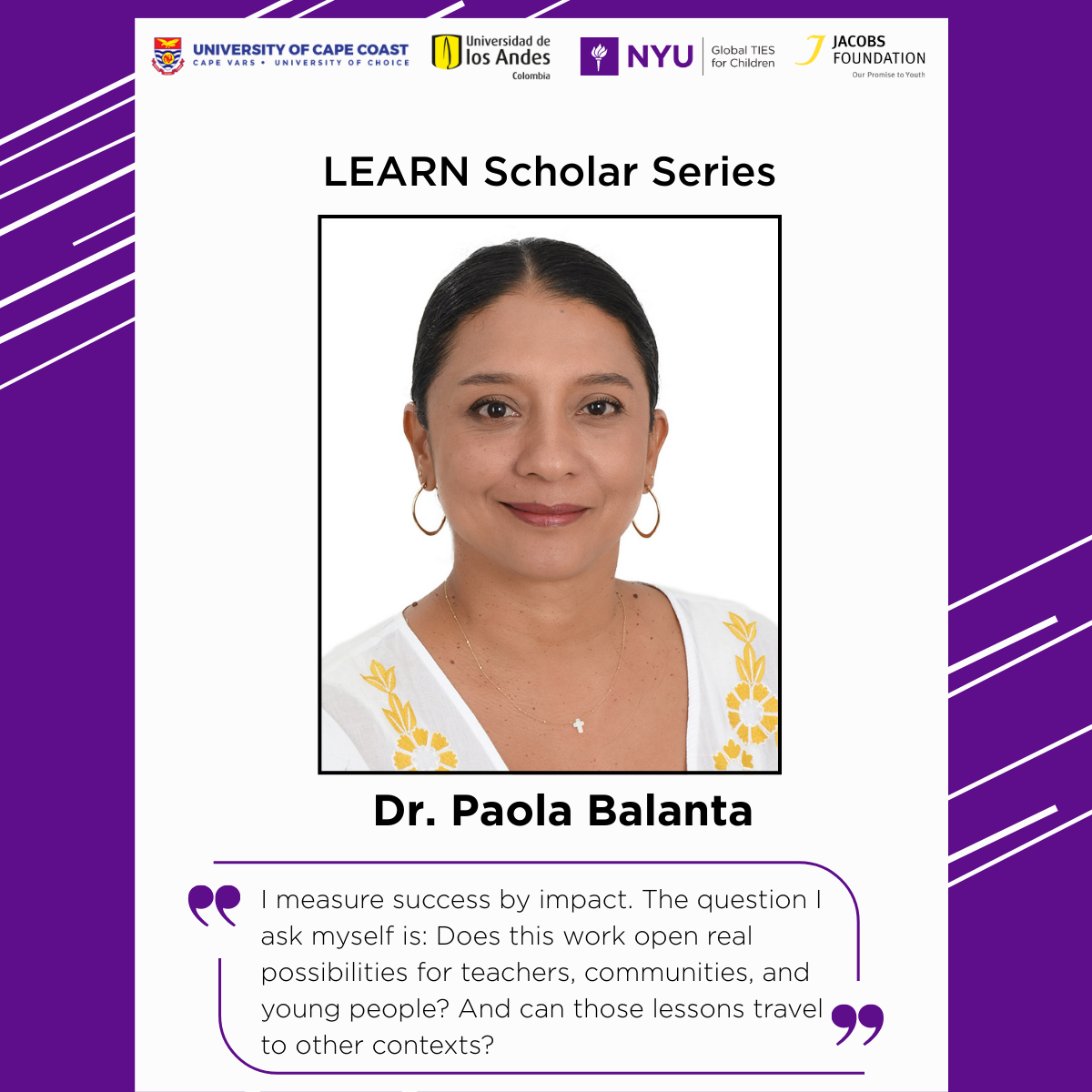
Dr. Paola Balanta, Senior Interdisciplinary Researcher in Human Development, Education, and Rights
Centering Agency, Resilience, and Care in Early Childhood Research
In our “Get to Know a LEARN Scholar” series, we are pleased to introduce Dr. Paola Balanta, a Researcher and Field Leader for the JUNTOS por la Prioridad Program—a collaborative initiative focused on prioritizing early childhood development and strengthening care systems, with the goal of positioning early childhood as a central priority within local and national agendas in Colombia. In this conversation, we spoke with Paola about her work and the path that led her to it.
While becoming a researcher in Colombia can sometimes be accidental, Paola’s journey was anything but. From an early age, she worked closely with families, children, and young people in communities shaped by inequality and armed conflict. Those experiences sparked a set of questions that have stayed with her ever since: What enables people to develop agency, resilience, and creativity in vulnerable contexts? Today, her work sits at the intersection of psychology, education, and social justice, turning everyday care and creativity into eco-pedagogies and community initiatives rooted in local resources, intergenerational relationships, and emotional co-regulation. In the interview that follows, Paola reflects on how these early experiences shaped her research agenda and continue to guide her commitment to early childhood development and systems-level change.
Q: You’ve been drawn to this work for a long time. What first led you into psychology and education?
A: It really started in my teenage years. I was surrounded by young people living with vulnerability, yet I kept seeing them protect one another, regulate emotions together, and imagine better futures. That experience fundamentally changed how I understood education. Schools aren’t just places where information is transmitted; they can also be spaces of protection, belonging, and identity-building. Over time, that led me to focus on how early relationships and educational environments support well-being and help prevent violence in contexts shaped by inequality and exclusion. I was also frustrated by how often children and youth are treated as problems to be fixed, instead of recognizing the emotional support, shared learning, and creativity they already offer each other. Those everyday strengths rarely show up in policies or programs, but they should.
Q: That perspective really centers on children's agency. Was there a moment that crystallized this for you?
A: Yes! Many moments, actually. One that stays with me happened in a classroom when a group of young children quietly took over an activity. They designed the task, explained it, coordinated among themselves, and presented their work while I stood in the background. It was a powerful reminder of how much agency even very young children have when adults create space instead of controlling every step. Experiences like that continue to shape how I approach my work.
Q: Your research often uses the term “eco-pedagogy.” What does that look like in practice?
A: My interest in eco-pedagogies comes from more than 15 years of working in contexts where material resources are scarce, but creativity is abundant. I’ve seen teachers and communities transform simple materials — sticks, fabric scraps, songs, stories, and many more easily available resources — into powerful learning experiences.
My research builds on those realities. I work with educational communities in southwestern Colombia, particularly Afro-descendant communities, to design and test low-cost, locally grounded pedagogies. These approaches strengthen social-emotional and cognitive skills while also contributing to developmental science from culturally grounded perspectives emerging from low and middle income countries.
Q: Why does this kind of work feel especially urgent right now?
A: Education and protection systems are under enormous strain. Youth mental health challenges are increasing, violence is rising, and schools are struggling to hold their social role. In that context, the relationships children and young people build with one another are a critical, but often undervalued, resource.
We increasingly need intergenerational, strengths-based approaches that build on what is already working in communities, rather than importing models that overlook local knowledge.
Q: Beyond the research findings, what keeps you motivated to continue this work?
A: I’m continuously motivated by what I see in the field. I’ve watched children and young people living with violence and scarcity gain confidence, care for one another, and start to see themselves as capable of shaping their own futures, especially through eco-pedagogies and intergenerational activities.
One group of young women I worked with began with very low expectations for themselves. Over time, they naturally became mentors to younger children. That transformation reshaped how I think about agency and success.
Q: That leads nicely to my next question: what does “success” look like in your work?
A: I measure success less by publications and more by impact. The question I ask myself is: Did this work open real possibilities for teachers, communities, and young people? And can those lessons travel across other low and middle income countries as serious, grounded knowledge?
Success means showing how relationships shape learning and well-being and turning that understanding into tools educators and communities can actually use. It also means co-designing with communities, informing real decisions with evidence, and recognizing children and youth as key actors in social transformation.
Q: That sounds amazing, but I can imagine it’s also difficult. What has been the biggest challenge you’ve faced along the way?
A: The hardest challenges are the everyday realities communities face: land insecurity, food scarcity, limited transportation, poor connectivity, and large learning gaps. I’ve had to adapt constantly by shifting formats, building remote support systems, training local mentors, and designing initiatives that don’t rely on my physical presence.
My current work with the Ministry of Equality and Equity in the Colombian Pacific has demanded continuous adaptation, while deepening the insights that shape my work. This project demands culturally sensitive methodologies that align with the traditions of the African Diaspora, where intergenerationality is a cornerstone of social fabric. In these territories, knowledge is transmitted through 'semilleros' (seedbeds of learning), where elders, youth, and children engage in oral traditions.
In contexts marked by systemic inequality and scarce institutional resources, formal classrooms often remain sterile and uninspiring. Instead, the most profound learning experiences and co-regulation dynamics emerge in organic spaces, such as, around dance, music, traditional cuisine, and the river. These natural environments serve as the true catalysts for interaction, where local resources and communal bonds compensate for educational gaps, fostering a vibrant, spontaneous pedagogy that transcends the limitations of formal schooling.
Funding constraints have also pushed me toward more resilient, community-led approaches. In the end, those challenges reinforced my belief that lasting change must be driven by communities themselves.
Q: Are there any recent milestones you’re especially excited about?
A: I recently co-authored an article in implementation science proposing a theory of change for Colombia based on the cultural adaptation of the LEAPS program. Through the LEARN fellowship and the PROLEER network, I’ve also been able to connect my work in Colombia to broader Latin American and international research conversations.
Q: What kinds of collaborations are you hoping to build next?
A: Location-wise, I’m particularly interested in partnerships rooted in the Global South generally, and Latin America specifically. I’m especially interested in opportunities that combine technical expertise, long-term research support, and global reach. I’m drawn to collaborations in peacebuilding, child and youth development, eco-pedagogy, and implementation science, including organizations like UNICEF or the Obama Foundation.
Q: Finally, how can people learn more about your work or connect with you?
A: The best way to connect is through my LinkedIn profile, where I share updates on eco-pedagogies, intergenerational emotional co-regulation, and sustainable educational approaches. My publications are also available on Google Scholar.
LinkedIn: https://www.linkedin.com/in/paolabalantacobo/