

Dr. Ebo Amuauh, Research Fellow - University of Cape Coast
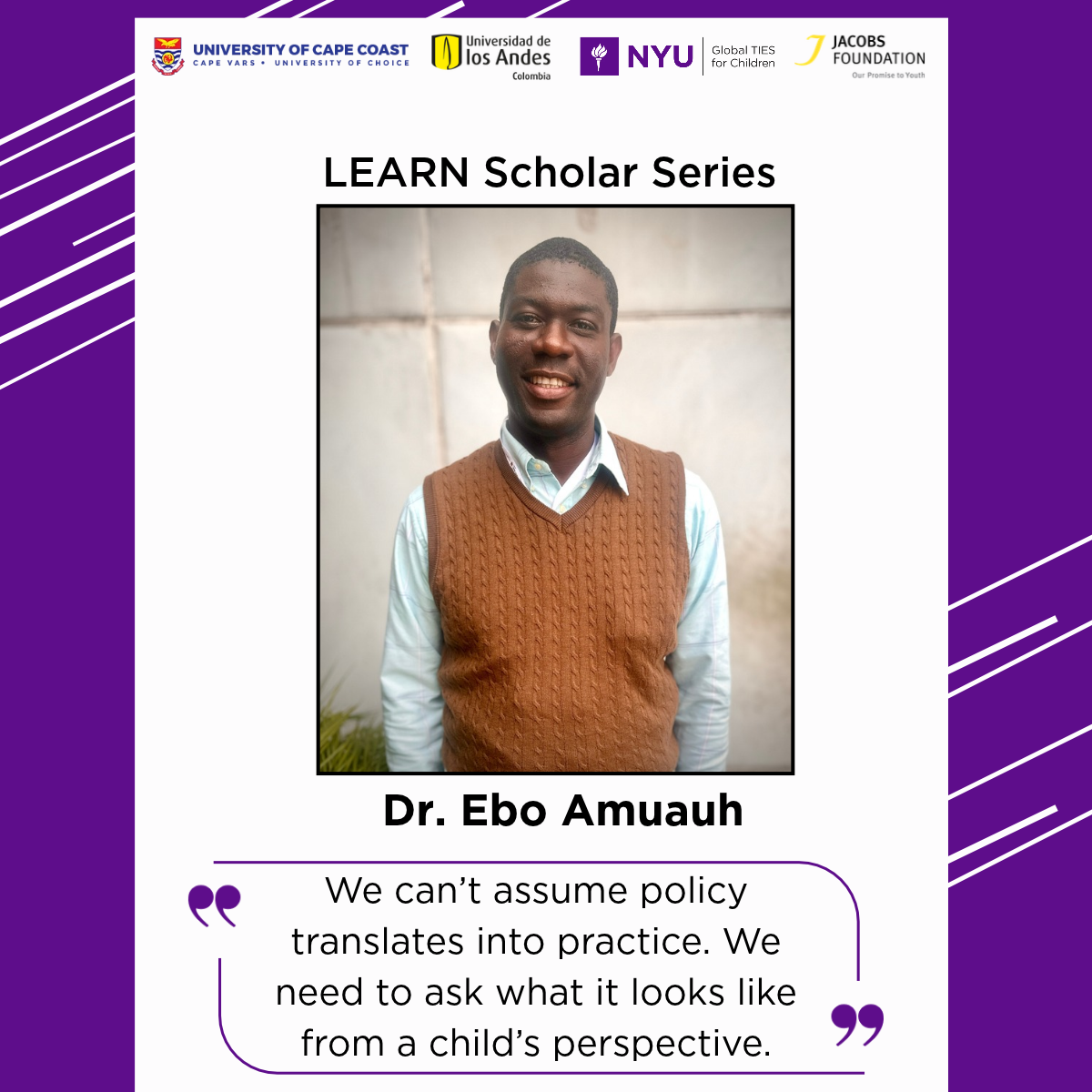
In this installment of our “Get to Know a LEARN Scholar” series, we feature Ebo Amuah, a Research Fellow at the Institute of Education at the University of Cape Coast in Ghana (UCC). With a background in mathematics education and nearly two decades of experience at UCC, Ebo’s research asks an important question: What happens when we look beyond what education policies intend and pay closer attention to what students actually experience in the classroom?
Ebo’s work focuses on mathematics education, classroom learning environments, and, increasingly, early childhood development and school readiness. Central to this work is his interest in the gaps between policy and practice, and in bringing students’ perspectives into conversations about how learning environments are designed and evaluated. Through culturally grounded measurement and classroom-level research, he examines how children experience belonging, emotional safety, teaching practices, and the relevance of what they learn. In the conversation that follows, Ebo reflects on his journey from supporting others’ research to building his own research agenda, and his goal of using locally grounded evidence to create learning environments that better reflect the realities of children in Ghana and across Africa.
You’ve spent much of your career at the University of Cape Coast, working across education and research. Can you tell us a bit about who you are, what you work on, and what first drew you into this field?
I’m currently in my fifth year as a Research Fellow at the Institute of Education at the University of Cape Coast (UCC), but I’ve been connected to the university in different roles for nearly twenty-five years. My work sits at the intersection of mathematics education, teacher education, and early childhood development, with a focus on improving teaching and learning in Ghanaian schools.
I was trained entirely at UCC, earning a BSc in Mathematics and Statistics, followed by a PGDE, an MPhil, and a PhD in Mathematics Education. Over time, my research interests have expanded beyond mathematics content alone to include the learning environments in which mathematics is taught, particularly in the early grades. For example, while exploring mathematics classroom learning environments at the primary level, I had the unique opportunity to participate in Jacobs Foundations mentoring programme that exposed me to issues in early childhood education. I therefore saw how preparation at early childhood and lower primary education explained challenges in future mathematics education. I therefore chose to explore how the underdeveloped Ghanaian context revealed the aforementioned challenges and how I can work collaboratively with colleagues to provide better learning experiences for the current and future generations.
My interest in education grew gradually through my involvement in different research units at the university. I was always struck by how senior researchers used evidence to shape policy and practice, and I could see clear links between research and some of the challenges I had experienced myself as a student. More recently, while collaborating with a senior colleague on a research paper, I had a moment of clarity: instead of only supporting others’ projects, I wanted to take ownership of my own research agenda and focus on issues I know firsthand. The approach helps me to fill critical gaps focused on overcoming peculiar challenges in the Ghanaian and African education context. That realization pushed me to engage more deeply with learning environment research, which remains relatively underexplored in the Ghanaian context.
Your work focuses strongly on mathematics education. What does that look like in practice, and why does it matter?
In practical terms, my research looks at how students experience their classroom learning environments and how those experiences shape their engagement and success in mathematics. This includes things like how lessons are structured, how teachers interact with students, how comfortable students feel asking questions, whether classroom practices reflect students’ cultural and social realities, and how the classroom experiences explain learning outcomes in mathematics. For example, when I tried to validate a mathematics classroom learning environment scale (forthcoming paper), I realised that the mathematics specified in the curriculum or policy document is different from what is learnt in the classroom. Thus, there is a disconnect between the classroom environment and policy-oriented mathematics learning outcomes.
What makes this area particularly interesting to me is the tension I often see between theory, policy, and what actually happens in classrooms. For example, a curriculum might emphasize student-centered learning, but in practice, classrooms may still rely heavily on rote instruction or high-stakes assessment. Cultural expectations, resource constraints, and policy demands all interact in ways that don’t always align.
I’m especially interested in questions like: Who designs learning environments? Whose perspectives shape them? And how do we know whether students’ real experiences match what educators and policymakers intend? By studying these gaps, I hope to identify concrete, classroom-level changes that can improve how students experience mathematics learning.
You’ve noted that students’ lived experiences are often missing from how learning environments are designed and evaluated. Why is that a problem, and how does your research respond?
Across Ghana, and in many other parts of Sub-Saharan Africa, there has been significant investment in schools, infrastructure, curricula, and education policies. The assumption is often that once these structures are in place, effective learning will naturally follow. But research and everyday classroom realities suggest that this isn’t always the case.
One major gap is that students’ perspectives are rarely included in how learning environments are designed and evaluated. For instance, classrooms may technically meet policy standards but still feel disconnected from students’ cultural backgrounds or everyday lives. In many Ghanaian classrooms, teaching approaches and materials do not fully reflect the languages, examples, or ways of thinking that children bring with them to school.
My research tries to address this by putting students’ experiences at the center. I work to capture how students, teachers, and even policymakers understand the classroom environment and where those perspectives align or diverge. A key part of this work involves developing and validating culturally relevant tools that measure aspects of the learning environment that standard frameworks may overlook, such as students’ sense of belonging, emotional safety, or perceived relevance of what they are learning.
By “zooming in” at the classroom level, I hope to identify what is working, what isn’t, and why, so that teaching practices and, eventually, policies can be adjusted in meaningful and realistic ways.
Looking ahead, what kinds of change do you hope this work will lead to?
At the most immediate level, I hope my work encourages educators and policymakers to take students’ learning experiences seriously when designing reforms. Rather than assuming that policies automatically translate into practice, I want to help stakeholders ask: What does this look like from a child’s perspective?
One example is my current work on school readiness, which is part of a Jacobs Foundation supported research grant focusing on Grade 1 children in rural Ghana. Through this project, we are examining how early classroom experiences, such as children's cooperation and sharing in learning activities, and their teachers' belief about the importance of environmental characteristics, shape children’s adjustment to formal schooling and their longer-term learning trajectories. My hope is that findings from this work will inform both early childhood practice and policy discussions around the transition into primary school.
More broadly, I want to contribute to building a stronger, more connected research ecosystem in Ghana. While challenges like limited funding and few local collaborators persist, support from foundations like Jacobs creates opportunities to generate locally grounded evidence, mentor emerging researchers, and strengthen the relevance of education research. Ultimately, my goal is to help improve education systems in ways that give children a stronger start and create learning environments where meaningful learning can actually take place.
So, if there are any researchers or funders who are interested in contributing to the agenda of mathematics education, school readiness, and early childhood education systems, I would love to connect. I am also interested in collaborating with practitioners and policymakers to study the whole lifecycle of a policy and its impacts, especially if it focuses on improving an aspect of early learning with the classroom systems. I can be found on LinkedIn here, which could be a good place to start. Alternatively, you can reach out to me on my email which is ebo.amuah@ucc.edu.gh or computalk2002@gmail.com, and you can read about some of my work here.
Linkedin: https://www.linkedin.com/in/ebo-amuauh-a250a3242/
Googlescholar: EBO AMUAH - Google Scholar
