

Dr. Viana Bustos, Researcher, Teacher, and Postdoctoral - Corporación Universitaria Reformada in Colombia
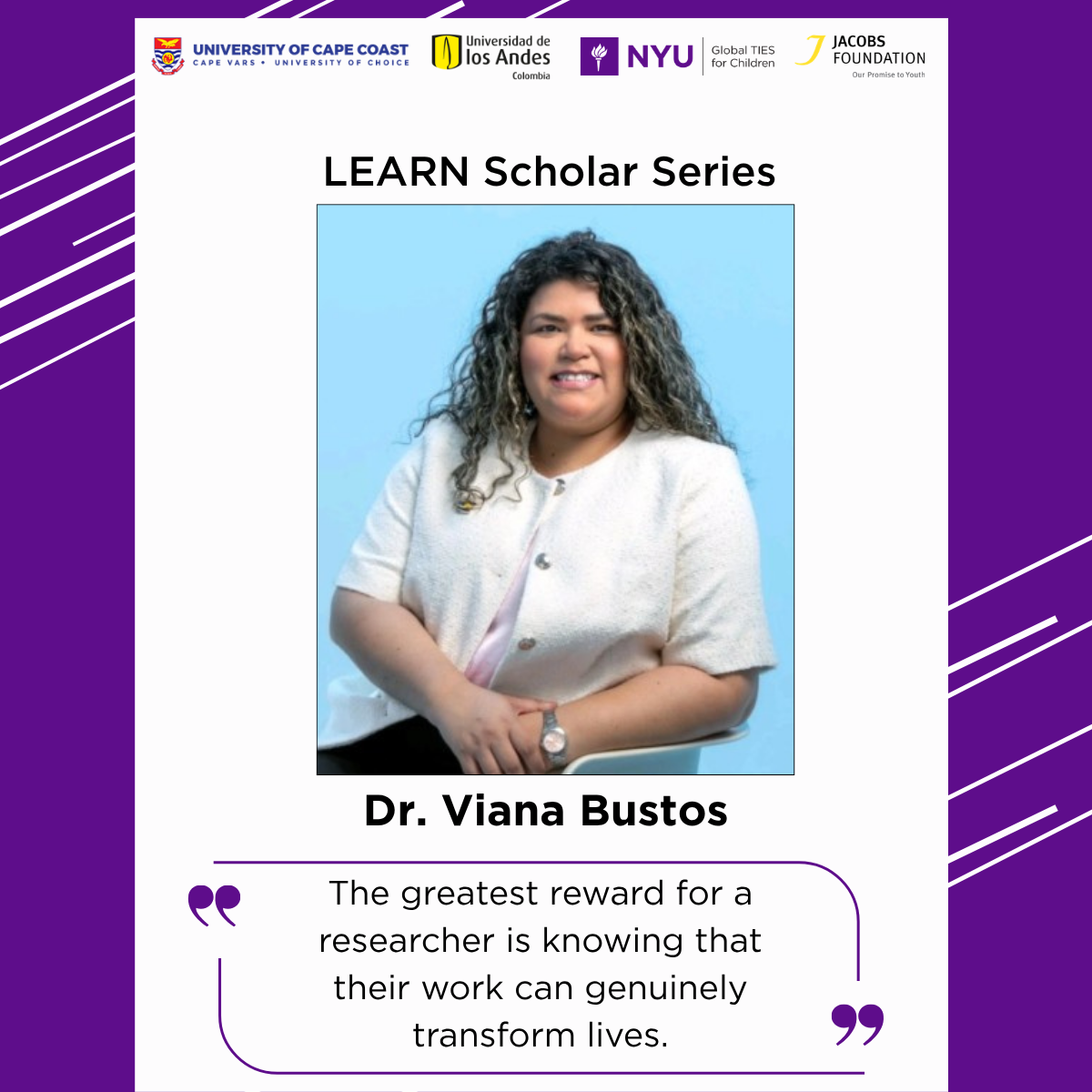
For this installment of our "Get to Know a LEARN Scholar" series, we sat down with Dr. Viana Bustos, a researcher, teacher, and postdoctoral fellow at Corporación Universitaria Reformada in Barranquilla, Colombia. Her work investigates how trauma and socio-emotional development intersect in children's lives — and how science can better serve the communities that need it most.
Dr. Bustos came to research the way many do: by accident, and then all at once. A clinical psychologist with over a decade of experience working with children, adolescents, and adults, she discovered her research vocation when she began teaching at the university level—and found she couldn't stop asking questions. Today, she holds three simultaneous roles: researcher, teacher, and postdoctoral fellow in Social Sciences, Childhood and Youth. Her current work centers on understanding how traumatic experiences shape the development of children aged 6 to 12 growing up in vulnerable social contexts in Colombia and across Latin America. She joined the LEARN program to further expand those connections.
Q: Let's start with you. You're a researcher, a teacher, and a postdoctoral fellow all at once. How did you find your way into all of this?
A: Thank you so much for your interest in me and my work! I live in Barranquilla, Colombia, and right now I wear three different caps: researcher, teacher, and postdoctoral fellow. I teach undergraduate and graduate courses in Psychology and Education at UNIR and UMECIT. As a postdoctoral fellow in Social Sciences, Childhood and Youth at [Universidad de Manizales], I focus on childhood and public policy. As a clinical psychologist with extensive experience working with children, adolescents, and adults, I conduct research in psychology, mental health, childhood, and vulnerable populations.
What I find interesting is that I discovered my interest in research through teaching. Once I started working at the university level, I found myself more and more drawn into the research process — and at some point I realized this was my path. That's what led me to pursue my doctorate in psychology through a scholarship from Colombia's Ministry of Science, Technology, and Innovation. It was a real turning point.
Q: So teaching was actually the thing that opened the door to research—that's interesting. What were you noticing in that classroom experience that made you want to keep pulling on those threads?
A: Teaching made me ask questions I couldn't stop thinking about. What I kept returning to was how early development shapes everything that comes after: mental health, relationships, resilience. Every interaction a child has — a word, a gesture, a relationship, an environment — can either protect or undermine their well-being. That observation became central to how I approach everything.
I'm constantly reminded of Ortega y Gasset's idea: “I am myself and my circumstances.” That phrase guides how I think about child development and psychology. What I try to do differently in my research is center each person's unique developmental trajectory because lasting change happens when we take individuality seriously, especially in diverse social settings where one-size-fits-all approaches often fall short. My goal is to strengthen the capacity of educators and mental health professionals to provide care that actually fits the realities of the people they're working with, and to inform public policies that respect differences and genuinely promote children's well-being.
Q: I want to dig in more on what you mean by "real-life contexts" and "vulnerable circumstances." Can you be more specific about the children your research focuses on and what you're trying to understand about their lives?
A: The central focus of my research is emotional development — specifically, how traumatic experiences shape human development across the lifespan. I'm especially focused on children aged 6 to 12 growing up in socially vulnerable contexts in Latin America. My team and I are currently testing a model that examines how traumatic experiences interact with socio-emotional development, cognitive skills, and caregiver support to shape children's outcomes. The goal is to give professionals, educators, and childcare institutions a science-based framework they can actually use for both educational support and mental health care.
One of the biggest obstacles in this work is human bias, particularly the way it can hide behind what I'd call "scientific disbelief." Working with traumatic experiences and collaborating with national and international organizations has exposed me to many difficult realities. I constantly push myself to question orthodox views of science, and in doing so, my own perspective keeps evolving. This work has truly kept me on my toes.
Ultimately, I want this research to serve children, adolescents, and families by strengthening social-emotional skills in ways that are meaningful within our specific Latin American contexts and by producing practical tools, technical guides, and resources that educators and caregivers can use in everyday settings.
Q: It sounds like you pour a lot into your work. What has reminded you, along the way, that it's worth it?
A: Several things, actually. Recently, I received scientific recognition from Corporación Universitaria Reformada for achievements acknowledged by Colombia's Ministry of Science, Technology, and Innovation. I've also taken on a new role as a Doctoral Thesis Advisor in a Doctorate in Education program in Panama. Both feel like meaningful milestones because they connect directly to my commitment to psychology and education—not just as a researcher but as someone invested in developing the next generation of scientists.
But the moments that stay with me most are the ones that come from the work itself. I still hold tightly to words that young participants said to me over ten years ago. One told me: "Thank you very much for what you have given us and for the words you say to us." Another said: "Thank you for teaching us to be brave and for teaching us to share." Those words have never left me. I think the greatest reward for a researcher is knowing that their work can genuinely transform lives — nurture someone's desire to keep going, help build resilience in the face of daily challenges.
I also remember a literature teacher who encouraged me early on and helped me find my voice through writing. That kind of experience serves as a kind of ethical and professional compass. In many ways, betting on transformation has become my guiding motto.
Q: Wow, I love the phrase ‘betting on transformation’. What does that transformation look like as you look ahead, and who do you hope to work alongside?
A: Looking ahead, I want to continue expanding Colombian and Latin American samples so we can develop tools, resources, and technical guides that are genuinely grounded in our own scientific and cultural realities. That opens up real opportunities: replicating studies, piloting interventions, refining instruments, and securing funding and technical support from both national and international agencies.
I'm especially interested in building collaborations with universities and research centers focused on childhood in contexts of social vulnerability; children's agencies engaged in longitudinal development studies; child protection organizations supporting children affected by traumatic experiences; and women's empowerment agencies working to close gaps in human rights protections and access to health services. These are the partnerships that can make research not just locally grounded, but actionable and sustainable over time. I welcome the connections.
Contact Viana via email vianab71@gmail.com or on Linkedin here: https://www.linkedin.com/in/viana-bustos-ph-d-b46b41207
Viana’s recommended reading: Psycho-affective Recovery. A Resilient Childhood (Bustos, Mass, and Russo, 2019), which explores the understanding of trauma and resilience and their implications for psychological intervention and emotional development in childhood.