

Dr. Benedicta Leonora Akrono, Lecturer and Researcher - University of Education in Ghana
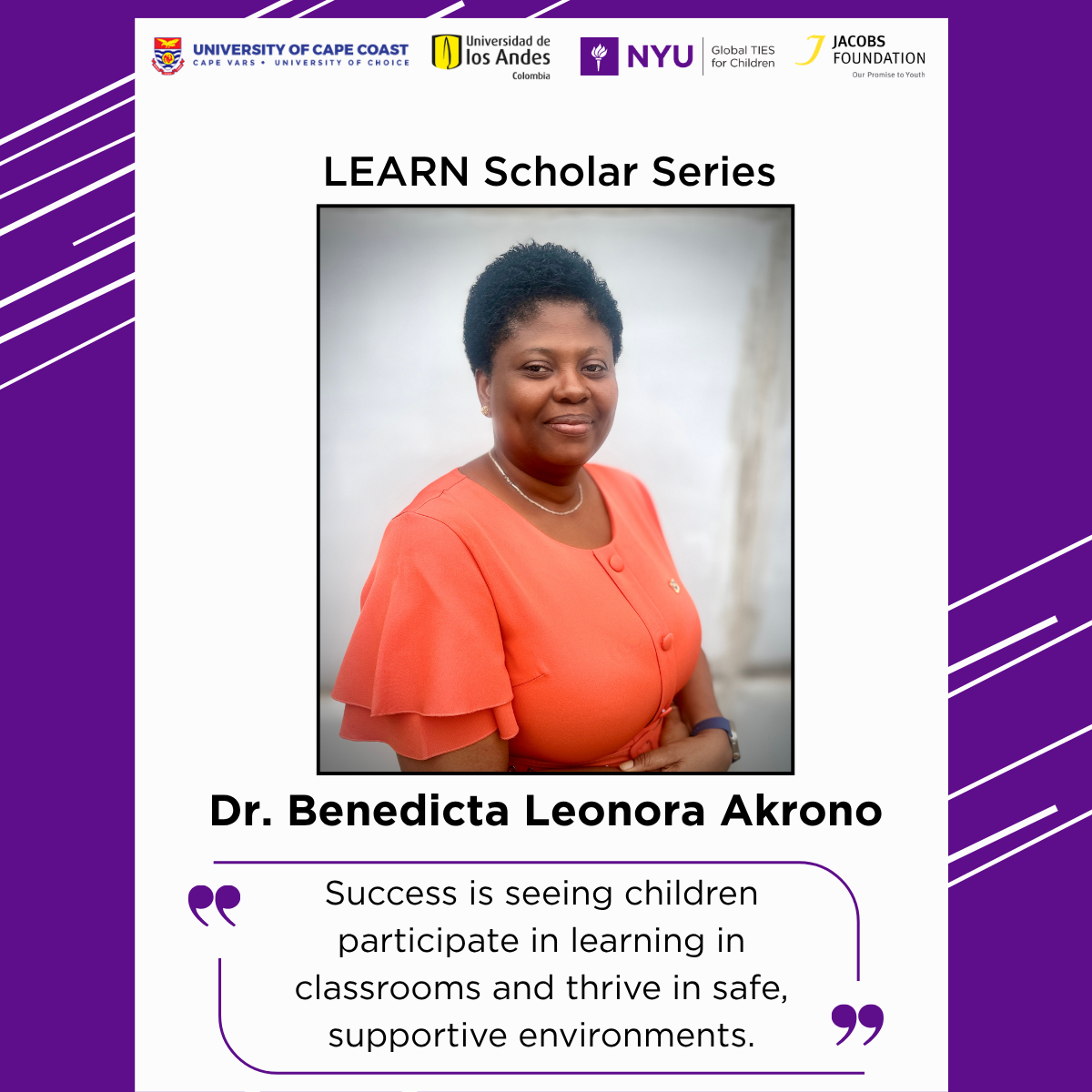
To continue our “Get to Know a LEARN Scholar” series, we now introduce Dr. Benedicta Leonora Akrono. She is a teacher of undergraduates at the University of Education (Ghana), and in the interview, she shared her story of becoming a researcher in education and economics.
Her love for learning began with her father’s love for books. She turned that early inspiration into a research career dedicated to understanding how family, education, and economics come together to define children’s futures. Continue reading below to know more about Benedicta and her research journey.
Q: Hi, Dr. Akrono! Thanks for taking the time to talk with us today. Can you introduce yourself to our readers?
A: Yes, of course. I’m Dr. Benedicta Leonora Akrono, a lecturer, researcher, and, I can also say, a lifelong learner. I hold degrees in Economics and Mathematics, including a PhD in Economics, and I currently teach undergraduates and supervise student research in the Department of Education at the University of Education (Ghana), especially on research projects related to child development.
Q: What first got you interested in education and economics?
A: It all started with my father. He was a teacher, and I remember how neatly he kept his books organized in his room. Watching him read captivated me. He once said to me, “Education is an asset”, and that stayed with me and got me interested in education and exploring how instrumental it can be in shaping a person’s future, especially if received as a child, during the formative years of one’s life.
As a child, I had a strong interest in mathematics. That love for numbers evolved into a desire to solve meaningful problems, and that’s what led me to study Economics, which I see as the science of using scarce resources to optimize efforts towards achieving life’s goals. During my university years, I was the only female student in my program, studying both Economics and Mathematics. Even in my department today, I’m the only woman, which, honestly, is a source of motivation for me. I’ve always loved learning and gaining new information, which works for me as a researcher. I've also enjoyed sharing knowledge with others, which makes teaching an integral and enjoyable part of my career. Over time, that early inspiration from my father grew into a subject of research to understand how education, or the lack of it, especially for children, shapes their lives. My research revolves around the effects of women's empowerment, child education, and health, as well as parental involvement in child education, which could address the learning loss due to child labor in Ghana.
Q: What made you decide to focus on child labor and parental involvement?
A: That story begins at home. My mother was a trader, and my older siblings often helped her with the business. Our family depended on that second income, but I noticed how their schooling suffered because of the time they spent working.
In university, I studied Economics, Mathematics, and Geography. My early research related to small-scale business growth, inspired by my mother’s experience. Indeed, I did not follow my sibling's path of selling for my mother. Instead, I chose higher education over a family business and sought to understand the issue of children who don’t attend school or drop out. While researching labor issues, I came across a 2013 International Labour Organization report showing that 265 million children were working globally, with 115 million of them in Africa, and 85% engaged in hazardous work. In Ghana alone, over 80% of children aged 5 to 17 combined schooling with economic activities, and 21% were engaged in child labor.
Those statistics hit me hard because they put numbers to a reality I had experienced firsthand through my siblings and my mother's trade. That realization pushed me to ask why, despite the government’s investment in free education, so many children in Ghana still miss school or perform poorly. My research since then has been driven by a desire to find answers to that question and remove barriers that keep children from reaching their full potential.
Q: You’ve mentioned that your research focuses on child development. What does that mean in practice?
A: In my work, I study how parental attitudes, child labor, and family investment in education affect children’s learning and development. My motivation partly comes from personal experience; I know what it’s like to grow up without certain privileges.
During my PhD, I focused on how child labor in the fishing industry affects outcomes like school performance, health, and cognitive ability — what economists refer to as human capital. I wanted to show how early work can hold back not just individuals, but entire communities.
Beyond child labor, my ongoing research explores women’s empowerment in relation to child education and health, parental involvement in education, including helicopter parenting, and youth wealth creation in Ghana.
Q: That’s wonderful -- I think we can agree that if child outcomes suffer, communities will suffer. In concrete terms, what are you hoping will be the impact of your research?
My goal is to inform policymakers about how child labor undermines progress toward the Sustainable Development Goals by reducing education, health, and employment outcomes, and ultimately hindering a country’s progress. This work highlights the importance of ensuring Ghana’s Children’s Act and related policies are fully enforced to restrict children’s involvement in economic activities. I also hope to better support children by strengthening collaboration between schools, social agencies, and communities. Ultimately, I would measure success in one simple way: seeing more children participate in learning in classrooms than in economic activities outside of it, and thriving in safe, supportive environments.
Q: Awesome, I love that goal! What are you currently working on that excites you the most?
A: I’m currently part of the LEARN Program, and leveraging my participation to focus on studying parental investment and child learning losses in Ghana. LEARN is an exciting initiative because my country has great potential to generate fresh insights, provided the provision of some support to upskill and connect with bigger international research networks. LEARN is doing just that, especially for me, so as to enable me to figure out how children’s learning can be better supported, especially in challenging contexts, such as Ghana.
One thing I’m especially proud of is serving as an international advisory member for the International Conference on Research in Social Science, Education, Management, and Arts. These experiences remind me of how essential collaboration and the sharing of ideas are to turning research into real change.
Q: Speaking of collaboration, what kinds of partnerships are you hoping to build next?
A: I’d love to collaborate across disciplines. For example, my work on Helicopter Parenting and Child Wealth Creation combines psychology and economics, which makes it especially rich. I’m eager to work with policy experts, educators, and technology partners who can help translate research into practical solutions, analyzing new data sources to inform new pilot school interventions. Collaboration is how we move from research to real impact.
Ultimately, I want my research to inspire others to see childhood not just as a stage of life, but as the foundation for everything that follows. If my research helps even a few children gain better access to education—and helps communities see the value of investing in them — I’ll know it has made a difference.
Q: For anyone who wants to follow your work or get in touch, where can they find you?
A: You can find me on LinkedIn or Google Scholar. That’s where I share updates, publications, and collaborations.