

Dr. Edmond Kwesi Agormedah, Lecturer and Research Scientist - University of Cape Coast
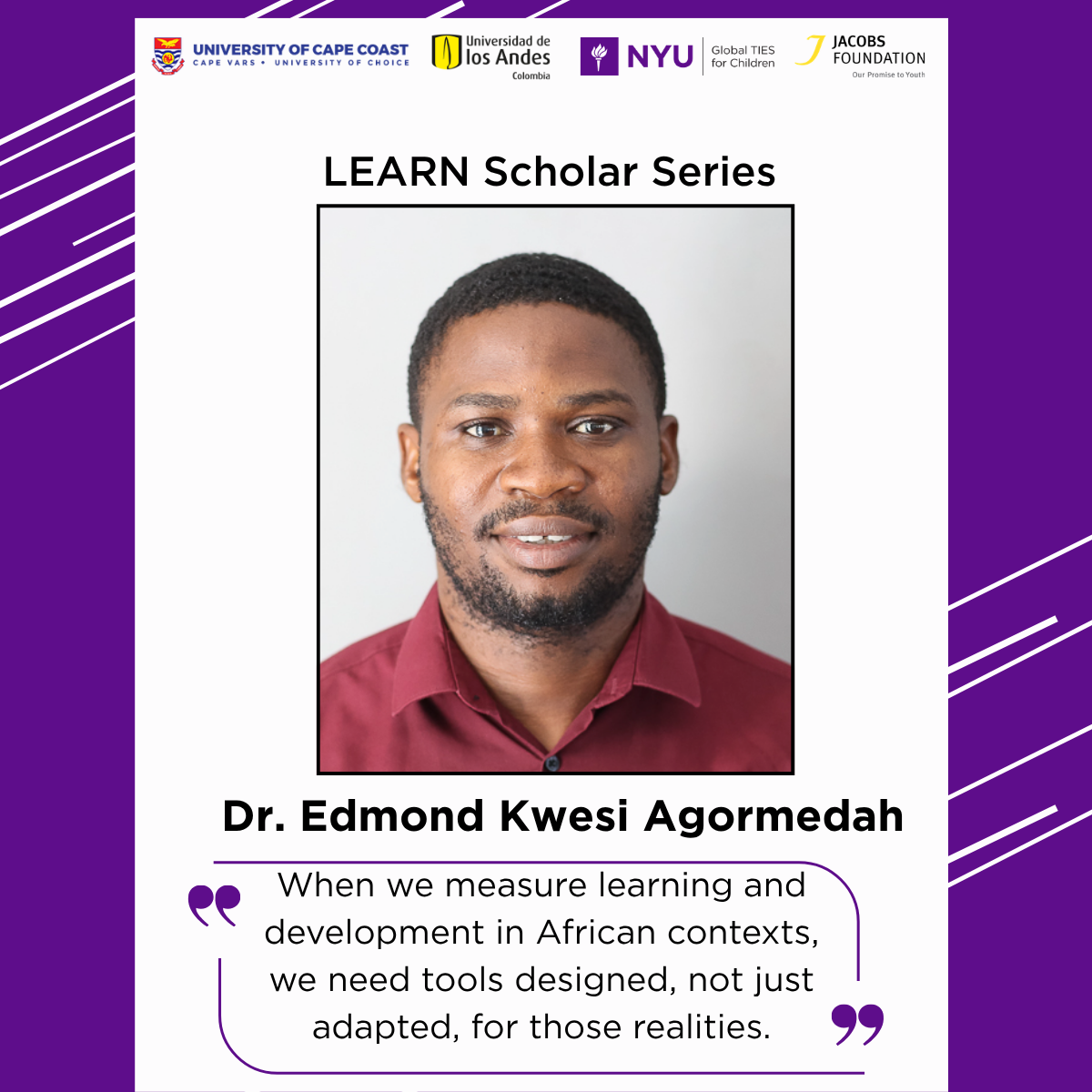
In this edition of our “Get to Know a LEARN Scholar” series, we feature Dr. Edmond K. Agormedah, a lecturer and research scientist at the University of Cape Coast in Ghana. Edmond’s journey into academia was not one he had always imagined. Growing up in a fishing-and-farming community, he initially planned to become a basic-school teacher. A conversation with a professor during his undergraduate studies, however, encouraged him to think differently about his path and about the role research could play in improving education.
Today, Edmond’s work asks questions about quality: How well do educational programs respond to what students need? Do curricula prepare young people with relevant skills? And what can we learn when students and faculty experience the same program differently? Drawing on his background in management education and curriculum studies, he uses these questions to identify gaps between curriculum, teaching, and the needs of learners and the labor market. His interests are now expanding into teacher professional identity, generative AI, early childhood education, and the development of measurement tools grounded in African contexts. In our conversation, Edmond reflects on this evolving research journey and his ambition to turn what we learn from students and teachers into better-designed educational programs.
Q: Hi Eddie! It’s nice to meet you.
A: Nice to meet you, too!
Q: Can you tell everyone what your role is?
A: I’m a faculty member and research scientist at the University of Cape Coast. My training is in Management Education (Ph.d.) and Curriculum and Teaching (M. Phil). I love teaching, but over time I’ve grown to love research even more. It's where I feel I can make the broadest contribution.
Q: That’s an interesting combination. What sparked your research interest?
A: I come from humble beginnings, in a community where fishing and farming were the expected path after secondary school. But I was drawn to teaching. I had originally planned to complete teacher training (which can be done without a university degree) and pursue a degree later, but I ended up going straight to university. In my final year, a professor spoke about our long-term career possibilities, and it clicked for me: I wanted to teach at the higher education level, engage in research, and influence how education is delivered to young people. Given my business background, management education became a natural place to bring those interests together.
Q: Wow, so it was a teacher who inspired you. I love that. How would you explain what you study to others and what excites you about it?
A: In a word: quality. I study the quality of management education which broadly includes understanding how curricula are designed and delivered, whether students gain the competencies they need, and whether programs match the demands of the labor market. I listen to students and faculty and ask: Does the program actually deliver what it promises? Transforming those insights into reforms is what keeps me motivated. Unfortunately, students, faculty, and employers can all face the same challenge from different angles: misalignment. Students want relevant skills, faculty want to deliver meaningful learning, and employers want graduates who can contribute immediately, but those things are not always aligned. My work aims to close those gaps.
Q: Interesting. What are some ways you have worked to close those gaps?
A: Two things. First, I borrow quality frameworks from industry and apply them to education. In doing so, I want to treat programs more like products and students as customers with specific needs.
Second, I use mixed methods and multiple reporters to better understand the full picture of what’s happening. Surveys tell me one story while interviews tell me another. Similarly, faculty might report “moderate” student engagement, while students describe it as “low.”. These discrepancies can indicate where change should start.
Q: OK, let’s apply your framework to your own research -- if it were a product pitch, what would it be?
A: Think of it as a user-centered curriculum redesign engine. I collect real user data, i.e. what students actually experience in classrooms and what faculty actually face in delivering instruction, and transform those insights into clear, evidence-backed design recommendations. Then I deliver those recommendations directly to the people who can act on them: professors and students. My current focus is management education, but the model itself is scalable.
Q: Well, you know what they say. The user knows best. What projects are you excited about right now?
A: I’m excited about several lines of work focused on how teachers learn, adapt, and develop their professional identities in changing educational environments. One project examines how preservice teachers in Ghana use generative AI for lesson planning and how that shapes their content knowledge and pedagogical choices.
Another project I’m particularly excited about brings an idea from medical science — “sense of coherence” — into teacher education. We’re developing a new instrument to understand how preservice teachers interpret and manage stress during their teaching practicum. We’ve completed data collection and are now preparing the manuscript. What excites me about this work is the opportunity to introduce a new measurement tool that could help us better understand and support teachers as they enter the profession. When we measure learning and development in African contexts, we need tools designed, not just adapted, for those realities.
The study on preservice teachers’ use of AI was recently published as a book chapter with Springer. I also have two additional book chapters accepted through the World Education Research Association (WERA).
Q: Who would you love to collaborate with?
A: I am currently exploring early childhood education, classroom design, parental engagement, and the home–school relationships that support child development. I’m also eager to deepen my expertise in psychometrics and measurement development tailored to African contexts. Too often, we import instruments and make surface-level adaptations; I want us to design from the ground up so the tools genuinely fit. I’d especially like to collaborate with researchers who bring expertise in psychometrics and instrument development, as well as scholars working in early childhood education and family engagement in African contexts. I think bringing those areas of expertise together could help us develop measures that are both methodologically rigorous and genuinely grounded in the contexts where they will be used.
Q: What is the best way for others to reach you?
A: Through my University of Cape Coast email [edmond.agormedah@ucc.edu.gh] and other platforms linked below.
LinkedIn: https://www.linkedin.com/in/edmond-kwasi-agormedah-3a496a238/
Other Links :
UCC Web Directory: https://directory.ucc.edu.gh/p/edmond-kwesi-agormedah
Scopus Profile: https://www.scopus.com/authid/detail.uri?authorId=57562222100
Google Scholar Profile: https://scholar.google.com/citations?user=uB598U4AAAAJ&hl=e
ResearchGate Profile: https://www.researchgate.net/profile/Edmond-Agormedah
ORCiD: https://orcid.org/0000-0002-4630-3520
Web of Science/Publons Profile: https://www.webofscience.com/wos/op/publications/summary
Loop Frontier Profile: https://loop.frontiersin.org/people/1774476/overview
