

Dr. Maxwell Nyatsikor, Associate Professor and Researcher - University for Development Studies
Not Every Child Can Move to a Better School
For this installment of our "Get to Know a LEARN Scholar" series, we sat down with Prof. Maxwell Nyatsikor, an Associate Professor and researcher at the University for Development Studies in Tamale, Ghana. His work investigates why some children fall behind in school -- and what education systems can do about it.
Prof. Maxwell Nyatsikor didn't plan to become an education researcher. He applied to the university to study something else entirely. But when he was placed in an education program instead, something unexpected happened: he found his calling. Today, as an Associate Professor at the University for Development Studies in Tamale, he studies the gaps in learning outcomes between children in rural and urban schools and between children from different socioeconomic backgrounds. His research draws on national assessment data to understand which factors -- at the level of the child, the home, the school, and the community -- shape whether a child reaches even basic proficiency in reading and math. He is part of the LEARN program's network of researchers working to translate that evidence into meaningful change.
Q: Hi Maxwell! Can you tell us a little about yourself?
I am an educationist and a researcher at the University for Development Studies in Tamale, Ghana. I hold a PhD in Education from the University of Aberdeen, Scotland, UK. My research projects and interests focus on educational and achievement inequalities, inclusive education, and equity issues. I also teach education and quantitative research methods courses to both undergraduate and graduate students in Ghana.
Q: Let's start at the beginning. You've described your path into education as almost accidental. What happened?
A: When I went for my bachelor's degree, I had applied to a non-education program. But I was offered a seat in the Bachelor in Education program in Psychology instead. Education is a privilege, so I accepted -- even though at that point I didn't really know what to make of it. But just a few months in, during the first semester, I realized what a great thing had happened to me. The course's diverse theories, principles, and applications just sparked something. Once you start learning about developmental theories, you begin seeing them take shape in real life. I don't think I could have settled for any other program. That interest has only grown since then.
Q: You mention seeing those theories "take shape in real life." Did that start pulling you toward research as well as teaching?
My research grew out of wanting to understand what I was observing. I primarily investigate the factors at the child, home, school, and community levels that create and sustain achievement gaps among primary school children -- and then explore ways to reduce those disparities and promote equity. In Ghana, those gaps often reflect differences in school location, family resources, and the quality of the learning environment available to children. My interest deepened significantly during my PhD at the University of Aberdeen, where I was supported by the Research Project Award Scheme scholarship. That gave me the opportunity to analyze the 2013 wave of the Ghana National Education Assessment. I discovered important connections among child-, home-, and school-level variables that influence learners’ achievement. For example, I found that a larger percentage of pupils in rural locations failed to achieve even the minimum competency than did pupils in urban locations. We know that rural areas are likely to fall behind on such indicators, but children in rural areas fell below the minimum competency cut-point. This was an eye-opener for me. Thereafter, I invested in investigating what’s happening, where our efforts as a country are falling short, and this also excites me. I think this is a kind of public service as it contributes directly to the realization of the United Nations’ Sustainable Development Goal 4, which seeks to ensure inclusive and equitable quality education for all, including my country.
Q: If you were describing your research not as a study but as a solution you're building — something designed to change the situation — how would you frame it?
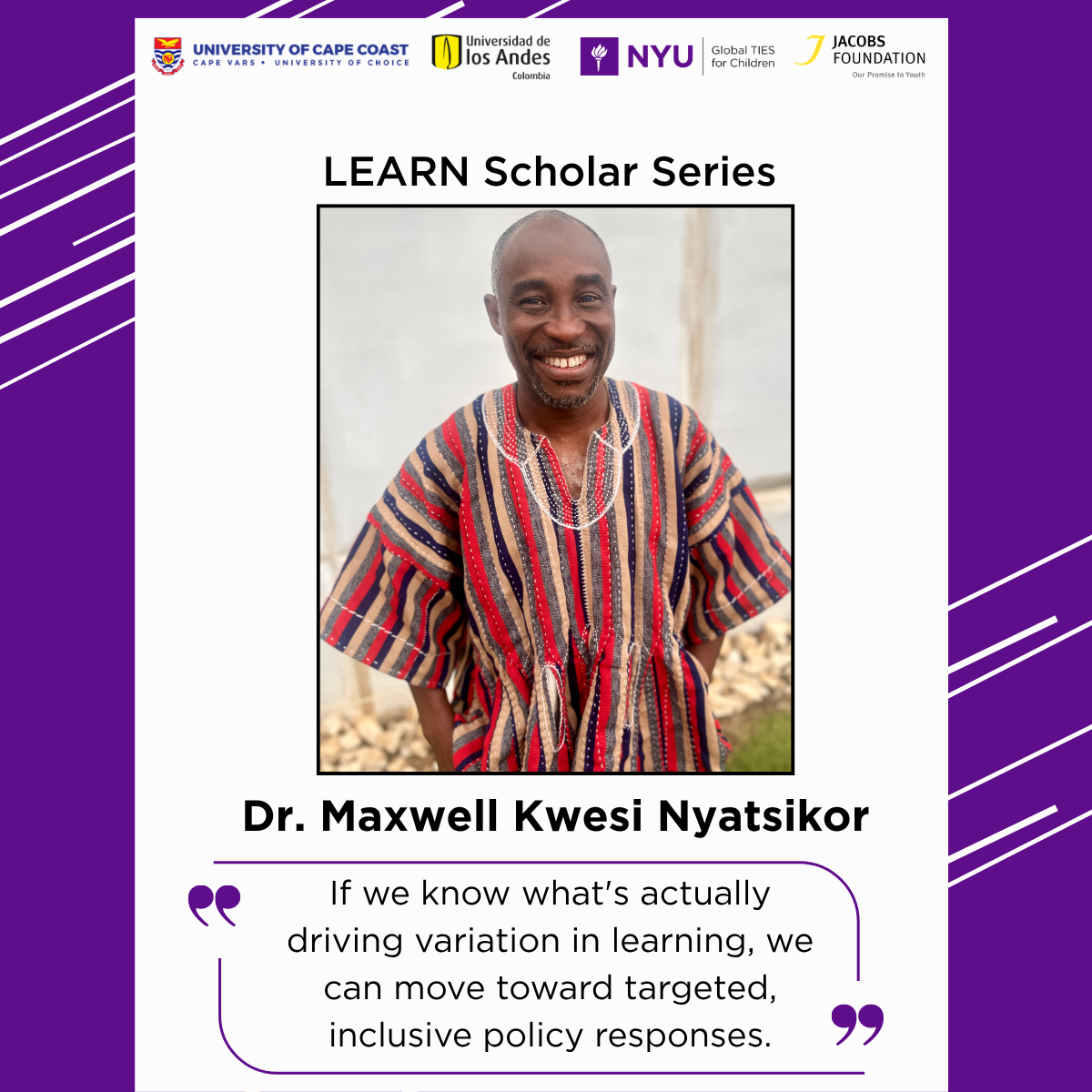
A: I'd say I'm building an evidence framework that helps us understand how different layers of a child's environment interact to shape learning outcomes. I analyze secondary achievement datasets to examine how factors at the home, school, and community levels affect learner proficiency. The theoretical lens I use is Bronfenbrenner's bioecological systems theory -- the idea that children don't develop in isolation but are shaped by the multiple contexts in which they live and grow. The primary beneficiaries of this work are lower and upper primary school children, especially those from disadvantaged backgrounds. The disparities aren't simply about individual effort or ability. They are shaped by structural conditions that children have no control over. If we know, through evidence, what's actually driving that variation, we can move toward targeted, inclusive policy responses. That's how I measure success -- by the extent to which this research contributes to national discussions and practical efforts toward equitable education in Ghana.
Q: That kind of structural work requires getting your hands on large datasets; I imagine that's not always easy in practice.
A: It's one of the biggest challenges I face. The bureaucratic procedures required to access some datasets can really slow research progress, and in some cases, data owners are simply reluctant to release their data. As a result, I sometimes have to work with smaller district or metropolitan datasets instead of large-scale national ones. It affects the scope of some studies, though it hasn't changed my overall research goals or methods. It's a frustrating constraint -- but it also makes the work feel more urgent.
Q: You clearly haven't let that frustration push you away from the work. Where do you find the motivation to keep going?
A: I draw a lot of it from personal experience. I have a niece who initially attended a primary school in a rural area -- my rural hometown, actually. She wasn't performing at her best. Later, she moved to an urban school, and within just one academic year, I watched a remarkable improvement in her literacy and numeracy skills. The new school had better teaching and learning conditions. That example is anecdotal, of course -- but it's a powerful reminder. Not every child can afford to move across socioeconomic contexts to access a better school. And in Ghana, education is widely seen as the great equalizer -- the thing that can genuinely change your future. Research supports that belief. So I always come back to that story, and remind myself that these disparities in educational opportunity need to be addressed. That keeps me invested.
Q: That story is striking precisely because you could see the difference a single school change made in real time. Has any of your published work captured something that surprised you in a similar way -- a finding that shifted how you think about the problem?
A: Yes -- I'm particularly excited about a recent publication titled "The Predictive Power of English Language and Mathematics: Which Better Explains the Other's Achievement in a National Education Assessment in Ghana?", published in the African Journal of Research in Mathematics, Science and Technology Education. The study found that proficiency in mathematics has a stronger influence on English language achievement than the reverse. That challenges a common assumption -- that mathematics performance is primarily dependent on English proficiency. It opens up new questions about how math proficiency might shape language skills across different contexts. I'd really encourage anyone whose work intersects with this to read it and reach out if it resonates.
Q: Given how interconnected those findings are across subjects and contexts, it sounds like your next steps involve bringing more people in. What does collaboration look like for you?
A: I hope to work with both international and national educational agencies, directorates, and NGOs -- whether as a research team member or as a consultant -- to support efforts focused on reducing inequalities in children's education and achievement. Those partnerships can improve data accessibility, and they can make research findings more visible and more relevant to policy. I genuinely believe collaboration is essential for translating research into meaningful change, especially in contexts where educational disparities are deeply rooted. I welcome connections with researchers, NGOs, and national and international organizations who share those goals.
You can write to me at this email address: mnyatsikor@uds.edu.gh/ connect with me on linkedin here:linkedin.com/in/maxwell-nyatsikor-512b521a8
