

Dr. Salome Amissah-Essel, Senior Lecturer - University of Cape Coast
From Motherhood to Research: Linking Health and Learning in Early Childhood Settings
In this installment of our “Get to Know a LEARN Scholar” series, we feature Dr. Salome Amissah-Essel, a Senior Lecturer at the University of Cape Coast, Ghana, whose work sits at the intersection of early childhood education and health.
Drawing from both her professional training in maternal and child health and her personal experience as a mother, Salome’s research explores how early learning environments shape children’s socio-emotional development. In the conversation that follows, she reflects on how everyday questions about safety, care, and well-being in preschool settings evolved into a research agenda focused on understanding how health, environment, and learning are deeply interconnected, especially in the Ghanaian context.
Q: To begin, could you tell us a bit about who you are and what your work focuses on today?
A: My name is Salome Amissah-Essel, and I am a Senior Lecturer at the University of Cape Coast in Ghana. I hold a PhD in Health Promotion with a specialization in Maternal and Child Health.
My work broadly focuses on health issues affecting mothers and children, but I am particularly interested in health and safety within early childhood school settings. Over time, my research has come to center on how these early environments shape children’s overall development, including social and emotional development, especially during the preschool years, when physical health, safety, and learning are closely interconnected.
Q: You are absolutely right in terms of preschool years being critical from a health, safety, learning and development perspective. I’m curious to know how you got into this. Was there a particular moment or experience that shaped your interest in early childhood education and health?
A: Hmm, in some ways, my journey into education felt more like fate or a plan. My father strongly encouraged all of his children to become educators because he believed it offered stability and a meaningful way to contribute to society. In Ghana, it is considered very noble to be a teacher. So growing up, I always knew I would end up in the education field, and over time, I came to appreciate the opportunity it gave me to support and facilitate learning for both myself and others.
But my deeper interest in early childhood education and health really took shape later, when I became a mother. After struggling to have a child, I found myself asking very practical but important questions when it was time to choose a preschool for my daughter: Which school would keep her safe? Which environment would support her overall development? How are young children actually cared for in these settings?
Those questions were very important to me personally, but as a researcher, they also shifted my perspective from seeing education as simply teaching and learning to thinking more carefully about the environments children grow up in, and how health, safety, and care are deeply connected to their development. That motherly instinct, and the need to ensure an optimal environment for a child, continues to shape the kinds of questions I ask in my research today.
Q: That’s a powerful shift. How did those personal questions evolve into your research focus today?
A: Like I said, those questions really stayed with me, and over time, they became the foundation of my research. I became curious about the kinds of environments young children are exposed to, especially in preschool settings. I became particularly interested in how early childhood school environments influence children’s health, safety, and overall development.
Now, what are the different aspects of the environment, one may ask? These include the physical space, hygiene, nutrition, and caregiving practices that come together in different settings, and how they shape children’s experiences in ways we don’t always immediately see.
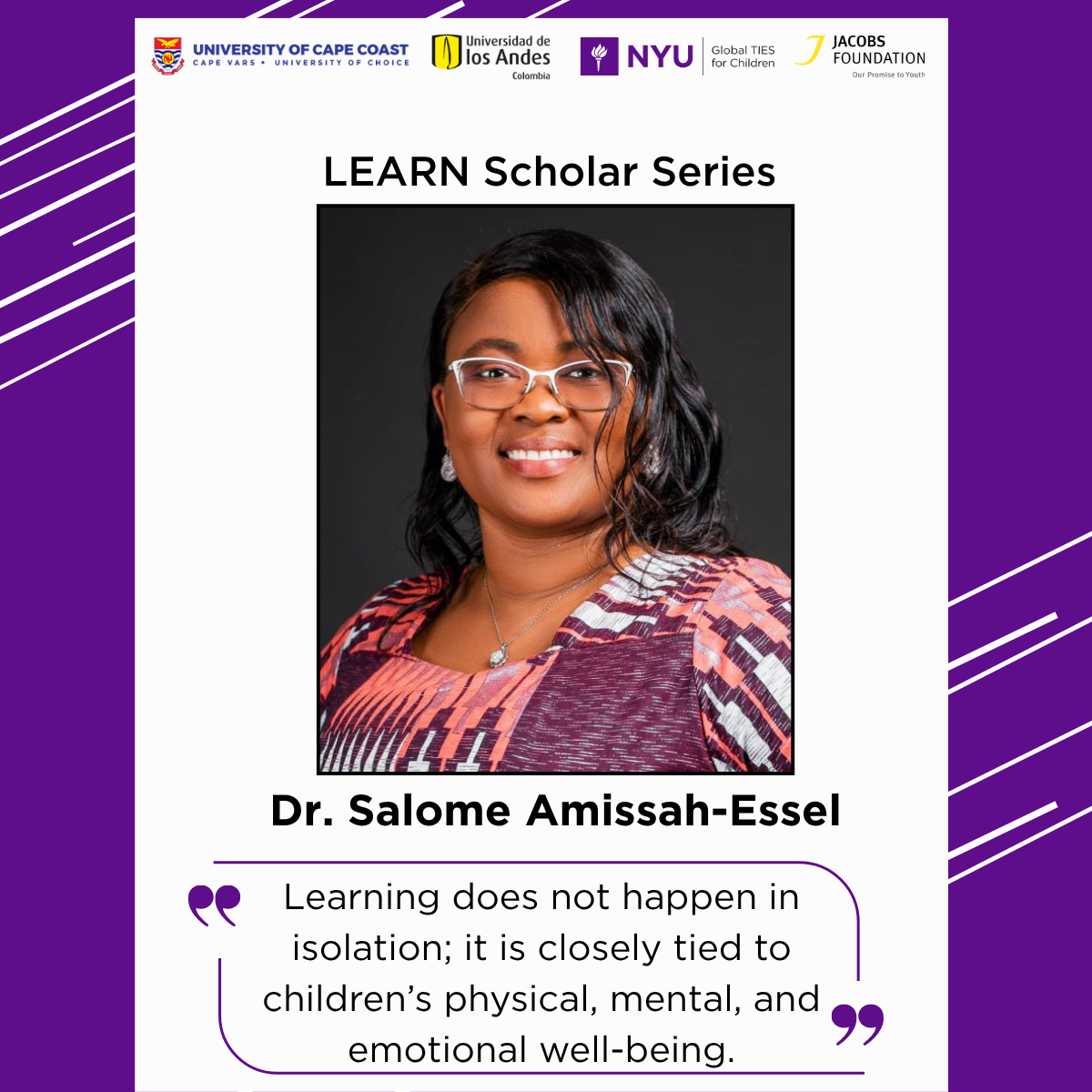
Over time, I began to see that learning does not happen in isolation; it is closely tied to children’s physical, mental, and emotional well-being, which are in turn shaped by the environments they spend time in. So my work now tries to understand these connections more systematically, especially within the context of preschool settings in Ghana.
Q: We would like to know more about your research. What exactly are you studying, and why does this work matter?
A: At a high level, my research focuses on socio-emotional learning in early childhood, particularly in the context of health risks within preschool settings. I am interested in understanding how and why children differ in their socio-emotional development, and what factors might explain those differences.
More specifically, I examine child-level factors such as age and gender, alongside home and school environments, including children’s exposure to health risks. In early childhood, physical health, nutrition, and environmental conditions are closely connected to how children learn and develop.
This work matters because preschool environments can expose children to health and safety risks that are not always immediately visible but can have lasting effects on their development. My research aims to inform teaching practices by supporting teachers in creating positive emotional climates in classrooms, while also helping caregivers better understand how to support children’s development at home.
It also contributes to policy by providing evidence on how early childhood environments can be designed to better support children’s health, safety, and overall development.
Q: If you think about your work in practice, what does it help us understand or do differently in early childhood settings?
A: One of the key things my work highlights is that we cannot think about learning separately from children’s health and everyday environments. It encourages a holistic way of understanding development, where what happens in the classroom, at home, and in the physical environment are all seen as interconnected. In practical terms, this means paying closer attention to the conditions in which children are learning.
In practical terms, this means paying closer attention to the conditions in which children are learning. For schools, it means prioritizing safety, hygiene, and nutrition at the design level, ensuring that early learning environments support children’s well-being as much as their learning. For teachers, it means creating classroom environments that are not only instructionally effective, but also emotionally supportive and responsive to children’s needs. For caregivers, it highlights the importance of everyday practices at home, including how children are cared for, supported, and nourished in their daily routines.
Overall, my work encourages educators, caregivers, and policymakers to see early childhood development as a shared responsibility, and to design environments that support the whole child rather than focusing on learning outcomes alone.
Q: I love that! Prioritizing the support for a whole child instead of learning outcomes alone. So, looking ahead, what kinds of collaborations or partnerships would help move this work forward?
A: Thank you, and to clarify, I don’t mean to say that learning outcomes aren’t important. They very much are, but there’s also other aspects, which if systematically addressed, would improve prospects for children exponentially, including their abilities to read and write, and do math.
In terms of collaborations, I would really like to be connected with researchers in health and child development, with a focus on early childhood school settings. This is an area where interdisciplinary work is especially important, as understanding children’s development requires looking at both education and health together.
Working with others who bring different perspectives and expertise would help strengthen the design and impact of this research, especially in contexts like Ghana, where there is still much to be explored in terms of how early environments shape children’s learning and well-being.
