

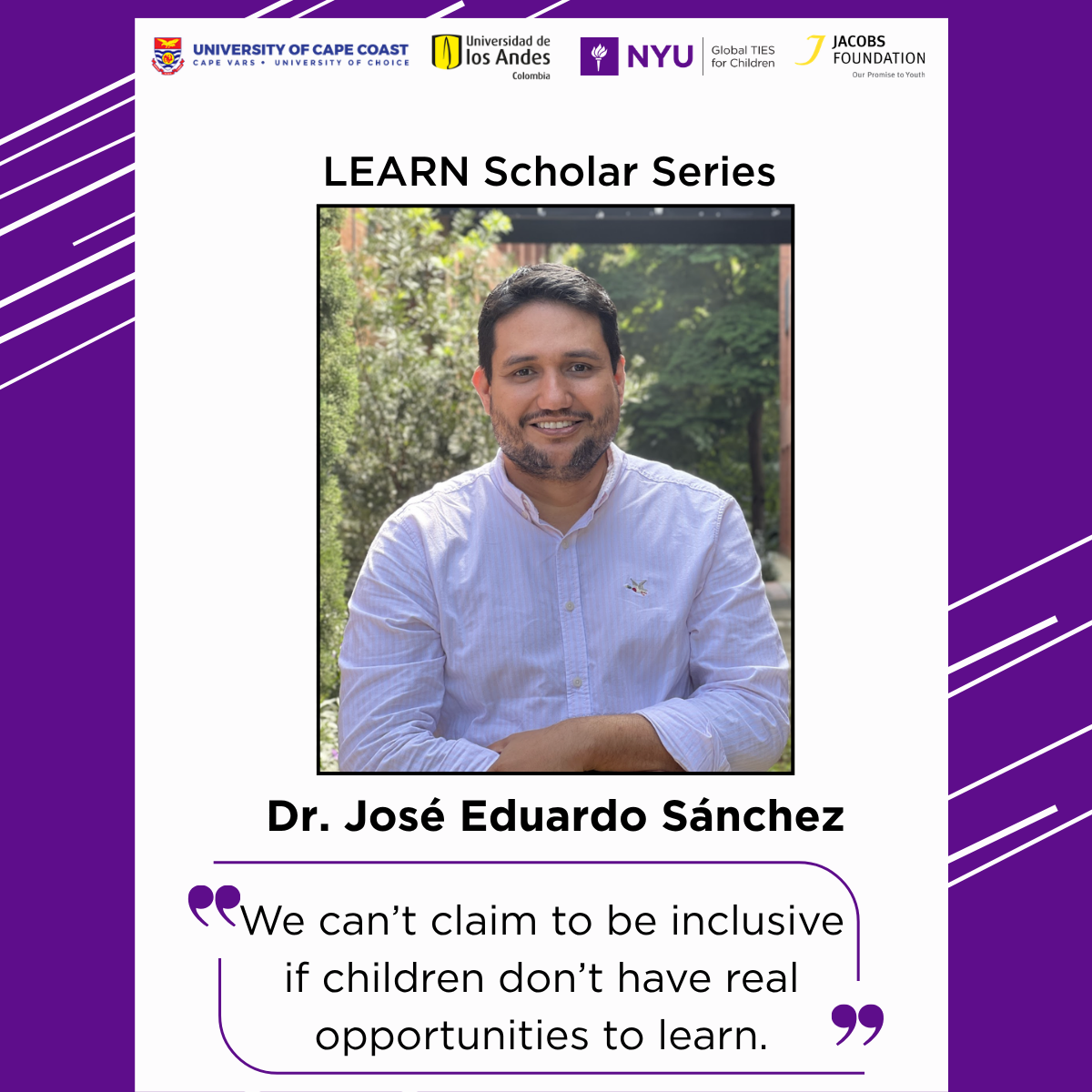
Dr. José Eduardo Sánchez, Director - School of Psychology, ICESI University
Beliefs Matter: Rethinking Inclusion and Learning in Early Childhood
In this edition of our “Get to Know a LEARN Scholar” series, we feature Dr. José Eduardo Sánchez, Director of the School of Psychology, Intervention, and Behavior at ICESI University in Cali, Colombia. José’s work sits at the intersection of psychology, education, and social inclusion, with a particular focus on how teachers’ beliefs shape children’s opportunities to learn. Drawing on perspectives from both sociology and psychology, he studies how early educational experiences, classroom interactions, and institutional conditions influence learning and development, especially in contexts marked by inequality.
In the conversation that follows, José reflects on the mentors and experiences that shaped his thinking, why inclusion and educational quality cannot be separated, and how schools can become spaces where diversity is recognized as a strength rather than a deficit. At the heart of his work is a simple but important question: how can education systems create conditions in which all children have genuine opportunities to thrive?
Q: Your work brings together psychology, sociology, and education. How did that path take shape for you?
A. My path into psychology wasn’t a straight line. I actually started out studying sociology, and that experience changed how I see the world. It taught me that you can’t really understand people without also understanding the communities, institutions, and social conditions around them.
Along the way, I came across a way of thinking in psychology, especially the work of Vygotsky, and that really clicked for me. It helped me see that learning doesn’t happen in isolation. It happens through relationships, language, and everyday interactions. Suddenly, things that are often treated as separate--like psychology and education, or individual growth and society--felt deeply connected.
From there, my interests naturally moved toward education as the place where all of this comes together.That’s what led me to focus on early childhood and the transition into school, where learning, language, and relationships first take root.
Q: That emphasis on relationships and learning seems to run through your work. Were there people who shaped that way of thinking early on?
A: Definitely. My undergraduate and graduate mentor, Professor María Cristina Tenorio, had a huge influence on me. She approached research as something deeply reciprocal -- we weren’t just studying others, we were learning from and with them.
She valued horizontal relationships while still being clear about responsibility and rigor. Learning, in her view, was a collective effort, not just the transfer of knowledge. Being part of her research group felt like belonging to a real learning community, and that experience continues to shape how I work with colleagues, teachers, and students today.
Q. Those ideas about collaboration and learning show up clearly in your current research. What drew you to focus on rural areas near Cali?
A: What I see, both locally and globally, is that inequality remains deeply entrenched. When we talk about diversity of language, race, gender, disability, or socioeconomic background, it is still too often framed as a challenge or a deficit, rather than as something valuable.
In Colombia, this is especially visible in the education system. Public schools largely serve the most vulnerable populations, while families with more resources can access a private education. In rural areas near Cali, these gaps are often even wider. Teachers are deeply committed, but inclusion depends on more than individual effort; it requires institutional support and conditions that allow teachers to do their work well.
Q: When you talk about inclusion, you also emphasize educational quality. How do those ideas connect in your research?
A: For me, inclusion and quality can’t be separated. We can’t claim to be inclusive if children don’t have real opportunities to learn. That’s why our research focuses on early childhood, where so much of this foundation is built.
We look at how early educational experiences, and especially children’s interactions and engagement with adults around them, support the development of executive functions, emotional skills, and language. Teachers’ beliefs play a major role here. In many Global South contexts, academic learning and emotional development need to be strengthened together. Emotional well-being is not an “extra”; it’s central to learning and self-regulation. As an example, I want to share a story that stayed with me. It is about an eight-year-old boy in a rural primary school in Palmira, Colombia, who was widely seen as both aggressive and academically weak. Through a 5D-based intervention, he was given opportunities to demonstrate forms of knowledge that were not typically recognized in the classroom. As his teachers and peers began to see his strengths differently, their interactions with him changed as well. Over time, this opened up new possibilities for participation and learning. For me, this experience illustrates how deeply our beliefs shape the opportunities children are given to grow and succeed.
Q: Looking ahead, where do you see your work going next?
A: One direction I’m excited about is developing a tool that can help schools and researchers better describe educational models and assess how inclusive they really are. This could support decision-making at the school level and also strengthen research more broadly. I hope this work can contribute to a shift in how schooling is understood, not just as a place where knowledge is delivered, but as a space where more just and inclusive societies begin to take shape.
I’m also very interested in collaborating with government agencies, NGOs, and multilateral organizations to connect research more directly to policy. And I see a lot of value in working more closely with quantitative researchers to complement qualitative insights and strengthen the evidence base.
Q: Finally, what keeps you personally invested in this work, beyond the research outcomes?
A: The level of exhaustion among teachers is very hard to ignore. Many are working under extremely challenging institutional, material, and social conditions, especially in areas affected by violence. As a researcher, I see my role as supporting their work: helping make visible what teachers already do, strengthening their impact, and contributing to more inclusive communities over time.
At the end of the day, it’s about children having access to the resources they need to build meaningful lives—especially in the earliest years. I also care deeply about teachers and the role they play in society, even though their work is often undervalued.
