

Strengthening Early Learning, Together with Teachers
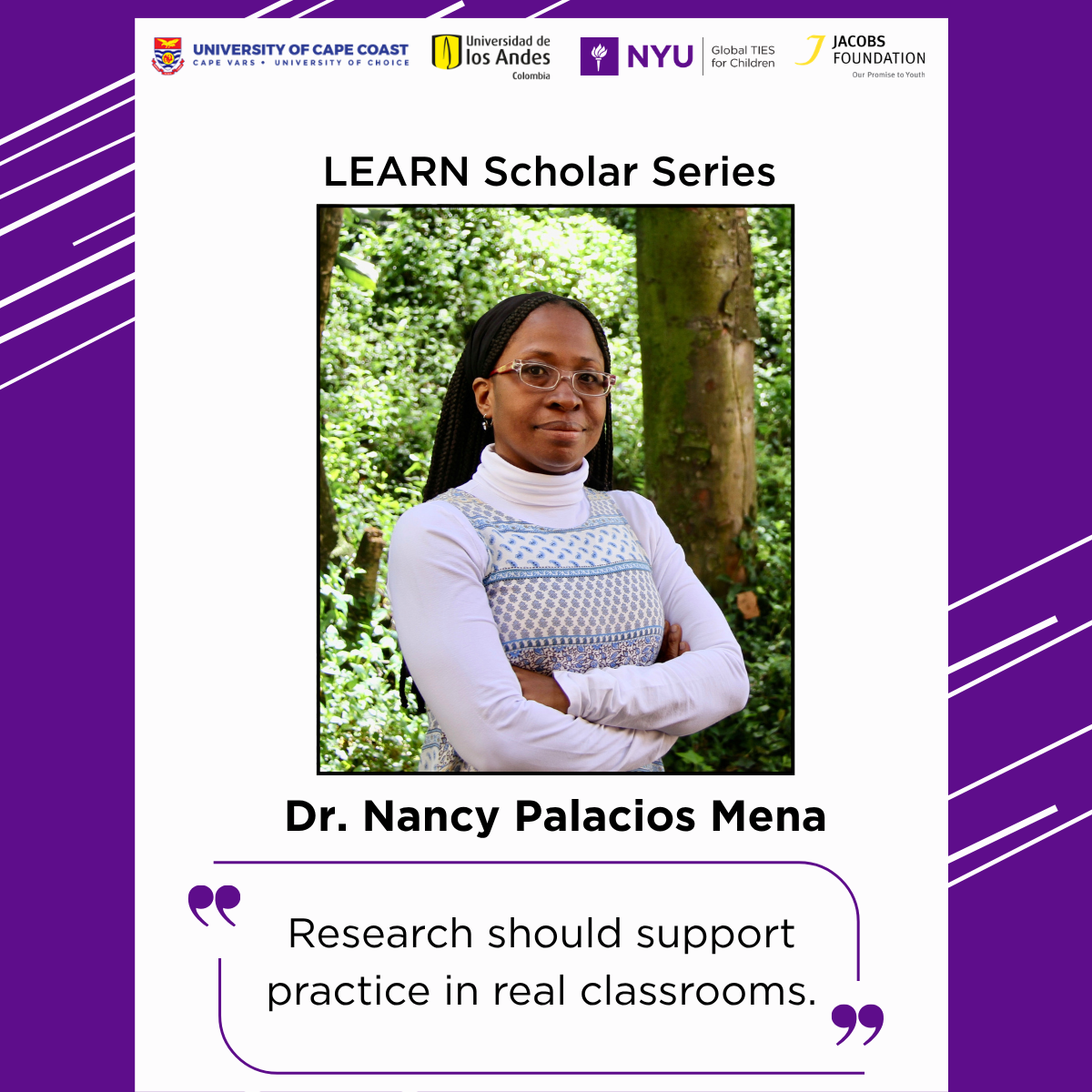
In this edition of our “Get to Know a LEARN Scholar” series, we feature Dr. Nancy Palacios, an Associate Professor at the Faculty of Education of Universidad de los Andes in Bogota, Colombia. When you talk with Nancy, you immediately notice not only her curiosity but also her generosity in sharing everything she has learned along the way. She has spent most of her life inside classrooms, and throughout our conversation, one thing became very clear: she truly believes in the power of good education.
Nancy trains future teachers and conducts research in early education, with a particular focus on preschool and kindergarten. We sat down with Nancy to talk about her path, her research, and why five-year-olds deserve much more credit than they usually get.
Q: Nancy, it’s a pleasure to get to know you. Could you tell us a bit about what you do?
A: It is great to talk to you! Thank you for the opportunity to share my journey. I began my career as a teacher, and I still see myself as one. I have taught at multiple levels, including primary, secondary, and kindergarten, and in very different contexts. Early on, I worked in a rural region with Colombia’s Ministry of Education. Today, I teach future teachers at the undergraduate level at the Universidad de los Andes and pursue research focused on how teachers’ beliefs shape children’s educational experiences. My goal is to build evidence on what quality kindergarten education does for children’s later academic success.
Q: That is pertinent to improving education in any country! Looking back, was there a specific moment in your life that sparked your interest in education and research?
A: Yes! My master’s degree in sociology really shaped my trajectory. I studied how adolescents relate to school and how family and context shape their attitudes and expectations. At the time, I was working with students in a region affected by drug trafficking. Many of them had low expectations for their education and their future, which increased their vulnerability to becoming involved in illegal activities themselves.
That experience led me to focus my thesis on conflict and the socialization of students in classrooms, and more broadly on adolescents’ subjective experiences of school. I began studying how students experience school and how those experiences shape their sense of possibility. At the same time, I saw how powerful teachers could be in those environments. A teacher’s expectations, encouragement, and daily interactions could shift how a student saw their future. That realization changed how I thought about education and eventually led me to focus my research on teachers’ beliefs and classroom practice.
Q: Teachers do play a central role. I would like to know more about your research agenda in terms of what it includes and what the main challenges it addresses are.
A: Today, my work focuses primarily on kindergarten, particularly with five-year-olds. I am interested in generating contextually relevant evidence about what quality early education looks like in Colombia. I ask questions such as: What happens when children receive strong early education? What skills and capacities develop? How do context and school quality interact to shape educational trajectories?
We know early childhood is a critical period for development, but many questions remain about how teaching quality, context, and children’s experiences interact. I want to generate evidence that speaks directly to these realities. Just as importantly, I want teachers to be part of the research process from the beginning. Too often, research findings reach teachers only at the end. I believe collaboration with teachers is essential if research is going to improve classroom practice.
Q: If you think about your research as building something, what are you working toward?
A: I see my work as building tools and partnerships. First, I aim to develop or adapt and validate assessment tools that measure key preschool skills. One area I am especially invested in is incorporating constructs such as historical and spatial thinking, which in Colombia are typically addressed only in primary school. I believe these areas deserve attention earlier.
This means designing or adapting instruments sensitive enough to capture the quality of teaching and learning across Colombia’s diverse regions. Establishing their validity and reliability in our context is critical. If successful, these tools could provide meaningful national data while still respecting regional differences.
Second, I want to use that evidence to collaborate directly with preschool teachers to strengthen practice. The goal is not simply to measure teaching but to use that information to improve classroom practices.
Q: What has surprised you most through this work, and is there a recent achievement that reflects that journey?
A: What has surprised me most is children’s capacity to learn when they are given the right support. Seeing how much children improve when they receive a good education is one of the most rewarding parts of my work. I’ve also observed that when teachers are genuinely committed and open to adopting new methodologies and practices, children’s learning outcomes improve significantly. That dedication makes a real difference.
One milestone that reflects this journey is the publication of my first book chapter in January 2026. The book examines transitions between preschool and primary school across different countries and continents, and I contributed a chapter focused on Colombia. In it, I analyze public policy and academic research related to school transitions in the Colombian context. This work connects closely to my broader interest in how educational systems can better support children during critical stages of their development.
Q: Looking ahead, who do you hope to collaborate with, and how do you like to share your work?
A: Looking ahead, I would love to connect with researchers who focus on preschool education, particularly those working in areas such as reading, writing, and social studies. I’m especially interested in collaborating with colleagues in Colombia, but I’m also open to building partnerships with researchers in other countries. I believe that exchanging ideas across contexts can strengthen how we understand early childhood education and improve practice more broadly.
I also care deeply about how research is shared. Academic publications matter, but I am especially committed to writing reports that teachers can easily read and use. Research should support practice in real classrooms.
Ultimately, I hope my work contributes to stronger early learning experiences for children and reinforces the central role teachers play in shaping how children see themselves as learners. That is what continues to motivate me.
