

A Global Learning Crisis Meets a Shrinking Aid Budget. Here’s How to Make Every Dollar Count

Written by Florencia Lopez Boo
Photo: New York City welcomes world leaders this week for the UN General Assembly, where heads of state and government will address pressing global challenges.
An NYU analysis of the newly released PISA 2025 confirms that Latin America's learning crisis is deepening. Across the 13 participating countries, three in four 15-year-olds (76%) do not reach basic proficiency in mathematics, and more than half fall below the minimum in reading (59%) and science (57%), compared with roughly one in three across the OECD. Reading and math scores have declined not only since the pandemic but throughout the 2015–2025 decade in the eight LAC countries with comparable data.
These trends reveal serious shortcomings in current educational approaches, coinciding with a period of unprecedented financial constraints in addressing them.
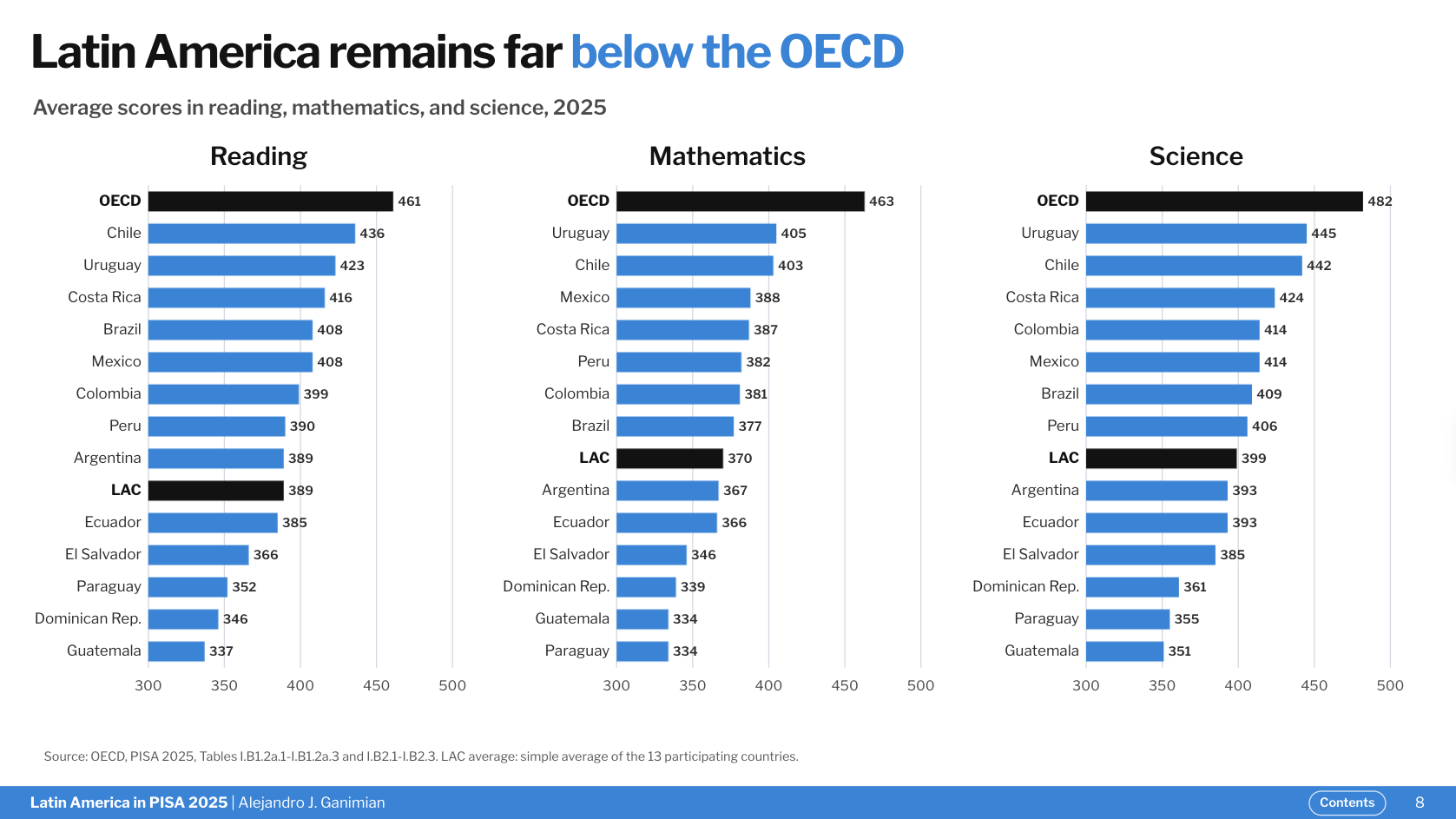
Bar charts comparing PISA 2025 average scores in reading, mathematics, and science for 13 Latin American countries, the LAC average, and the OECD average.
On top of this learning crisis, just over a year ago, the U.S. government announced plans to significantly reduce USAID, denoting a major shift in global development priorities. This move was soon followed by the United Kingdom’s decision to decrease official development assistance from 0.5% to 0.3% of gross national income (GNI), representing a 40% reduction from previous commitments. Researchers caution that sustained aid reductions could have serious consequences for children worldwide, mainly by weakening health, nutrition, and child protection systems. It is estimated that 4.5 million children under five could lose their lives by 2030 across 93 low- and middle-income countries if these trends continue.
US and UK aid cuts make up part of a broader donor retreat. In 2024, the OECD recorded the largest single-year decline in official development assistance in decades. For a sector used to steady growth, this constitutes a fundamental shift, forcing authorities and institutions to triage resources. The key question is no longer "how much aid exists?" but "how effectively is it being used?”
More Money Doesn't Always Mean Better Outcomes
Over a decade ago, Colombia transitioned from community-based childcare to larger institutional centers, each costing $1 million and increasing annual per-child costs to $1,500. A randomized controlled trial evaluation demonstrated that child outcomes were no better—and in some cases worse—than those achieved by the community-based homes. This case illustrates a wider lesson in international development: increased spending does not necessarily yield greater impact. Across the sector, considerable investments in large-scale programs have often produced only modest results.
In contrast, some of the most meaningful improvements in children’s lives have come from smaller, leaner, more rigorously tested interventions. In Colombia again, a 440 US dollars (USD) per child per year program (the community-based homes) yielded significantly better results for children, a reminder that in child development, more spending doesn't always mean more impact.
The difference between these two outcomes is almost never luck. More often, it comes down to whether programs are designed and adapted using credible, reliable evidence about what actually works, and whether results come from rigorous (often randomized) evaluations.
For children and families reliant on international assistance, abrupt funding cuts from multiple donors compel authorities and agencies to decide which programs to rank, adapt, or eliminate while trying to preserve prior accomplishments. Without clear evidence, such decisions risk being shaped by politics or convenience rather than demonstrable impact.
How Benefit-Cost Ratios Guide Smarter Investments
As in the private sector, governments should direct limited resources toward programs with the highest returns. Benefit-cost ratios (BCRs) offer a rigorous way to do this: when monetized benefits — ideally measured via randomized controlled trials — exceed costs, the ratio exceeds 1, and the program merits investment. A recent analysis presented at the World Bank-IMF Spring Meetings and UNGA event this week found BCRs for early childhood interventions ranging widely across cash transfers, preschool, childcare, and hybrid parenting interventions — a striking spread that has real consequences for how every dollar should be allocated.
The Cheapest Lever: Evidence Without a Price Tag
One of the findings of PISA 2025 is the real need for an evidence-based focus on technology use in classrooms: intensive use is already associated with lower science scores across the region. This finding aligns with a growing body of research on phone-restriction policies, which are a highly scalable, almost cost-free intervention for governments.
For instance, seven Argentine jurisdictions, beginning with the City of Buenos Aires in August 2024, have implemented regulations on classroom phone use. Despite these measures, 94% of secondary students in Buenos Aires still bring phones to school daily, with only 20% using them for academic purposes. A 2025 study of Colombian secondary students, as I wrote recently in the newspaper PERFIL, found that over one-third of high school students spend more than four hours daily on social media, with intensive use associated with depression symptoms in 39% and anxiety symptoms in 24% of students.
Meta’s recent $17.1 billion settlement with U.S. state attorneys general, following allegations of intentionally designing addictive features and concealing internal research on harm to teenagers, has reframed the issue as a product-design problem rather than one of individual willpower. Early evidence from large-scale school phone-ban implementations indicates measurable advances in student wellbeing and mental health, even when effects on test scores are less marked or slower to emerge in the US; in Brazil, these restrictions did improve test scores. This indicates that cost-effective, evidence-based policies can achieve outcomes that increased spending alone may not.
Research Centers as Neutral Ground in a Political Context
Research centers such as Global TIES for Children intentionally operate independently of partisan cycles, supporting policymakers, funders, and program implementers in making defensible decisions under budget limitations. These centers ground their recommendations in evidence regarding interventions that improve the lives of children and caregivers in a cost-effective manner, with particular attention to those facing intersecting risks from poverty, conflict, and climate-related stress.
As the international aid environment changes, the stakes for children remain exceptionally high. Funding decisions will determine opportunities for millions of children both now and in the future. However, there is reason for optimism: the most transformative programs are not necessarily the most costly. In this context, evidence functions not as a luxury or a purely academic activity, but as essential decision-making infrastructure.
The central question for the global community is not whether research-driven guidance for children confronting hardship is affordable, but whether it is feasible to continue without such guidance.