

By Kate Schwartz and Hirokazu Yoshikawa
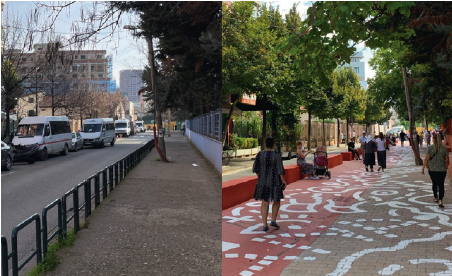
A before-and-after montage illustrates the urban transformations resulting from the implementation of the Tirana School Street model.
School streets—interventions that transform the congested, car-dominated zones surrounding schools into pedestrian-friendly community spaces—have become one of the most widespread innovations in the child-friendly cities movement. Yet despite their global adoption, not a single rigorous causal impact evaluation has been conducted anywhere in the world.
This research gap has real consequences. Municipal leaders considering investments in street redesign lack empirical evidence that these interventions work; researchers studying child development and urban health lack data on the mechanisms of impact; and advocates for sustainable cities lack the evidence base needed to shift policy at scale.
This is beginning to change in Tirana, Albania.
A Global First in Urban Research
In partnership with Epoka University and Qendra Marrëdhënie, the Albanian NGO that pioneered the implementation of school streets in Tirana, NYU Global TIES for Children has launched the first-ever causal impact evaluation of a school streets initiative. The evaluation builds on 12 successful pilot sites implemented since 2021 and a currently in-progress expansion to 38 additional schools across the city, creating a unique opportunity to assess the impact of these interventions.
The school streets model is straightforward in concept: widen sidewalks, add green space, remove a parking lane, lower speed limits, and install traffic-calming measures. The goal is equally clear: reduce air and noise pollution while creating safe, social spaces where children and families thrive. But what actually changes when you implement this? How do families respond? Does it improve children's well-being and school engagement?
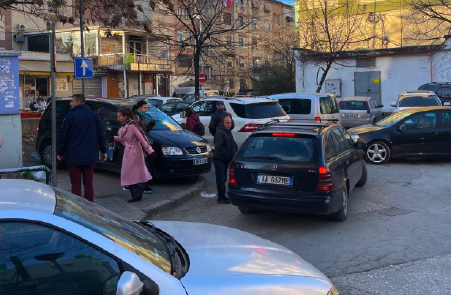
Prior to intervention, the areas outside schools were often characterized by disorder and elevated stress levels.
Research Design: Rigor Meets Lived Experience
The evaluation employs a quasi-experimental design, comparing schools receiving school-street interventions with matched comparison schools. Baseline data collection began in Fall 2025, before any interventions were implemented. Endline data will be collected in Spring 2027, after half of the new school streets will have finished construction (and before the other half are started).
What distinguishes this research is not just methodological rigor, but an integrated approach to understanding impact. The team is measuring:
Child well-being and behavior: Children's moods, stress levels, sense of safety, and how they commute to school.
Family practices and experiences: Drop-off and pick-up patterns, caregiver stress, social connections among families.
School engagement: Teacher reports of student behavior and classroom engagement.
Community activation and broader environmental impacts: Pedestrian activity, social interaction, public space use, traffic congestion, and air quality.
The evaluation combines quantitative surveys with qualitative data collection. Notably, at endline, children will create visual renderings of the spaces outside their schools and discuss these with researchers, capturing the lived experience on the school streets in children's own terms.
This integrated methodology reflects lessons from Global TIES for Children’s 12 years of rigorous experimental research on child development programs conducted by team members in the United States, Chile, Lebanon, Jordan, Bangladesh, and Colombia. The approach asks not just whether school streets work, but how and for whom they work.
What We Learned from Pilot Testing
In Spring 2025, the research team piloted data collection procedures with first- and third-grade students and their families across Tirana schools that had previously received school streets interventions. This pilot work was essential for understanding how to collect valid data from young children and for refining protocols before the full evaluation.
Most critically, we wanted to know if our youngest primary school students, the first graders, could engage in this type of data collection in a way that produced reliable data. We found that they could — indeed, many of the data collectors felt that their responses were more sincere and spontaneous than the 3rd graders, but also less structured and less straightforward — but also that we needed to change the wording of many specific questions/prompts to help them better understand what was being asked.
Specifically, post this pilot, we adapted our wording to avoid more vague, abstract words such as ‘irritated’ or ‘frustrated’ with simpler, concrete ones and streamlined the emotion questions, as some questions that felt qualitatively different to the research team felt redundant to the students.
Designing Evidence for Change
For urban researchers and practitioners alike, this evaluation arrives at a critical moment. Cities worldwide are pursuing Sustainable Development Goal 11 (sustainable cities and communities) while grappling with traffic congestion, air pollution, social isolation, and declining rates of active transportation. School streets offer a potentially elegant solution—but without causal evidence, they remain conceptual rather than actionable.
If successful, this research will demonstrate whether physical interventions can meaningfully shift family behavior, reduce stress, improve well-being, and enhance school engagement. The findings will provide an evidence base for policy decisions affecting millions of children.
Even if results are more modest than hoped, this research will clarify the mechanisms through which urban design influences child development and family life, informing the next generation of evidence-based city planning.
School streets represent more than street infrastructure. They embody a choice about whose needs matter in cities. This research is designed to answer a fundamental question: When cities are reimagined from a child's perspective, do children thrive? The evidence from Tirana will help shape the answer.
Learn more: Global TIES for Children School Streets Study