

Resources

Now more than ever: Strengthening systems for social and emotional skills and well-being assessment during the COVID-19 pandemic in Lebanon and Peru
In many countries, the outbreak of COVID-19 compounded crises vulnerable populations are facing. Children are among the most vulnerable, due to the potential for adverse impacts on emerging neurobiological, cognitive, social, emotional, and physiological developmental systems. That is why now more than ever, coherent, timely, and cost-effective policy responses are needed to support children’s remarkable capacities for resilience. But the ability to develop meaningful policy responses is predicated upon education systems’ own capacities for rapidly generating and using evidence on how children, caregivers, teachers, and principals are doing and what they are experiencing. In this brief, we share efforts NYU-TIES has taken in collaboration with government agencies in Lebanon and Peru and with non-governmental organizations (NGOs) in Lebanon to strengthen education systems’ capacity for assessing social and emotional skills and well-being among host-country and refugee populations.

The Best Start in Life: Early Childhood Development for Sustainable Development
What does a successful early childhood care program look like? How has a child’s brain developed at the age of 3? How does nutrition impact the future well-being of a child into adulthood? Learn the answers to these questions and more in "The Best Start in Life: Early Childhood Development for Sustainable Development". With leading experts in the field – hailing from Harvard University, New York University and UNICEF, among other institutions – we’ll explore how neuroscience, sociology, anthropology and other studies have influenced our understanding of early childhood development.

Lebanon Year 2 Deidentified Data (2017-2018)
To generate the evidence needed to understand, improve and share what works to help refugee children learn and succeed in school, the International Rescue Committee (IRC) and NYU Global TIES for Children (TIES/NYU) established a strategic partnership, the Evidence for Action: Education in Emergencies (3EA) initiative. In Lebanon, this program was designed and delivered to complement the Lebanese public education system and enhance learning and retention of Syrian refugee children through remedial tutoring programs infused with climate-targeted social-emotional learning (SEL) principles and practices (Tutoring in a Healing Classrooms - HCT) and skill-targeted SEL interventions (Mindfulness activities, Brain Games, 5-Component SEL Curriculum).

Niger Year 2 Deidentified Data (2017-2018)
To generate the evidence needed to understand, improve and share what works to help refugee children learn and succeed in school, the International Rescue Committee (IRC) and NYU Global TIES for Children (TIES/NYU) established a strategic partnership, the Evidence for Action: Education in Emergencies (3EA) initiative. 3EA in Niger was designed and delivered to help strengthen the public education system in Niger and to serve refugee, IDP and host community children in the hard-hit Diffa region. It strove to achieve this through a remedial tutoring program infused with climate-targeted social-emotional learning (SEL) principles and practices (Tutoring in a Healing Classrooms), and adding skill-targeted SEL interventions (Mindfulness activities, Brain Games).

Niger Year 1 Deidentified Data (2016-2017)
To generate the evidence needed to understand, improve and share what works to help refugee children learn and succeed in school, the International Rescue Committee (IRC) and NYU Global TIES for Children (TIES/NYU) established a strategic partnership, the Evidence for Action: Education in Emergencies (3EA) initiative. 3EA in Niger was designed and delivered to help strengthen the public education system in Niger and to serve refugee, IDP and host community children in the hard-hit Diffa region. It strove to achieve this through a remedial tutoring program infused with climate-targeted social-emotional learning (SEL) principles and practices (Tutoring in a Healing Classrooms), and adding skill-targeted SEL interventions (Mindfulness activities, Brain Games).


Research Near & Far: Global TIES for Children
IHDSC met with NYU Global TIES for Children (TIES) researchers Lindsay Brown and Ha Yeon Kim to discuss their research with students in Niger and the insights and challenges that come with doing research in conflict-affected areas. This conversation was edited for clarity and length.

Looking at Play Through the Eyes of Rohingya Children in Cox's Bazar
The second brief in our series aims to capture the point of view of young Rohingya children in order to provide context to how they may be mediating between their world of origin and the host society through play. Our data show that Rohingya children demonstrate a tremendous amount of spontaneous and creative activity in their everyday lives, despite the many challenges in the Cox's Bazar camps. This brief provides fresh perspectives into the remarkable resilience and creativity these young children possess.

Looking at Play Through the Eyes of Rohingya Children in Cox's Bazar
The second brief in our series aims to capture the point of view of young Rohingya children in order to provide context to how they may be mediating between their world of origin and the host society through play. Our data show that Rohingya children demonstrate a tremendous amount of spontaneous and creative activity in their everyday lives, despite the many challenges in the Cox's Bazar camps. This brief provides fresh perspectives into the remarkable resilience and creativity these young children possess.

Family Socialization and Experiences of Early Childhood Programs in the Rohingya Camps: Study Protocol
Image credit: Van Tay Media (@vantaymedia on Unsplash)

Teachers’ Observations of Learners’ Social and Emotional Learning: Psychometric Evidence for Program Evaluation in Education in Emergencies
Rigorous evaluation of social and emotional learning programs requires the use of measures that provide reliable and valid information on the meaningful differences in children’s social emotional skills across treatment and control groups, as well as changes over time. In contexts affected by conflict and crisis, few measures can provide the evidence required to support their use in program evaluations, which limits stakeholders’ ability to determine whether a program is working, how well it is working, and for whom.

Reimagining Education in Emergencies: Lessons from research in three crisis-affected countries RewirEd Summit virtual session
The pre-recorded video was disseminated to global key stakeholders participated in the RewirEd summit.
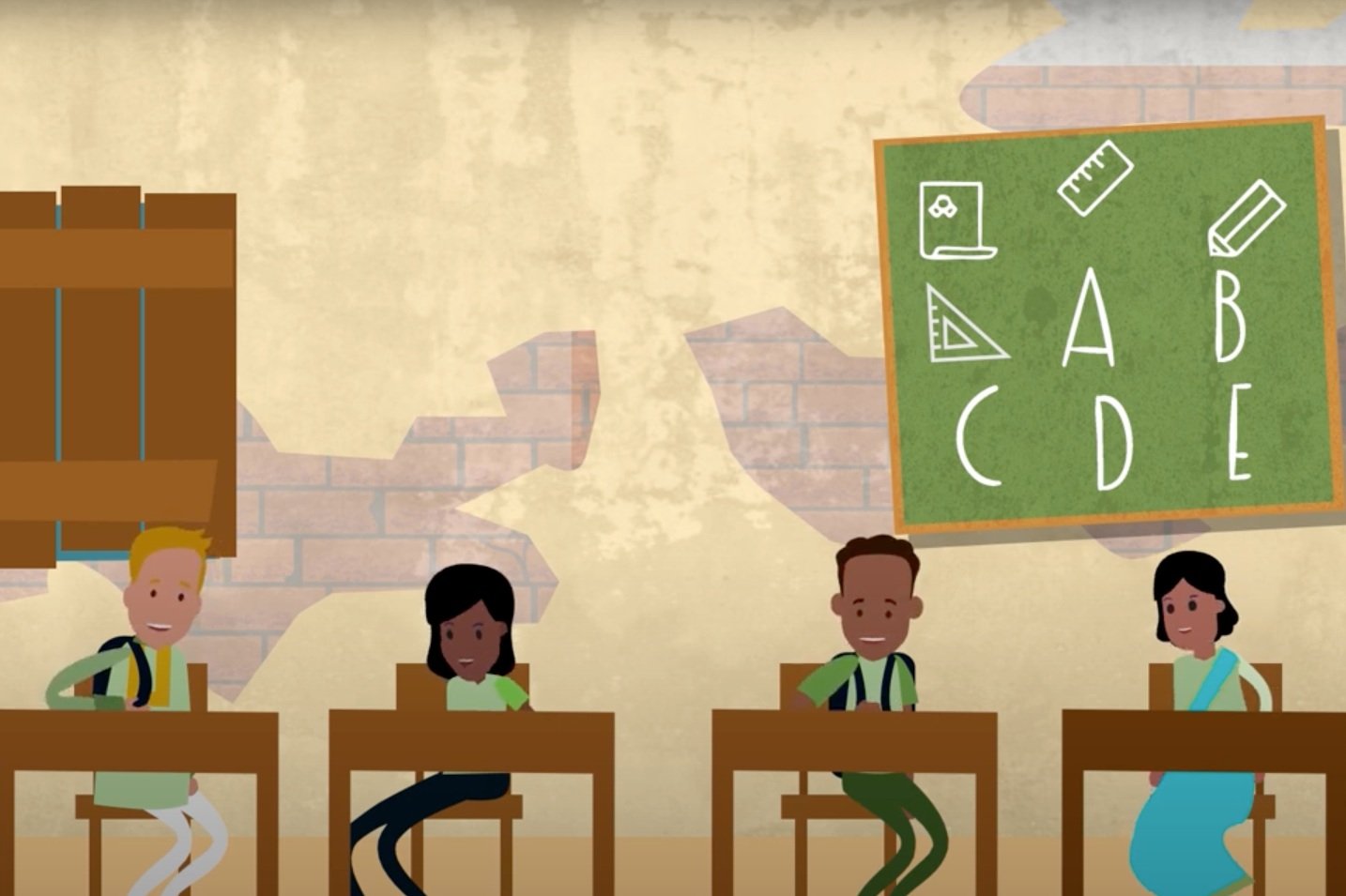
التعليم في حالات الطوارئ
الوصف: يركز هذا الفيديو التوضيحي على "إنشاء الأبحاث": الدروس المستفادة والنصائح العملية للباحثين وأصحاب المهنة لتوجيه المجال نحو إنشاء الأبحاث. للمزيد من المعلومات حول هذا العمل، اقرأ هنا: https://www.cambridge.org/core/journa..
L'éducation en Situations d'Urgence : Vidéo Explicative des Preuves Pour l'Action (3EA)
Cette vidéo explicative est axée sur « Construire une science pour l'action » : leçons tirées et conseils pratiques pour les chercheurs et les praticiens afin de faire avancer le domaine de l’éducation vers la construction d'une science pour l'action.
Education in Emergencies: Evidence for Action (3EA) Explainer Video
This explainer video is focused on “Building a Science for Action”: Lessons learned and practical advice for researchers and practitioners to move the field towards building science for action. The 3EA initiative, born out of a research-practice partnership between TIES and the International Rescue Committee, aims to generate evidence and tools on what works to improve children’s holistic learning and development. This work also aims to improve the quality of program implementation and to answer the questions of what works, how, for whom, and under what conditions.
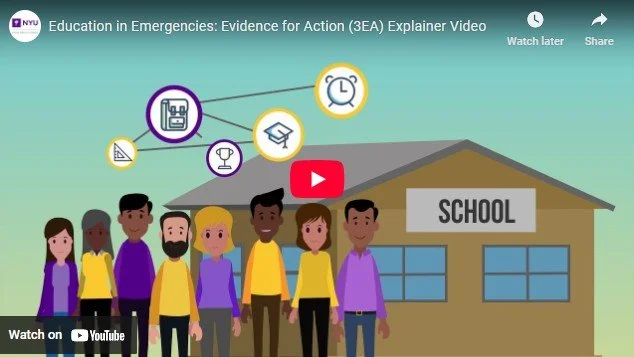
Education in Emergencies: Evidence for Action (3EA) Explainer Video
This explainer video is focused on “Building a Science for Action”: Lessons learned and practical advice for researchers and practitioners to move the field towards building science for action. The 3EA initiative, born out of a research-practice partnership between TIES and the International Rescue Committee, aims to generate evidence and tools on what works to improve children’s holistic learning and development. This work also aims to improve the quality of program implementation and to answer the questions of what works, how, for whom, and under what conditions.

TEACHERS IN CONFLICT CAN SUPPORT STUDENTS’ MENTAL HEALTH — IF WE INVEST IN THEIRS
Few of us were prepared to take on the role of teacher in the wake of COVID-19 school closures – one we often take for granted. Indeed, if this past year has taught us anything, it should be the value of student contact with a teacher at school. Research confirms that teachers are the most important school-based factor in student learning, and their effects can be detected well into adulthood. But while we expect teachers to don the hats of social worker, psychologist, and mentor, among others, we collectively do little to support them in their work. This is especially true in developing countries, where teachers are often embedded in and products of a struggling educational system that cannot or does not adequately support them. As millions of children return to schools in the wake of the COVID-19 pandemic, we have a moral obligation to support the well-being of teachers and, by extension, a healthier classroom culture. An investment in social-emotional learning (SEL) can help.

Adrenocortical and psychosocial responses of families in Jordan to the COVID-19 pandemic
This study of 52 predominantly lower income Jordanian and Syrian families with young children (31 girls; Mage = 53.37 months, SD = 3.53) in Jordan began in 2019, before the pandemic. Families were followed to explore stress physiology, family functioning, and mental health over the first 9 months of the pandemic. Mothers reported less adaptive coping and more negative changes to family life in June 2020 when their children had poorer behavioral self-regulation and more behavior problems, and when families had lower income, in 2019. More negative changes to family life predicted greater hair cortisol concentrations in children in June 2020, and more negative changes and less adaptive coping predicted worse child and mother psychosocial adjustment in December 2020.

Arabic Sesame Street helps children explore emotions
Sesame Street began airing an Arabic-language show called “Ahlan Simsim” (Welcome Sesame) in the Middle East with a focus on dealing with emotions.