

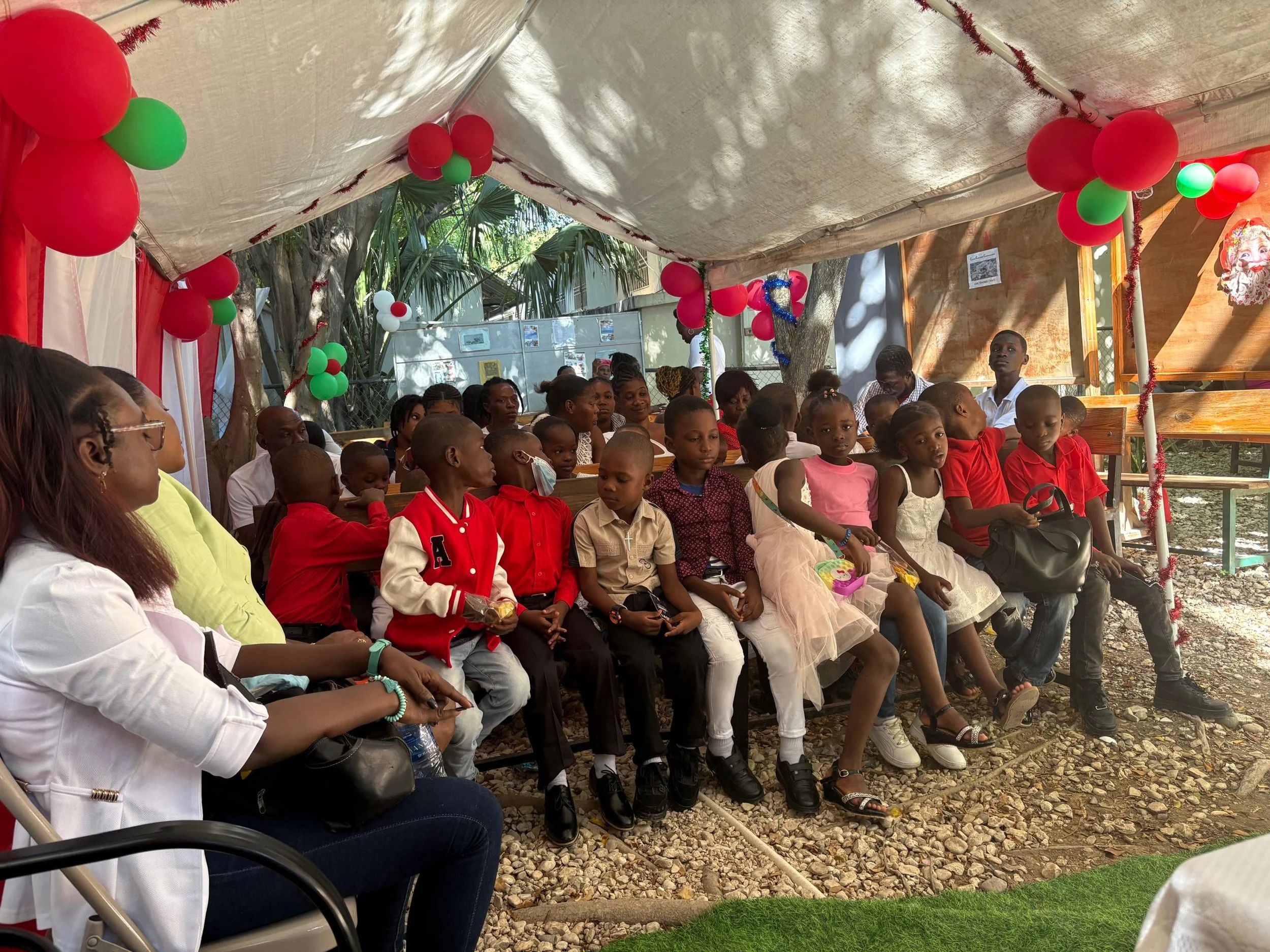
Written by Florencia Lopez Boo, Carolina Rivas, and Kate Schwartz
A pilot of two hybrid preschool models suggests pathways for learning amid conflict.
Armed violence in Haiti has significantly disrupted access to schooling, particularly in Port-au-Prince. Armed groups currently control large portions of the capital, contributing to widespread insecurity and school closures. Hundreds of schools have been closed or destroyed in recent years, affecting hundreds of thousands of children and disrupting their education.
At the same time, access to early childhood education in Haiti has historically been limited. Available data suggest that roughly 60–63% of children aged 3–5 were enrolled in preschool programs before the current crisis.
Given this context, we collaborated with GHESKIO (a local health and education focused not-for profit) and other international and local funders, educators, and researchers to answer: Can early learning reach children even when it is not safe, or not always safe, for them to leave home?
Adapting a Model for Active Conflict
The Remote and Hybrid Early Learning Program piloted two delivery models under conditions of insecurity. Both are different versions of hybrid programming (meaning they both have remote and in-person components), but are named according to whether the teacher is in-person (when possible: the hybrid model) or remote:
1. Hybrid model
Target group: children previously enrolled in GHESKIO's in-person preschool.
Approach: primarily in-person instruction, with temporary shifts to remote sessions when it is not safe for families and school staff/teachers to get to school.
2. Remote camp model for internally displaced persons
Target group: families living in displacement camps.
Approach: structured group sessions delivered by the teacher via phone, with in-person coordination and support from community health workers in the camps.
This program was implemented by the Haitian health and research organization GHESKIO in partnership with NYU Global TIES for Children; with engagement and coordination from the Inter-American Development Bank (IDB) and the Fonds d'Assistance Économique et Sociale (FAES); additional training, research, and qualitative analyses support from colleagues at Florida State University and Association des Écoles Privées in Haiti; and support from the Abdul Latif Jameel Poverty Action Lab (J-PAL).
⇢ Across both models, caregivers played a central role in facilitating children's learning at home.
Families received take-home kits containing books and materials, and teachers conducted regular sessions to guide caregivers through structured activities.
A total of 129 families participated (69 hybrid; 60 remote), with program delivery running between November 2025 and January 2026.
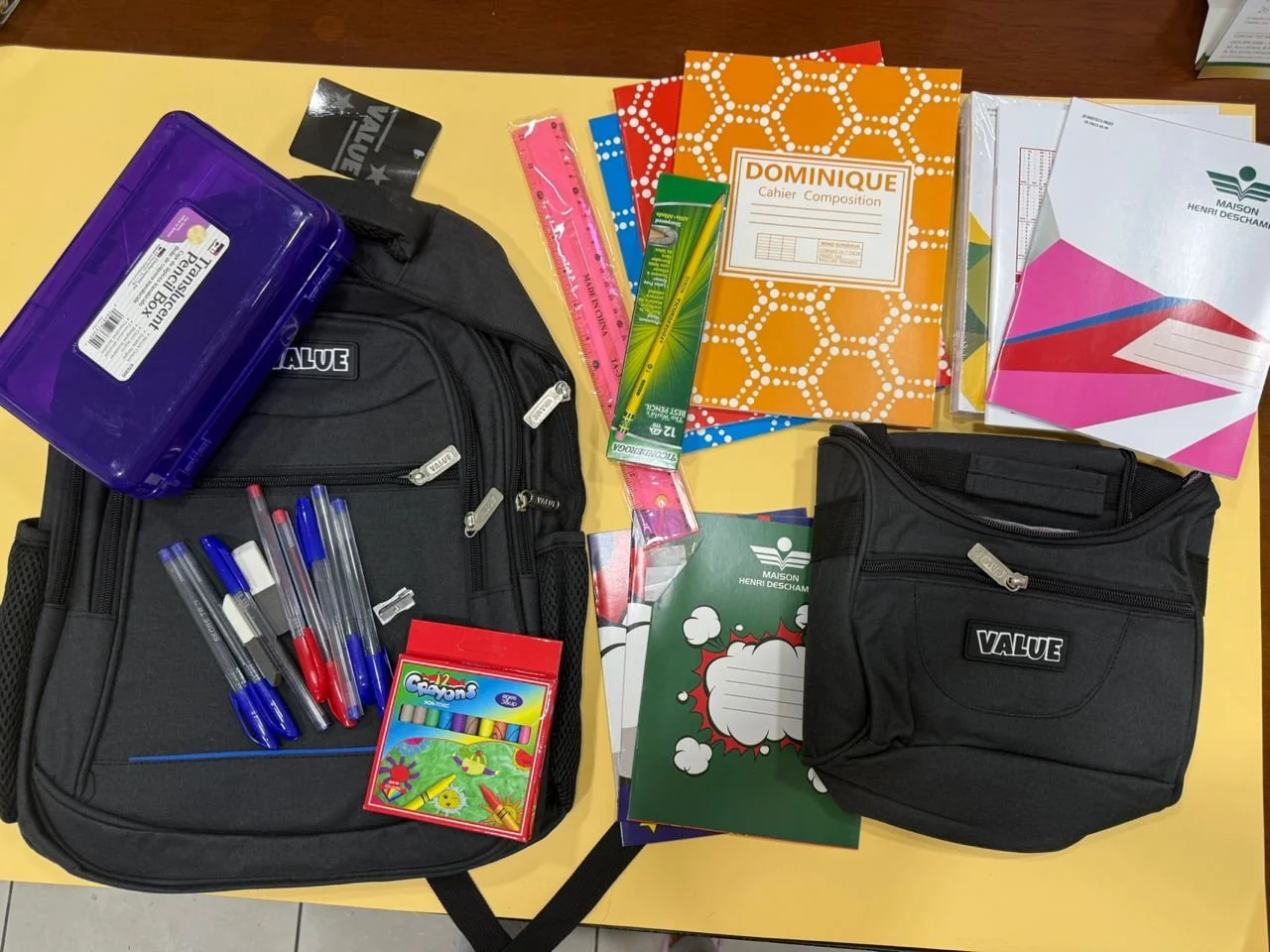
A take-home learning kit in Haiti
What the Pilot Was Designed to Test
This was a pilot, not an impact evaluation. Its primary objectives were:
To assess the feasibility of delivering early childhood instruction remotely and in hybrid formats.
To test how well data collection instruments (caregiver/parent surveys, interviews, and child development assessments such as IDELA) perform in this novel and high-risk environment (toward a potential future impact evaluation).
To understand participant and implementer experiences, with a focus on what worked best and what the biggest challenges were that should be addressed in future iterations of this programming.
Data collection included surveys with participating caregivers, interviews with 40 select caregivers and participating teachers, and child assessments. Surveys were conducted in person or over the phone; interviews were conducted in person; and child assessments were conducted primarily in person (15 were piloted via video call, with some in-person assistance).
Key Implementation Findings
1. High participation under difficult conditions
The program achieved an overall participation rate of approximately 96% across both delivery models. This indicates strong sustained engagement during implementation.
Interviews with caregivers, where they both directly talk about why they want their child in a program like this and describe the steps they take (including foregoing income-generating opportunities) to make sure their child attends and benefits from this programming, suggest that this engagement likely relates to the incredibly high value they place on education generally and early education in particular (quotes below are translated from Haitian Creole).
"I don't want my child to go astray like many young people I see today… I want my child… to succeed in life. I want people to see my child as a good person who will take on his responsibilities for Haiti tomorrow and contribute to the country as a citizen." (Hybrid Caregiver 068)
"Preschool allows children to grow and develop, which helps create a better society tomorrow." (Remote Caregiver 153)
2. A clear sense of teacher and caregiver commitment to the program
Both teachers and caregivers showed a high level of commitment throughout the program. Teacher interviews revealed a deep sense of personal responsibility, as captured by one teacher:
"Sometimes a child shows up, and you question yourself, thinking, "Wow. I can’t. I can’t." Then you finally say, "No, it's up to me." You feel a case is beyond you, so you work on yourself…" (Teacher 1: Pre-Program)
Teachers also described going well beyond class hours to prepare and support families. Teachers' views on caregiver commitment were mixed — while some identified parents' constraints as a challenge, others were struck by how engaged families were given their difficult circumstances:
"Parents would call me to say ‘Madam, I do not understand this’, and I would explain it to them. That surprised me because their conditions are not good, especially how they live in the camps… I was happy to see they took the work to heart, and the community agents had explained the foundation of the program well to them, so they understood the program too."
3. A strong belief that preschool is very important for helping individuals succeed and for improving Haiti's future
This is shown in some of the caregiver comments above and was also strongly emphasized in conversations with the teachers.
"They often say, 'Bwa kowchi pa drese' (a crooked tree doesn't straighten). So, in the future, everything you want to create and the kind of society you need start there. If you want to create a society of frustrated people, it starts there. If you want to create conscious individuals with a different perception of themselves, who are aware of and responsible for their country, you have to start from the youngest age. (Teacher 1: Pre)
4. Deep joy in seeing the children learn, engage, and grow
Teachers and caregivers also talk about their joy in watching the children learn and grow, with many teachers describing in detail what they love about working with children this age, and many caregivers expressing their sense of this program and this opportunity as a gift.
5. Feasibility of hybrid and remote delivery
Both models were operationally feasible. During the pilot, the need for hybrid classrooms to transition between in-person and remote formats did not arise (as they had just moved to a safer school location), but they tested the transition and found it worked well. Furthermore, remote groups successfully conducted regular phone-based sessions within camp settings. Teachers, including those who had expressed deep reservations about the remote teaching components before the program, later reported that it worked and that there is a real need for programming like this to continue and expand across Haiti. Parents also spoke of this option, in addition to being a gift, as one that worked within the real - and very challenging - demands of their lives and situations.
This suggests that flexible delivery systems can operate even in violent and volatile environments, though further testing at scale is needed.
6. Data collection is possible, but challenging
Caregiver surveys were piloted both in person and over the phone. Phone surveys had some connectivity issues, but calls were scheduled and anticipated, and data collectors found caregivers more attentive and surveys faster and smoother than in person, where multiple-choice questions often turned into longer side conversations. Across both modalities, data collectors felt the survey would be best broken into 2-3 separate calls or meetings.
For child assessments, the original plan was to split trials evenly between remote and in-person, but a lack of quiet, private space in the camps meant all assessments of children living in the camps were conducted in person. Families were provided with support in getting to the GHESKIO main school building with their children, and assessments were conducted in a private room there. 15 assessments of children in the hybrid model were piloted remotely, with a GHESKIO staff member helping to navigate the video call. For both modalities, teachers noted that children — especially younger ones — needed frequent breaks, but (with this flexibility) they were able to keep them engaged throughout the assessment.
No one raised concerns about family members answering for children remotely, but teachers had mixed feelings about whether remote assessments reflected children's abilities as reliably as in-person ones, as they often needed to repeat questions due to connectivity issues. Most teachers preferred in-person assessments for the one-on-one time and richer insight into each child's strengths, and many said that remote assessments required more patience and effort to complete.
Why This Matters Beyond Haiti
Education is often the first system to break down in active conflict and the last to be rebuilt. Programs like this one offer a working answer to a question too many humanitarian and education actors face: what do you do when it is not safe to bring children to a classroom?
⇢ The early answer from this pilot is that flexible, caregiver-centered models, paired with trusted local partners who understand the realities on the ground, can keep learning moving even when little else is stable.
GHESKIO's decades of experience absorbing successive crises in Haiti, from the 2010 earthquake to today's gang violence, made it possible to implement this kind of program quickly and adapt it as conditions shifted week to week.
That partnership, between an organization deeply rooted in its community and a research and coordination team focused on testing what works, is what allowed the pilot to move from a paper proposal to a functioning program in the middle of one of the world's most difficult operating environments.
What Comes After This Pilot
With the pilot completed, the team is now focused on the research phase of the project, including further data analysis, refinement of study instruments based on pilot findings, dissemination and presentation of preliminary results, and exploration of next steps for a possible larger-scale intervention and evaluation.
The findings will inform whether and how this model could be tested at a larger scale, offering further evidence for scalable, contextually grounded early childhood education interventions in conflict-affected settings.