

Two Generations, Two Signatures: Biological Embedding of Pre-pregnancy Trauma in Mother and Infant
Written by Alice Wuermli
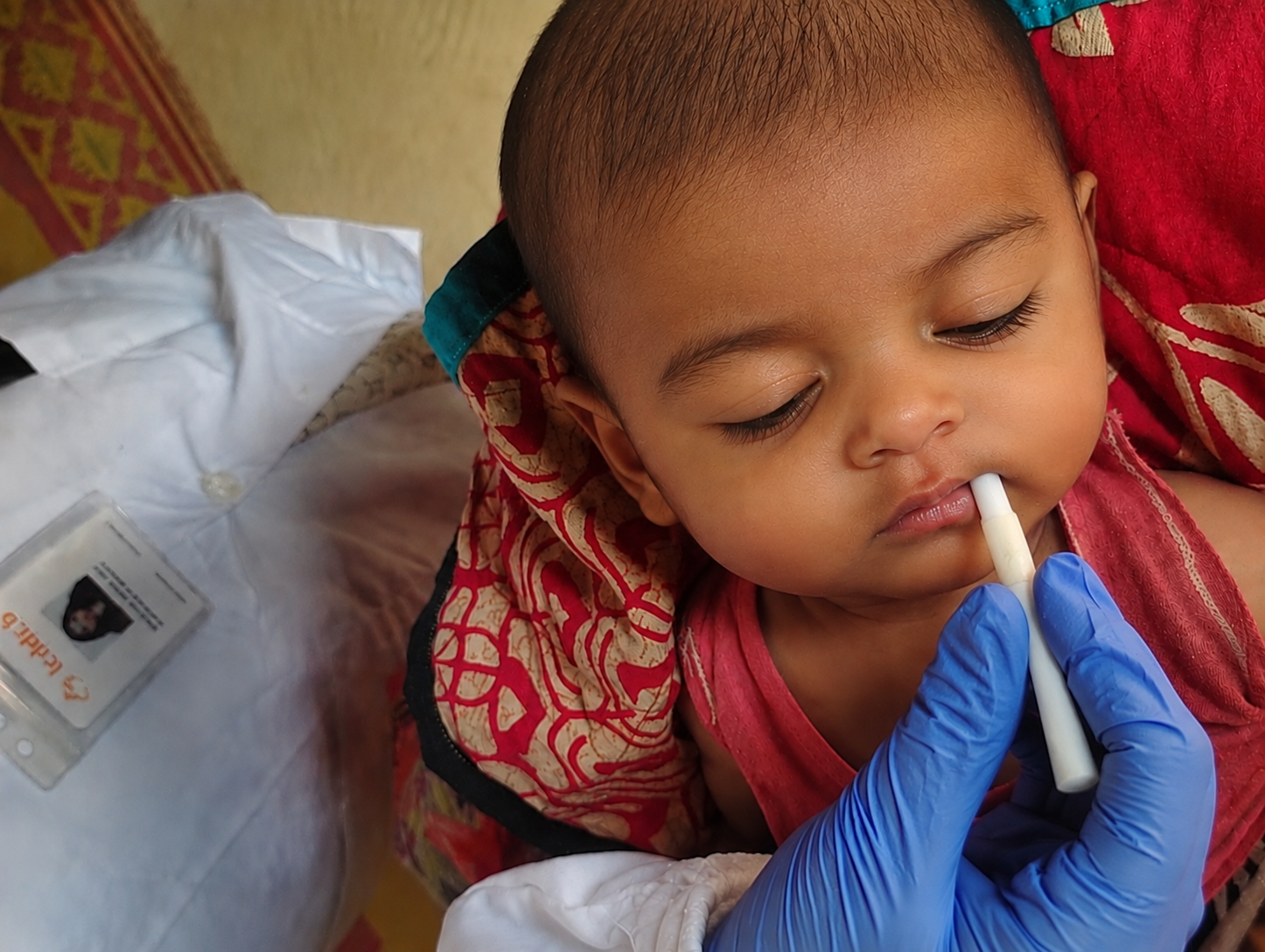
*This image has been modified with AI to ensure the infant's privacy is maintained.
When a mother lives through trauma — whether it happened years ago or is unfolding around her during pregnancy — the effects don't stop with her. A growing body of research shows that maternal stress and adversity can shape a child's development before birth, through a process known as “fetal programming”. Several biological systems involved in the stress response appear to carry this influence forward, including the hypothalamic pituitary adrenal (HPA) axis and the immune system, with epigenetic modifications, e.g., DNA methylation, emerging as one of the earliest measurable signs that trauma has been passed from mother to child.
Most of our current understanding comes from studies conducted in stable, predominantly WEIRD (Western, Educated, Industrialized, Rich, and Democratic) countries. Almost none of it comes from populations living through the kind of cumulative trauma — conflict, forced displacement, chronic adversity — that defines life for millions of people worldwide. In fact, research on trauma specifically tied to conflict and displacement remains scarce. Our study aims to make inroads into how trauma and mental health shape offspring life-course development, and the many factors that can buffer from past and present adversity.
I recently shared early findings from this work at the International Congress of Infant Studies (ICIS), held in Panama City. I had the chance to present these results during a session on "Emotion, Stress, and Family Context," a theme that pushed researchers to look beyond typical study settings and toward the full range of environments in which infants actually develop, including displacement and humanitarian crisis.
What We're Finding in Mothers and Infants
We're drawing on an ongoing study of pregnant Rohingya refugees and host-community women in Cox's Bazar, Bangladesh, callediRRRd (Intergenerational Risk and Resilience of Rohingya in Displacement). Rather than looking at one biological marker (e.g., cortisol) at a time, we used a technique called untargeted, mass-spectromity-based proteomics (the analytical pipeline for this project was developed and led by my colleague Dr. Kültz at UC Davis) which measures thousands of proteins from a single sample, to obtain a broad, systems-level snapshot of what's happening biologically in pregnant women and, later, in their infants at around one month of age. We used saliva, which can be collected non-invasively, making it a particularly well-suited method in this context.
The results I presented at ICIS this year relied on a subsample of 233 Rohingya mother-infant dyads, drawn from the 1st and 4th quartiles of PTSD symptoms in the whole iRRRd cohort. My investigations built on a first set of analyses conducted by my colleague Dr. Leprêtre at UC Davis, who compared women in the high-PTSD group to those in the low-PTSD group and did the same for their infants. Separately, I compared mothers and infants from the 1st and 4th quartiles of maternal conflict and displacement trauma experiences restricted to the subsample of 233, resulting in N=111 dyads.
The question driving these analyses is: does maternal trauma exposure, separately from PTSD symptoms, become biologically embedded — and can we detect early traces of that transmission in newborns? The charts here show only the pathways that held up under our strictest test — patterns confirmed by multiple independent analytic methods, not just one. It's a conservative bar, but it means everything shown here is a finding I'm confident in. Figures 1 and 2 depict results for mothers and infants, respectively.
In mothers, PTSD symptom severity and trauma exposure told partly different stories — sometimes literally opposite ones. PTSD produced the broader, more coordinated signal, and it wasn't a single "dialed up" or "dialed down" pattern.
Pathways responsible for detecting and repairing DNA damage, and for maintaining structural tissue, ran lower in mothers with high PTSD scores. At the same time, protein-building machinery, several immune pathways, and the cell's protein quality-control systems ran higher.
In three systems, PTSD and cumulative trauma pointed in genuinely opposite directions: immune activity was elevated with high PTSD but suppressed with high cumulative trauma, while DNA damage repair and structural-tissue maintenance (i.e., ECM Organization) each showed the reverse pattern — suppressed with high PTSD, elevated with high trauma. That split is itself informative: PTSD symptoms and trauma exposure aren't just different doses of the same underlying stress response — they appear to reflect distinct biological states.
Figure 1: Trauma and PTSD related Reactome pathways in mothers
Notes:
Reactome hierarchy: Gillespie et al., Nucleic Acids Res 2022.
PTSD contrast: N=233 dyads; darker bars
Trauma contrast is based on 1st and 4th quartiles of trauma scores (N= 111) sorted by PTSD-HL mean NES in mothers; lighter bars
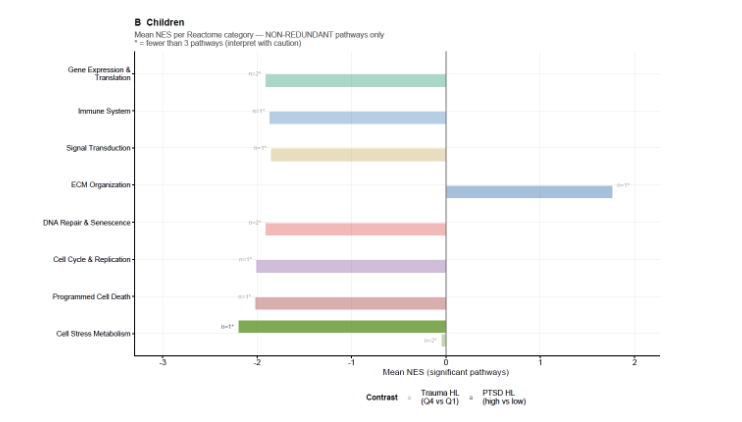
In infants, the picture is different in an important way: what predicts the infant's biology is the mother's pre-pregnancy trauma exposure, not her current PTSD symptoms.
Nearly every one of the most robustly confirmed pathways in one-month-old infants of high-trauma mothers seemed to be running lower than in infants of low-trauma mothers — including pathways involved in cell division, DNA repair, immune activity, and programmed cell death. One pathway broke that pattern in the opposite direction: a system involved in building and maintaining structural tissue (extracellular matrix) seemed elevated in these infants — a finding we're still working to understand.
Some of these infant patterns echo what we saw in mothers; others point in the opposite direction — trauma and PTSD don't produce a single, consistent cross-generational signature so much as a mix of matching and diverging biological responses.
One category, cell stress and metabolism, is a good example of why these charts need to be read carefully: it looks flat in the infant trauma comparison, but that's because two different pathways within it move in opposite directions and largely cancel each other out when averaged across these broad biological processes — not because trauma has no effect on cellular stress management in these infants. Untangling which specific overlaps are meaningful and which are coincidental is next on our list.
Figure 2: Trauma and PTSD related Reactome pathways in infants
Notes:
Reactome hierarchy: Gillespie et al., Nucleic Acids Res 2022.
PTSD contrast: N=233 dyads; darker bars.
Trauma contrast is based on 1st and 4th quartiles of trauma scores (N= 111) sorted by PTSD-HL mean NES in mothers; lighter bars.
Why This Matters for Humanitarian Research
Research on fetal programming has grown in recent years, but almost entirely in high-income contexts. Right now, 117.8 million people worldwide are forcibly displaced, according to UNHCR — and their infants are entering the world without the health systems and support that might otherwise buffer them from these effects. If trauma is being biologically passed from one generation to the next in these populations, understanding how is a humanitarian priority, not just a scientific one.
Next, we're expanding this work to include 116 host-community dyads, so we can start asking whether these biological patterns are specific to the Rohingya experience of displacement or reflect something more universal about how trauma is embedded and moves from mother to child. We're also looking for the malleable factors that might protect against this transmission — because if we can find them, that's where interventions could actually make a difference.
Acknowledgements
Thanks to Brenda Luu, who carried out the lab work for this project, and to Maxime, who ran the first set of analyses this work builds on and has continued to be an invaluable source of support for my own analyses since. Thanks also to Drs. Paul Hastings, Oliver Fiehn, Dietmar Kültz, and Fahmida Tofail, who have been part of conceptualizing this work on the omics side, and to the research teams at UC Davis, NYU, and icddr,b.