Global TIES for Children at CIES 2026: Re-examining Education and Peace in a Divided World
The CIES 2026 conference, themed “Re-examining Education and Peace in a Divided World,” took place from March 28 to April 2 in San Francisco. Global TIES for Children was proud to contribute to this vital conversation, sharing insights from our latest initiatives that tackle education delivery in crisis and the necessity of equitable research systems.
The first of our two featured presentations took place during the panel, “Innovation Under Constraint: Technology, Access, and New Delivery Models.”
Kate Schwartz shared early insights from a pilot program in Haiti testing two hybrid early learning models. Designed specifically for unstable, conflict-affected contexts, this work explores how to provide quality early childhood education when school access is inconsistent or impossible.
Preliminary qualitative findings are both sobering and promising. While families and teachers navigate extreme constraints, there is a powerful demand for early learning. The evidence suggests that hybrid and remote approaches can succeed when designed with local realities at the forefront.
We are deeply grateful to our collaborators at Centres GHESKIO, the Inter-American Development Bank, Fond d’Assistance Economique et Sociale (FAES), and our partners across Haiti for making this work possible.
See the LinkedIn post here: https://www.linkedin.com/feed/update/urn:li:activity:7444495125625376768/
Our second major contribution to CIES focused on the Leverage, Empower, Advance Research Network (LEARN). Lindsay Brown, Co-P.I., presented the vision and core tenants behind LEARN, a collaboration between Global TIES for Children, the Jacobs Foundation, Universidad de Los Andes, and University of Cape Coast to build research capacity in early childhood and education and move local scholars to the center of global agenda-setting conversations.
Participating scholars receive rigorous training in measurement, psychometrics, longitudinal methods, child development, and grant-writing. They can also access mentorship and international research networks through incredible partners such as Society for Research in Child Development and International Society for the Study of Behavioural Development.
Following the introduction, Priyamvada Tiwari shared how LEARN is being implemented in Colombia, and how demands for local ownership of data, context-specific evidence, and culturally-relevant tools are shaping the research ecosystem.
Christopher Yaw Kwaah,PhD presented the work in Ghana, highlighting how the model adapts while staying grounded in a shared framework.
See the LinkedIn post here: https://www.linkedin.com/feed/update/urn:li:activity:7445549768413597696/
Whether through innovative delivery models in Haiti or building scholar networks in Colombia and Ghana, TIES remains dedicated to ensuring every child has the opportunity to learn—and that every local scholar has the platform to lead.
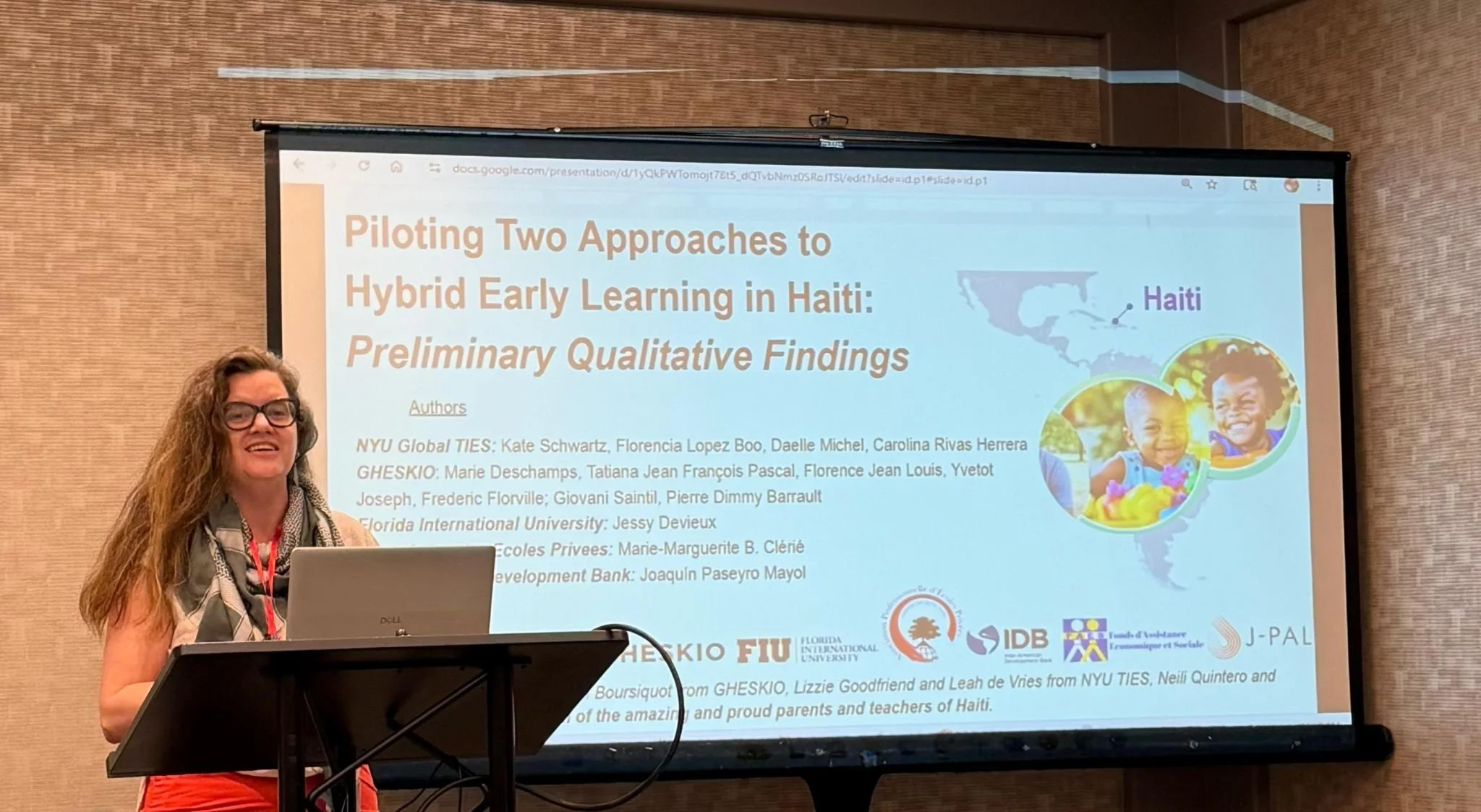
Kate Schwartz
presenting at CIES 2026
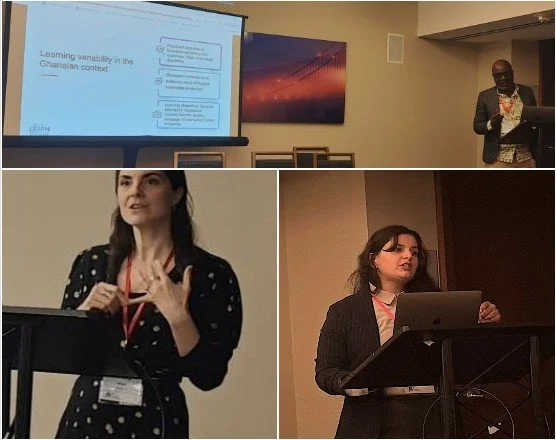
Christopher Yaw Kwaah, Lindsay Brown and Priyamvada Tiwari presenting at CIES 2026