

Resources
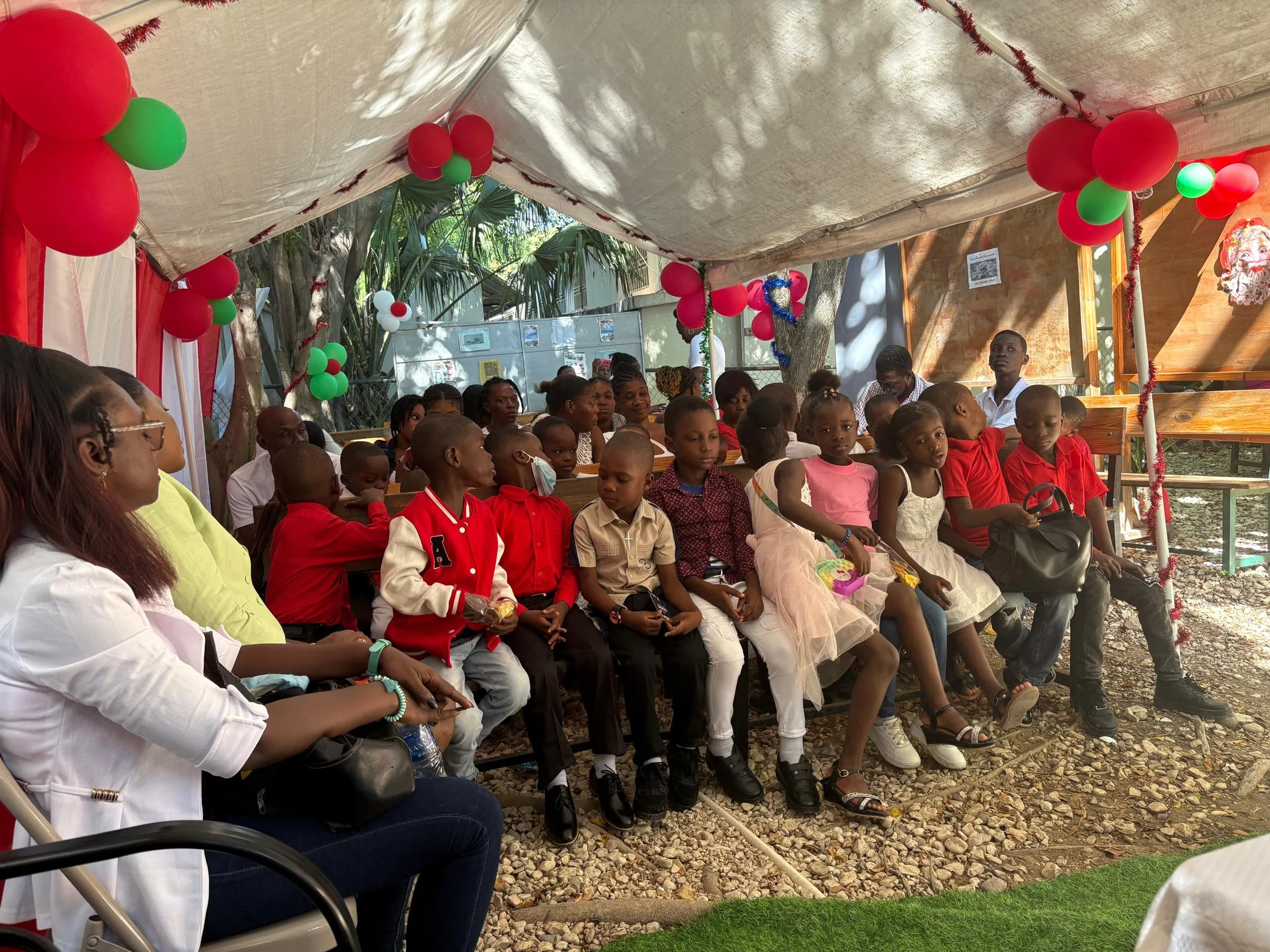
Can Early Learning Continue in Active Conflict? Evidence from a Pilot in Haiti
A pilot of two hybrid preschool models in Haiti suggests pathways for learning amid conflict.

Closing Ceremony for the Haiti Remote and Hybrid Early Learning Program (RHELP)
Our local partner, GHESKIO officially marked the completion of the RHELP pilot program with a heartwarming and impactful closing ceremony!
This milestone is a testament to what can be achieved when innovation meets unwavering community dedication. Our partners at GHESKIO gathered to celebrate the educators, families, and young learners who made this journey possible.
Faced with ongoing political instability and severe disruptions to traditional schooling, this program successfully adapted a phone- and hybrid-based learning model to meet families exactly where they are. Over the course of the project, we didn’t just keep education going, we watched parents step into their power as primary learning guides, and we saw young children maintain critical developmental milestones despite prolonged crises.
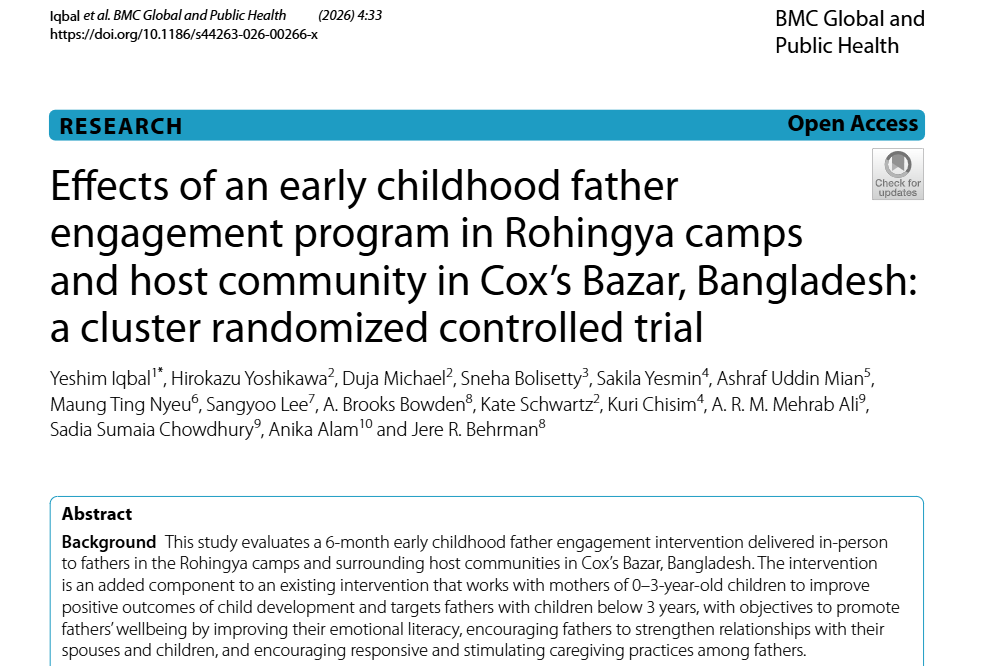
New publication on the effects of an early childhood father engagement program in Rohingya camps in Cox’s Bazar, Bangladesh
We’re pleased to share a recently released journal article on our study about father engagement and early childhood development in humanitarian settings, based on work in the Rohingya camps in Cox’s Bazar, Bangladesh.
This study examined how fathers interact with their young children in contexts of displacement and what happens when programs intentionally include them in parenting support.
Key findings include:
Increased father engagement in play and interactions with young children
Shifts in caregiving practices, including more responsive and supportive behaviors
Reductions in harsh child discipline among participating fathers
Evidence that fathers - often overlooked in ECD programming - can be meaningfully reached and engaged, even in highly constrained settings
Taken together, the results reinforce a point that still hasn’t fully translated into programming at scale: fathers matter - not just as secondary caregivers, but as central actors in children’s development.
They also point to something more pragmatic: targeted, relatively low-cost interventions can shift parenting behaviors, even in complex humanitarian environments.
At a time when resources are tightening across the aid sector, that’s not a trivial finding; it has real implications for how programs are designed and prioritized.
Global TIES for Children at CIES 2026: Re-examining Education and Peace in a Divided World
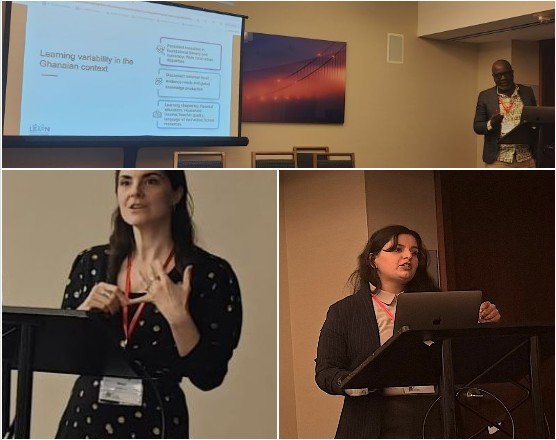
The CIES 2026 conference, themed “Re-examining Education and Peace in a Divided World,” took place from March 28 to April 2 in San Francisco. Global TIES for Children was proud to contribute to this vital conversation, sharing insights from our latest initiatives that tackle education delivery in crisis and the necessity of equitable research systems.
The first of our two featured presentations took place during the panel, “Innovation Under Constraint: Technology, Access, and New Delivery Models.”
Kate Schwartz shared early insights from a pilot program in Haiti testing two hybrid early learning models. Designed specifically for unstable, conflict-affected contexts, this work explores how to provide quality early childhood education when school access is inconsistent or impossible.
Our second major contribution to CIES focused on the Leverage, Empower, Advance Research Network (LEARN). In collaboration with the Jacobs Foundation and in alignment with their Learning Variability agenda, TIES has partnered with Universidad de los Andes and the University of Cape Coast to bring LEARN to life.
Lindsay Brown, Co-P.I., presented the vision and core tenants behind LEARN, a collaboration between Global TIES for Children, the Jacobs Foundation, Universidad de Los Andes, and University of Cape Coast to build research capacity in early childhood and education and move local scholars to the center of global agenda-setting conversations.
Following the introduction, Priyamvada Tiwari shared how LEARN is being implemented in Colombia, and how demands for local ownership of data, context-specific evidence, and culturally-relevant tools are shaping the research ecosystem.
Christopher Yaw Kwaah,PhD presented the work in Ghana, highlighting how the model adapts while staying grounded in a shared framework.
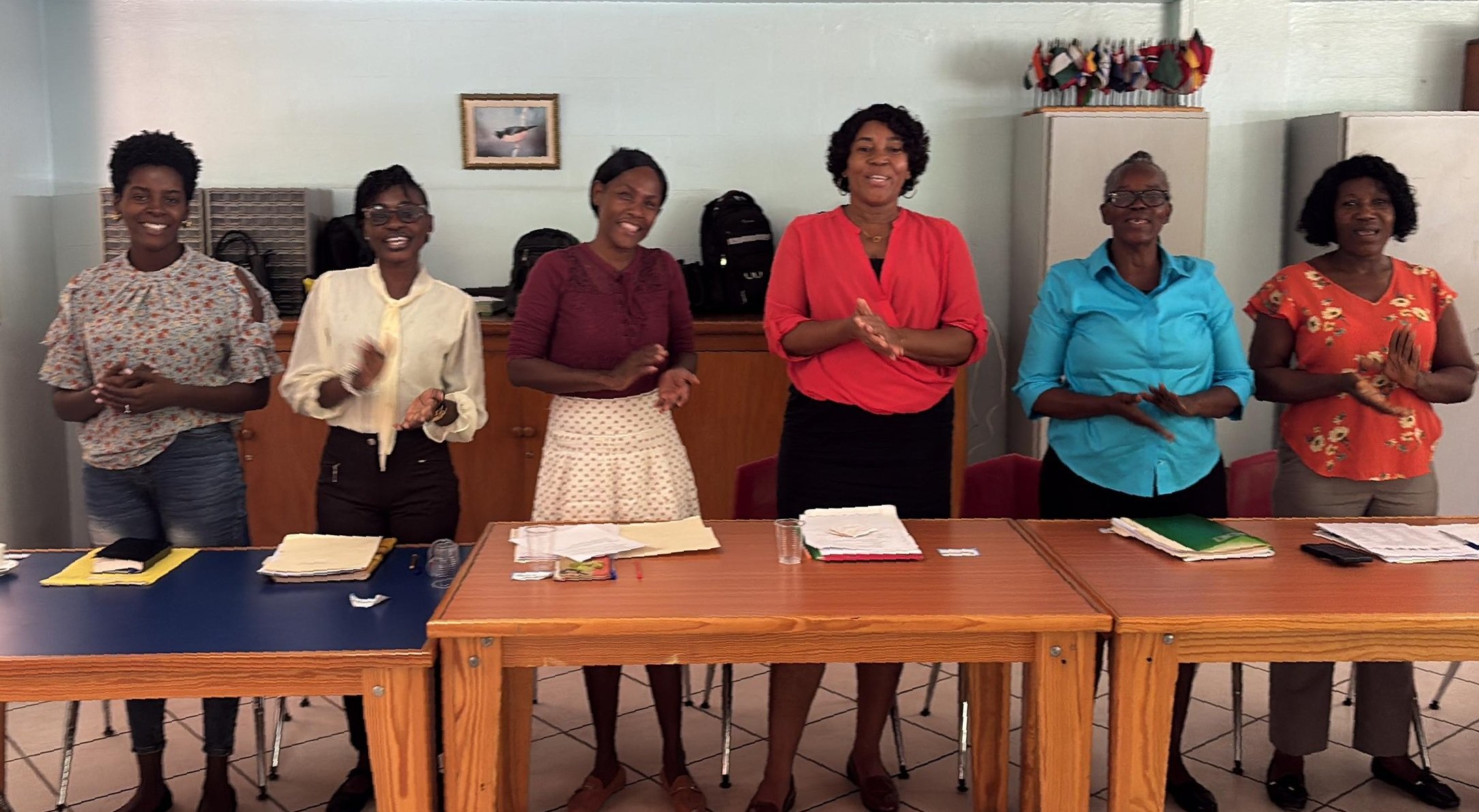
Data Collection begins for the Haiti Remote and Hybrid Early Learning Program (RHELP)
In partnership with our incredible local partner in Haiti, GHESKIO, data collection has begun for the Haiti Remote and Hybrid Early Learning Program (RHELP).
Amid ongoing instability, economic crises, and severe service disruptions, young children in Haiti face massive barriers to consistent, high-quality early childhood education. When classrooms are inaccessible, we have to look for new ways to reach them.
Building on successful evidence-based models previously evaluated in the Middle East, RHELP is testing how remote and hybrid early learning models can be adapted to support children’s holistic development and school readiness during times of crisis.
Through this data collection phase, our goals are to:
Test Feasibility: Understand how remote early learning support can be delivered effectively in hard-to-access settings.
Measure Impact: Generate actionable evidence on children's learning outcomes and caregiver engagement.
Inform the Future: Build a global evidence base for early childhood education in crisis-affected regions.

Early Childhood Parenting Support – Call Quality Instrument (ECPS-CQI)
The ECPS-CQI instrument was developed in English by Anaga Ramachandranm, Dalia Al Ogaily, Kate Schwartz, Joyce Rafla and Hirokazu Yoshikawa and used to measure the quality of interactions during a phone call with a parent or caregiver. The instrument assesses the domains of relationship with family, responsiveness to family strength, needs, and culture, facilitation of caregiver-child interaction, and active listening. The ECPS-CQI tool has shown promising evidence for reliability and validity, and with caution, it can be used for intended purposes with similar samples/contexts.

Navigating Remote Early Childhood Education in Hard-to-Access Settings: A Qualitative Study of Caregivers’ and Teachers’ Experiences in Lebanon
Despite the immense challenges of economic crises, power outages, and unreliable internet, caregivers in Lebanon’s hard-to-access areas went to extraordinary lengths to ensure their children could participate in remote early childhood education. Their profound commitment to learning and resilience in the face of adversity underscores the critical role of early education, even in crisis settings.
Building on our team at NYU’s Global TIES for Children’s impact findings from a three-arm randomized controlled trial—showing significant impact on child development from a short remote ECE intervention—this newly published qualitative article offers a deeper, behind-the-scenes perspective. Applying Weisner’s ecocultural framework, we explore how caregivers integrated remote early learning into their daily lives, navigating cultural and environmental constraints. While theory suggests that intervention success depends on aligning with participants’ routines, our findings reveal that these programs thrived despite the absence of structured daily rhythms, demonstrating remarkable adaptability.
Our mixed-methods research challenges the common narrative by showing that remote ECE programs can, in fact, provide quality learning opportunities for children facing adversity. The study highlights the resilience of caregivers and teachers, offering valuable insights for designing flexible, impactful educational interventions in crisis-affected and resource-limited settings.

Cluster randomized controlled trial of a phone-based caregiver support and parenting program for Syrian and Jordanian families with young children
This study assessed a 6-month phone-based early childhood development (ECD) intervention for Syrian and Jordanian caregivers in Jordan

বাংলাদেশের কক্সবাজারের রোহিঙ্গা ক্যাম্প এবং হোস্ট কমিউনিটিতে ফাদার এনগেজমেন্ট মডেলের প্রভাব: একটি র্যান্ডোমাইজড কন্ট্রোল (Randomized Control) ট্রায়াল
This study is a causal impact evaluation of Watch, Play, Learn (WPL), a program by Sesame Workshop that consists of videos that aim to bring playful early learning opportunities to children, especially those affected by conflict and crisis, via mobile phones. This study focused on the effects of WPL math and social-emotional skills content delivered to Venezuelan migrants and Colombian children living in communities in Colombia where families and children face challenges in accessing essential services, including early education. Implementation was led by the Colombia office of Innovations for Poverty Action.

Effects of a Father Engagement Model in Rohingya Camps and Host Communities in Cox’s Bazar, Bangladesh: A Randomized Controlled Trial
This study is a causal impact evaluation of Watch, Play, Learn (WPL), a program by Sesame Workshop that consists of videos that aim to bring playful early learning opportunities to children, especially those affected by conflict and crisis, via mobile phones. This study focused on the effects of WPL math and social-emotional skills content delivered to Venezuelan migrants and Colombian children living in communities in Colombia where families and children face challenges in accessing essential services, including early education. Implementation was led by the Colombia office of Innovations for Poverty Action.

Lessons from an Implementation Study of Integration of Early Childhood Development (ECD)Information and Guidance into Well-Child Visits in Primary Healthcare Centers run by Jordan’s Ministry of Health
This study, led by Global TIES for Children at New York University in collaboration with the International Rescue Committee (IRC) research team, is an implementation study of a new intervention co-designed by the Ministry of Health (MoH) in Jordan, the IRC, and Sesame Workshop. This intervention seeks to increase families’ access to early childhood development (ECD) information and activities through the expansion of MoH midwife training beyond physical health and nutrition to other aspects of ECD, such as managing child behavioral challenges and supporting early learning,
and the incorporation of such additional content into well-child visits for children ages 0 to 5 years old.
![[Dataset]Phone-Based Reach Up and Learn](https://images.squarespace-cdn.com/content/v1/5fa0560c3a27c834f6a6b5ac/1703271023801-JED68Q0PDBWB8Z0FFEFX/Primary%2BEducation%2Band%2BLearning%2Bin%2BEmergencies.jpg)
[Dataset]Phone-Based Reach Up and Learn
Reach Up and Learn (RUL) is a home-visiting program that was introduced in Jamaica in 1975. In 2016, the International Rescue Committee (IRC), in collaboration with the Arab Resource Collective, adapted RUL for the context of Syrian and host community families in Lebanon, Jordan and Syria and integrated RUL into its education, child protection, and health programs in Jordan, Lebanon, and Syria.

New remote ECE model with large impacts holds promise for SDG 4.2 progress
The last few decades have seen immense gains in global recognition of the critical importance of early childhood education (ECE). Despite this, the goal of universal ECE – as we have traditionally defined it – has remained aspirational: with little progress since 2015 toward the universal quality ECE called for in SDG 4.2. Partly, this is due to financial constraints and continued limited investment in ECE. But partly, it is because there are contexts in which setting up in-person pre-school and kindergarten classrooms is not viable.

Lessons and Impacts of Ahlan Simsim TV Program in Pre-Primary Classrooms in Jordan on Children’s Emotional Development: A Randomized Controlled Trial
In this brief, Global TIES researchers evaluate the effects of Ahlan Simsim, a television show co-produced by Sesame Workshop and Jordan Pioneers that has been viewed by more than 23 million children across the MENA region, including 57% of displaced Syrians across Jordan, Lebanon, and Iraq.

Lessons and Impacts of a Remote Early Childhood Education Program in Hard-To-Access Settings in Lebanon: A Randomized Controlled Trial
In this brief, Global TIES researchers explore outcomes from the first evaluation of a remote early childhood education (ECE) program for families affected by conflict and crisis and the second of the effect of short-term (shorter than 3 months) ECE programming.

Lessons and Impacts of a Phone-Based Parenting Program for Syrian and Jordanian Families with Young Children
In this brief, Global TIES researchers evaluate a phone-delivered version of a parenting program in the Middle East and the first randomized-controlled evaluation of an audio-only parenting program.

دروس وآثار برنامج تربوي للآباء والأمهات عبر الهاتف تقييم فاعلية برنامج تربوي لتنمية الطفولة المبكرة قائم عبر الهاتف:دراسة من الأردن السورية والأردنية للأطفال الصغار
الوصف: في هذا الملخص، قام باحثو مركز جلوبال تايز (Global TIES) بتقييم برنامج تربوي قائم عبر الهاتف لتنمية الطفولة المبكرة في الشرق الأوسط، وهو أول تقييم عشوائي محكم لمثل هذه البرامج في المنطقة. على الرغم من أهمية هذه البرامج خاصة في سياقات الأزمات والظروف الإنسانية التي تعرقل تنفيذ البرامج حضورياً إلا أن المعلومات حول آثار برامج تنمية الطفولة المبكرة المقدمة عن بُعد تعتبر قليلة. في عام 2020، قامت اللجنة الدولية للإغاثة بتكييف برنامج التربية الذي يتم تقديمه حضوريًا على شكل زيارات منزلية ليتم تقديمه عن بُعد عبر مكالمات هاتفية صوتية فقط، مما أتاح فرصة فريدة لتقييم برنامج تربوي مقدم عن بعد. البرنامج الحضوري الأصلي الذي تم تعديله يُدعى "Reach up and Learn-RUL" وقد قدمته اللجنة الدولية للإغاثة من عام 2016 حتى بداية عام 2020 في أجزاء من الأردن، واستهدف كلًا من المربين الأردنيين والسوريين. تم إجراء التعديلات لتقديمه عن بُعد كاستجابة للجائحة وكجزء من مبادرة "أهلاً سمسم" بالتعاون مع "ورشة سمسم".