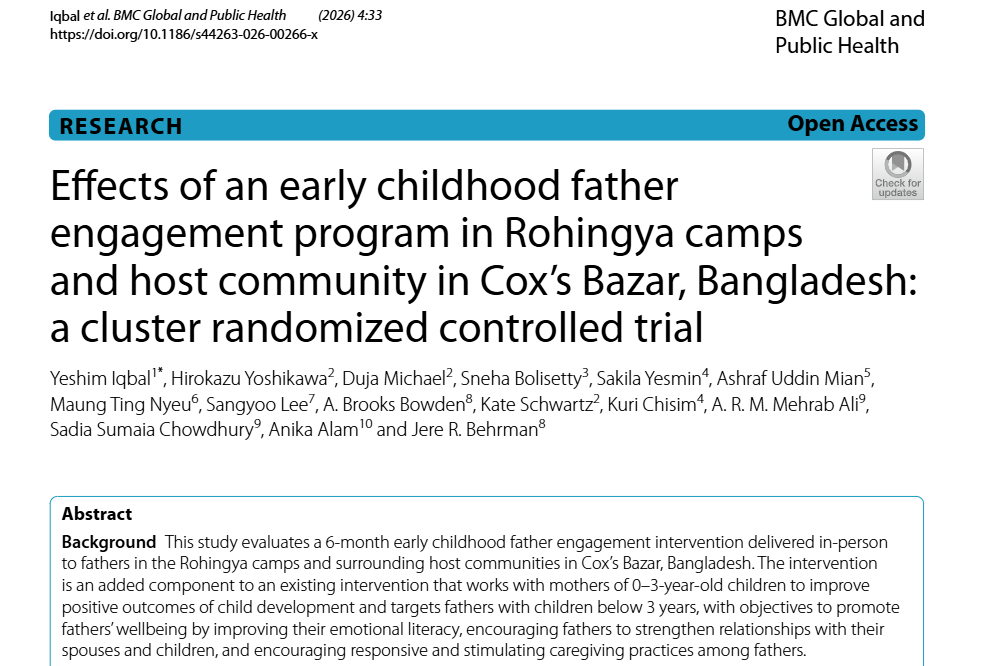
New publication on the effects of an early childhood father engagement program in Rohingya camps in Cox’s Bazar, Bangladesh
We’re pleased to share a recently released journal article on our study about father engagement and early childhood development in humanitarian settings, based on work in the Rohingya camps in Cox’s Bazar, Bangladesh.
This study examined how fathers interact with their young children in contexts of displacement and what happens when programs intentionally include them in parenting support.
Key findings include:
Increased father engagement in play and interactions with young children
Shifts in caregiving practices, including more responsive and supportive behaviors
Reductions in harsh child discipline among participating fathers
Evidence that fathers - often overlooked in ECD programming - can be meaningfully reached and engaged, even in highly constrained settings
Taken together, the results reinforce a point that still hasn’t fully translated into programming at scale: fathers matter - not just as secondary caregivers, but as central actors in children’s development.
They also point to something more pragmatic: targeted, relatively low-cost interventions can shift parenting behaviors, even in complex humanitarian environments.
At a time when resources are tightening across the aid sector, that’s not a trivial finding; it has real implications for how programs are designed and prioritized.
🔗 Read the full article: https://link.springer.com/epdf/10.1186/s44263-026-00266-x
🔗 See the LinkedIn post here.
Congratulations to the authors! Yeshim Iqbal, Hirokazu Yoshikawa, Duja Michael, Sneha Bolisetty, Sakila Yesmin, Ashraf Uddin Mian, Maung Ting Nyeu, Sangyoo Lee, Brooks Bowden, Kate Schwartz, Kuri Chisim, A R M Mehrab Ali, Sadia Sumaia Chowdhury, Anika Alam, and Jere Behrman.