

Father Engagement Program Shows Promise in Rohingya Camps
Written by Yeshim Iqbal and Hirokazu Yoshikawa
A recent cluster-randomized trial finds family-level benefits from engaging Rohingya fathers in early childhood care.
A father engagement program conducted in the Rohingya camps of Cox's Bazar, Bangladesh, is changing how fathers relate to their children and partners, according to a cluster-randomized controlled trial published in BMC Global and Public Health.
The study is the first randomized trial to evaluate a father-engagement program for fathers in a humanitarian context. Recently, we observed both World Refugee Day and Father's Day. This blog serves as a reminder that fatherhood looks different in displacement and can still be well supported.
A Six-Month Program Built Around Fathers
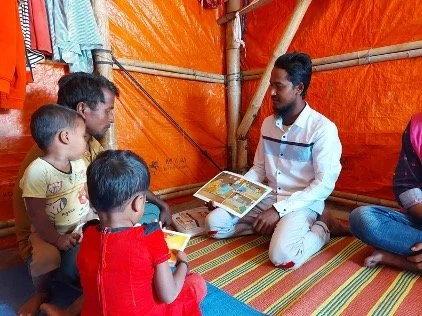
The intervention added a father-focused component to an existing program for mothers of children under age three. Trained male volunteers, drawn from the same Rohingya and host communities, delivered weekly 30-minute home visits and monthly group sessions to fathers over six months.
The curriculum's goals: strengthen fathers' emotional literacy, deepen their relationships with spouses and children, and support responsive, stimulating caregiving.
Developed by BRAC Institute of Educational Development with extensive input from Rohingya fathers and mothers, this program was part of the Play to Learn partnership of BRAC, Sesame Workshop, and NYU Global TIES for Children funded by the LEGO Foundation. The program was built on BRAC's Humanitarian Play Labs model and was evaluated by NYU Global TIES for Children, through a collaboration with a local data collection partner, the ARCED Foundation.
The trial included 2,002 fathers: 786 households in the Cox's Bazar camps and 1,216 in surrounding host communities, which also face significant poverty.
Strong Engagement, Measurable Family Benefits
In notable contrast to many father-engagement programs in early childhood evaluated to date, this program did not simply invite fathers to a program designed for mothers. The curriculum was designed for the unique circumstances and needs of fathers in these communities. And the program was implemented by Rohingya men (largely fathers themselves) visiting the fathers in the camps, and host-community Bangladeshi men visiting the host-community fathers. Each group of facilitators was trained extensively and received supervision and support from BRAC during the program as well.
Fathers attended an average of 89 percent of sessions, signaling strong acceptability of the program among the Rohingya. Compared to families receiving the mothers' program alone, fathers in the program group reported significant gains in responding to their children's needs, collaborating with their wives about childcare, offering physical support to their wives, and engaging in stimulating play. Their beliefs about the importance of fathering and play were also strengthened.
Mothers independently corroborated several of these impacts, with positive effects on their reports of husbands' engagement with their very young children and support at home, lending confidence that the changes were real rather than due to self-report bias.
Fathers also reported improvements in their children's social-emotional development. Importantly, reductions in harsh discipline were found for the camp-based (Rohingya) sample.
A Model for Humanitarian Settings Worldwide
More than 117 million people are displaced worldwide, and displacement often reshapes family roles and caregiving practices in ways researchers are only beginning to understand.
This trial is the first to rigorously test a father-focused program in early childhood among the Rohingya, addressing a longstanding gap in research on fathering in humanitarian and low- and middle-income country contexts.
The findings point to design features worth replicating elsewhere: curricula built for fathers rather than adapted from mothers' programs, flexible scheduling around men's unpredictable work, and a blended model of private home visits and group sessions led by trusted local volunteers. For practitioners and funders designing the next generation of early childhood programming in crisis settings, the message is clear: fathers are reachable through curricula responsive to their circumstances, and reaching them during the first 1,000 days of children's lives can benefit the whole family.
Read the full study, "Effects of an Early Childhood Father Engagement Program in Rohingya Camps and Host Community in Cox's Bazar, Bangladesh," in BMC Global and Public Health.