

When Parents Carry Trauma but Keep Caring
A panel in Incheon, South Korea, asked how researchers can study caregiving across the full arc of protracted crisis — from pregnancy through recovery.
The focus was on understanding how families living in protracted displacement, in complex contexts, care for young children. This discussion took place at the 28th Biennial Meeting of the International Society for the Study of Behavioral Development (ISSBD) in South Korea.
The symposium, titled "Identifying, Measuring, and Scaling Nurturing Care Across the Full Arc of Protracted Crisis and Recovery," brought together four studies — two drawing on iRRRd (Intergenerational Risk and Resilience of Rohingya in Displacement), TIES's ongoing longitudinal birth cohort study in Cox's Bazar, Bangladesh. The exchange presented new evidence on what nurturing care looks like, how it can be measured, and how it persists even when families carry significant mental health burdens.
The panelists were Drs. Yeshim Iqbal (Assistant Professor of Behavioral Science, Duke Kunshan University and former TIES Senior Research Scientist), Qusai Khraisha (Postdoctoral fellow, Yale Jackson School of Global Affairs), and myself (Caroline Hiott, Research Scientist, NYU Global TIES). Dr. Paul Hastings (Professor, UC Davis and iRRRd co-Investigator) was the discussant.
Researchers
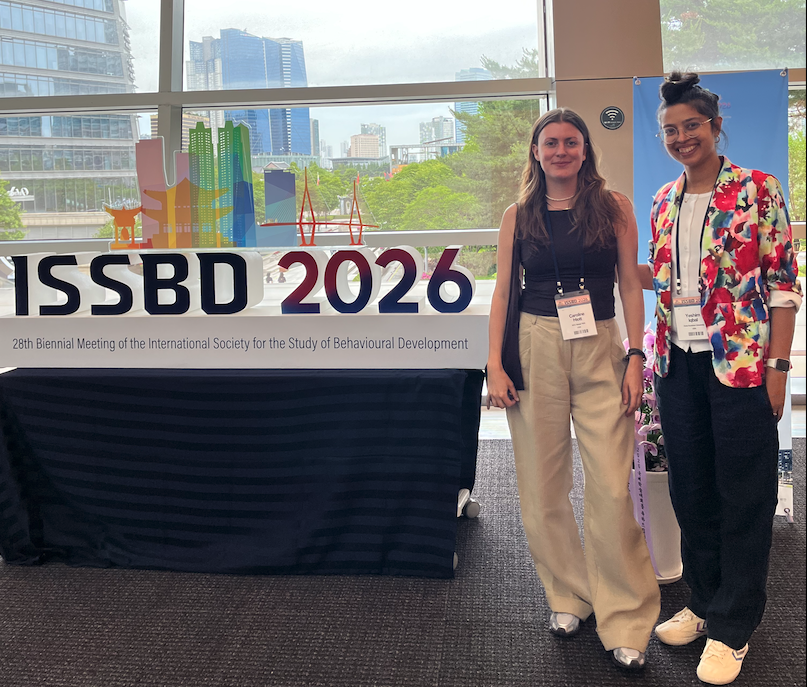
Caroline Hiott and Yeshim Iqbal at the ISSBD
The Lived Experiences of Early Motherhood
The panel opened with a qualitative study of 46 pregnant Rohingya women, presented by Yeshim Iqbal, exploring the lived experience of pregnancy in displacement.
The findings revealed a picture more layered than crisis narratives typically allow: extended kinship networks function as a genuine system of support; husbands play a significant role in emotional wellbeing during pregnancy; and women hold strong aspirations for their children grounded in faith and cultural identity. Even in a context of significant vulnerability, families arrive at the beginning of the developmental timeline with sources of strength that programming can build on.
Measuring Care When Language Is a Barrier
The panel's first study, presented by Qusai Khraisha, introduced BRIDGE (Behavioral Recognition in Displaced Group Exchanges), a new observational coding tool designed to assess caregiver-child relationship quality through paralinguistic cues — tone, gesture, physical proximity — rather than language comprehension.
Tested on more than 1,000 videos of Syrian refugee mothers and children in Jordan, BRIDGE demonstrated strong inter-rater reliability even when coders could not understand a word the dyads were speaking. For researchers working with displaced populations across dozens of languages, it represents a practical and principled solution to a persistent methodological problem.
Fathers Carrying High Burden — Still Showing Up
I had the opportunity to present data from the six-month wave of iRRRd on 642 Rohingya fathers and their infants. The mental health findings were stark:
With an average of more than 10 trauma events, exposure to trauma during conflict and displacement was taking a measurable psychological toll across the sample.
26% of fathers scored above clinical cutoffs for PTSD, 42% for anxiety, and 53% for depression.
To measure caregiving behaviors, we used the Rohingya Modot-goroya (caregiving) Measure (RMM), a culturally grounded caregiving measure co-developed by TIES and the Rohingya-led Humanitarian Assistance Program (HAP) through community consultation and structured ethnographic methods. The tool maps caregiving across three developmental stages rooted in Rohingya language and cultural practice — Ledara (newborn), Hambuijja (crawling), and Aadhullah (toddling) — rather than imposing Western developmental frameworks in contexts where they may not fit.
When we examined how these fathers were actually engaging in caregiving behaviors with their six-month-old infants, we found no association between fathers' trauma exposure, mental health burden, and their caregiving behaviors.
Fathers may simply not yet be engaging as much with their children when they are only 6 months old as they will when their children are older — but they are present, and trauma, through mental health, does not appear to be associated with suppressed caregiving in these early months.
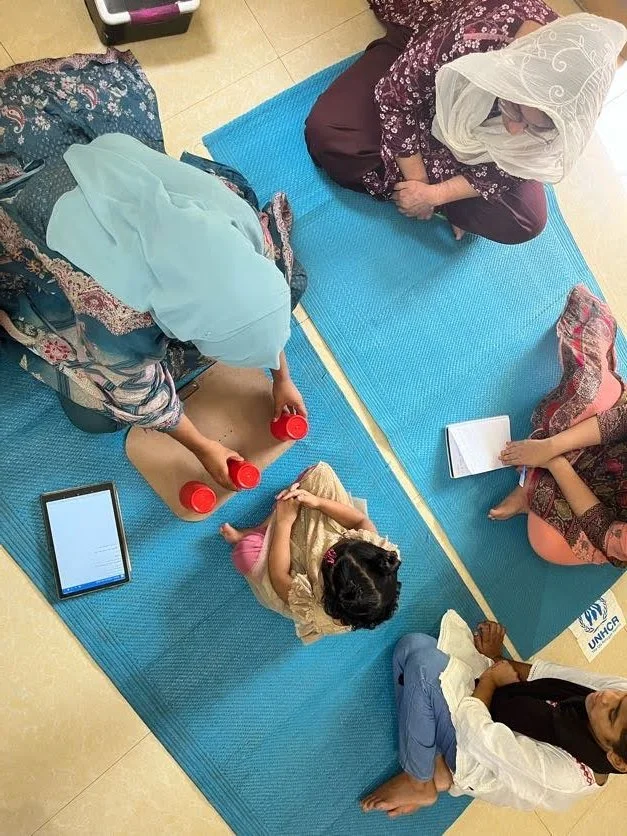
From the field
The iRRRd study is now tracking the cohort to 36 months to examine children's development and fathers' changing engagement.
Why This Research Matters
Taken together, the panel made a case for studying caregiving as it actually exists in protracted crisis, not as a scaled-down version of caregiving in stable contexts. Families displaced for years develop practices, relationships, and sources of meaning that standard tools may miss or misread.
The iRRRd study is now following its cohort toward the 36-month visit, when children's developmental trajectories and fathers' evolving engagement can be examined with greater precision.
This research not only advances measurement in challenging contexts but also informs the development of better programs to support families during prolonged crises. To learn more, visit globaltiesforchildren.nyu.edu/irrrd